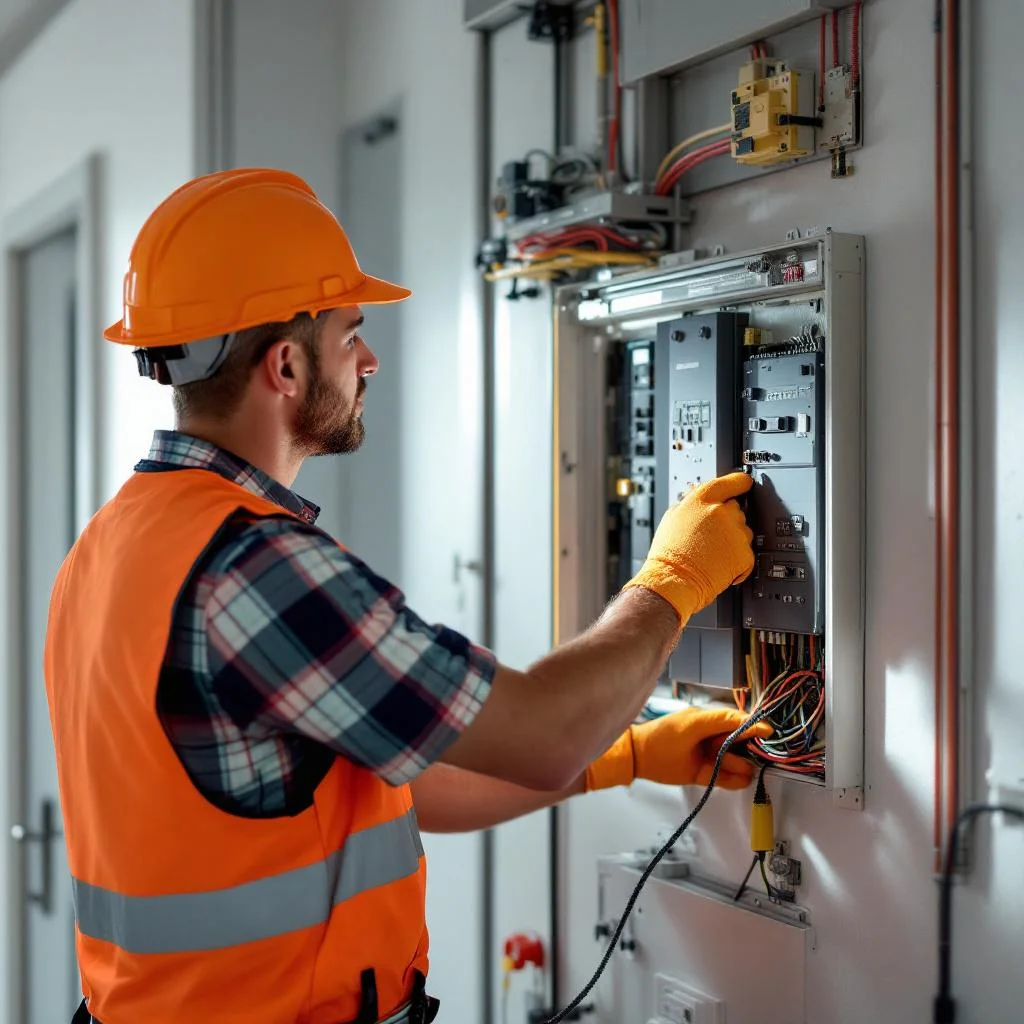
An alarm system brings together detectors, a control panel and alerting devices to signal an intrusion, a fire or an anomaly in a home or business premises. In Western Switzerland, these installations are fitted in houses, flats, shops and co-owned buildings. The choice of equipment depends less on fashion than on your building, your habits and what you wish to protect.
This page presents the trade, the situations in which you should call a professional, the differences from one canton to another and how to prepare your quote request.
What alarm installation covers in a home in Western Switzerland
The trade covers several families of devices, which are often combined in a single project:
- Intrusion alarms: opening contacts on doors and windows, motion detectors, glass-break detectors, indoor or outdoor siren.
- Fire and smoke detection: detectors linked to the control panel or standalone, audible warning devices.
- Technical detection: water leaks, gas, abnormal temperature changes in a cellar, a freezer or a utility room.
- Video surveillance: indoor or outdoor cameras, recorder, remote access from a phone.
- Access control: keypad, badge, fingerprint reader, intercom, sometimes linked to the locks.
- Alert transmission: local siren, smartphone notification, automatic call, link to a remote monitoring centre.
The most common jobs are a full installation in a house or flat, adding detectors to an existing system, replacing an outdated control panel, updating after a renovation and periodic maintenance, in particular changing batteries and checking that everything works.
When to call an alarm specialist
A battery-powered smoke detector can be fitted yourself. As soon as the system has to be connected to the mains, wired into the walls or linked to a monitoring service, it is better to entrust the work to a professional. A poorly set-up system triggers false alarms, leaves blind spots or is disabled at the first incident. Repeated false alarms tire those around you and may end up no longer being taken seriously.
A few typical situations in which professional advice is essential:
- a new build or major renovation, where the wiring is planned before the finishing work;
- a recent burglary or a neighbourhood that worries you;
- a second home or chalet that stands empty part of the year and that you want to monitor remotely;
- business premises containing equipment, stock or data;
- a co-owned building where common areas and access points are to be coordinated;
- extending an existing system whose installer can no longer be reached.
Work affecting the electrical installation cannot be improvised. Ask the professional who will actually carry out the connection what training they have had and whether they work alone or with a subcontractor. These are normal questions, and the answer should be able to appear in the quote or the contract.
Alarm systems and the Swiss framework: what changes from one job to another
In Switzerland, the electrical and security trades rely on recognised vocational training, whose titles vary by speciality. Rather than relying on a commercial label, ask what the company can do itself and what it entrusts to others. Installing an alarm in fact involves several skills: electrical work, low-voltage systems, IT networks, and sometimes carpentry or locksmithing.
The contractual framework matters as much as the technology. The relationship between you and the company is governed by the Code of Obligations. If the quote or contract refers to the SIA 118 standard (the general conditions of the Swiss Society of Engineers and Architects), its terms apply to construction work; check this before signing. As for the rest, privacy comes into play as soon as a camera films: point the lenses at your own property, not at the street or your neighbour’s garden, and inform the people concerned.
Requirements by canton: Geneva, Vaud, Valais, Fribourg, Neuchâtel, Jura and Bern
Most interior installations are carried out without authorisation. The rules change when the project alters a building or its appearance. Here are the useful reference points, to be confirmed with the municipality or the relevant cantonal department.
- Geneva: building permits are issued by the canton, through the Office des autorisations de construire. The old town and protected districts call for particular care with anything visible on the façade. Many rental buildings are managed by agencies, which are the required point of contact for a shared installation. On energy, the cantonal law (LEn) and the cantonal energy office (OCEN) oversee the subsidies of the Buildings Programme.
- Vaud: the building permit is issued by the municipality, with the file going through the cantonal authorisation centre (CAMAC) when cantonal departments need to give their opinion. The old towns and the Lavaux vineyards, a UNESCO World Heritage site, call for caution with exterior elements.
- Valais: authorisation is issued by the municipality within the building zone, and by a cantonal commission outside it. Chalets and second homes are numerous, with the federal law on second homes applying in the municipalities concerned; a remote alarm is often mentioned there to keep watch over an unoccupied property.
- Fribourg: permit applications go through the cantonal platform FRIAC; the permit is issued by the prefecture or the municipality depending on the type of work. The canton is bilingual and its old towns are protected.
- Neuchâtel: applications are submitted to the cantonal counter SATAC, with the decision taken by the municipality. The watchmaking heritage of La Chaux-de-Fonds and Le Locle, listed by UNESCO, is a reason to make enquiries before any visible installation.
- Jura: the permit is issued by the municipality or by the canton depending on the scale of the project. Delémont, Porrentruy and Saint-Ursanne have old towns to be respected.
- Bern (Biel/Bienne): the permit is issued by the municipality or the prefecture depending on the project. Biel/Bienne is officially bilingual, which may matter for the language of the contract and documentation.
On energy, each canton has its own department and subsidy programme. An alarm is not in itself an energy measure, but if it forms part of a wider renovation (home automation, heating control), ask the cantonal energy department what may be supported.
Preparing your quote request for an alarm
The more precise your description, the more comparable the offers. Before contacting professionals, gather the following:
- the type of property (house, flat, shop, chalet) and its approximate floor area;
- the number of floors, external doors and accessible windows;
- what you want to protect and against what: intrusion, fire, water leaks, visitor access;
- any system or cabling already in place;
- your status: owner, tenant (with the landlord’s consent), co-owner, business;
- your expectations for alerts: siren only, phone notification, remote monitoring;
- the presence of pets, which affects the choice of motion detectors;
- photos of the entry points and of the intended location for the control panel.
If possible, ask for a site visit. A quote drawn up without seeing the premises can only be approximate, and it is often during the visit that a blind spot or a hard-to-wire area is spotted.
What a reliable alarm quote should detail
A good quote first describes what you are buying. Check that the following points are present:
- the list of equipment, with make, reference and quantity;
- the plan or description of the areas covered;
- the type of system: wired, wireless or mixed;
- installation, cabling, commissioning and configuration;
- user training and the handover of codes;
- how alerts are transmitted and any subscriptions;
- the terms for maintenance and battery replacement;
- response times in the event of a fault, under the conditions set out in the contract;
- ancillary work (drilling, making good) and what remains at your expense;
- the planned schedule and the payment terms.
Be wary of offers that detail nothing or that push you to sign on the spot. Two quotes are comparable only if they cover the same scope.
What makes the cost of an alarm installation vary
The price of a system cannot be guessed from an average. It depends in particular on:
- the size of the property and the number of points to monitor;
- the choice between wired and wireless, the former requiring more installation work;
- the range of the equipment and its compatibility with other devices;
- the presence of cameras, access control or fire detection;
- the accessibility of the premises and the condition of walls and ceilings;
- a remote-monitoring subscription or online services;
- the maintenance planned over time;
- any connection to an electrical installation that needs to be brought back into working order.
A free, no-obligation quote lets you see what is included and what is not. Compare the total cost over time, subscriptions included, rather than the purchase price alone.
Legal warranties after an alarm is installed
The Code of Obligations provides warranties that apply even if the contract says nothing about them. For an immovable work, the warranty period is five years under Art. 371 CO; for a movable work, it is two years. Which of the two applies depends on the nature of the work and how it is integrated into the building: a system built in and wired into the walls is not always treated like a freestanding appliance. Have this classification set out in the contract.
On acceptance, check that everything works, test each detector and note any defects in writing. If a defect appears later, report it to the company in writing without delay. If the contract refers to the SIA 118 standard, it governs the terms of acceptance and notice of defects; in that case, read it carefully. Keep the invoice, the quote, the contract and the technical documents you were given.
Request an alarm quote near you
Describe your project in a few minutes: your request is passed to professionals in the region, who will contact you to prepare a free, no-obligation quote. You can go straight to request a quote for your installation.
To see the information specific to your region, open the page for your canton:
Updated 29 October 2026