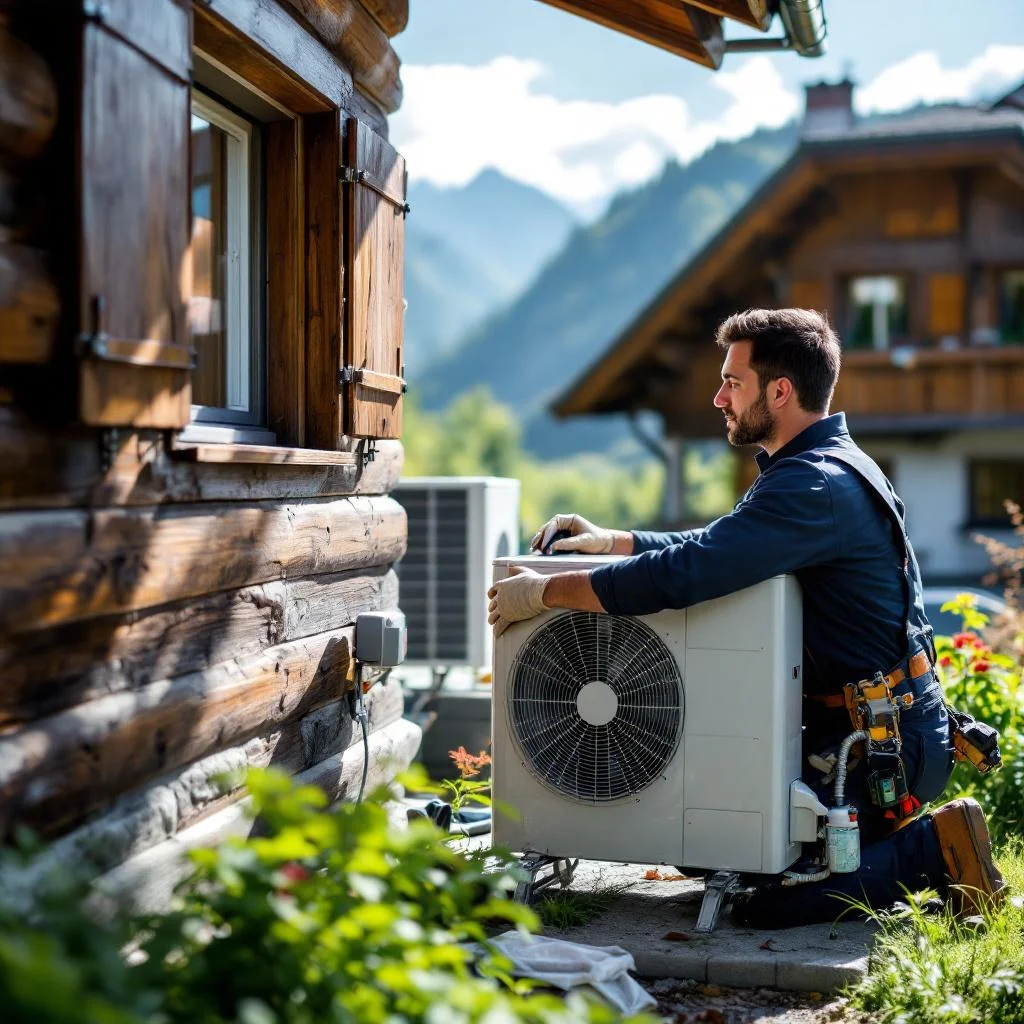
A heating engineer installs, services and replaces the systems that heat a home or a building: boiler, heat pump, wood heating, connection to a district heating network, radiators, underfloor heating and controls. In Western Switzerland, the choice of system depends as much on the building as on the cantonal energy rules.
On SOS Travaux, you describe your project online; the request is passed on to tradespeople and companies in your area, who contact you to prepare a free, no-obligation quote. This page presents the trade, what changes from one canton to another and how to prepare your request.
Heating engineer: installation, servicing and replacement
The trade covers several families of work, found just as much in a house as in a rental building or a co-owned property.
- Oil or gas heating: boiler servicing, repair, replacement of the burner or of the whole installation.
- Heat pump: study, installation of the unit (air-to-water, water-to-water or with geothermal probes), hydraulic and electrical connection, adjustment.
- Wood heating: stove, log, wood-chip or pellet boiler, with connection to the chimney.
- District heating: connecting the building to the network, installing the substation and adapting the internal distribution.
- Heat distribution and emission: replacing radiators, installing underfloor heating, hydraulic balancing of the circuits.
- Controls: sensors, thermostats, programming, adjusting the heating curve to avoid heating unnecessarily.
Many projects combine several of these elements. Replacing a boiler with a heat pump, for example, often means checking whether the existing radiators suit the new temperature regime.
When to call a heating engineer in Western Switzerland
Some situations cannot be handled yourself, and the winters in Romandy make breakdowns particularly unpleasant, especially at altitude or in the cold valleys of Valais, Jura and the Fribourg Prealps.
A professional is useful in the following cases:
- the boiler is old, noisy, often breaks down or visibly uses more energy than before;
- a radiator stays cold at the top or bottom, or the circuit makes noise: this is often air in the system or a hydraulic imbalance;
- you are buying a property and want to know the condition of the heating before committing to work;
- you are renovating the building envelope and the system needs to be resized;
- the periodic boiler inspection is approaching;
- you want to move away from fossil fuels.
For gas and oil, never tinker with the burner, the fuel supply or the flue gas outlet. If you smell gas, leave the premises and call the emergency services.
What is different in Switzerland: training, standards and the energy law
The trade is learned through an apprenticeship: in Switzerland, training as a heating installer leads to a federal certificate of capacity (CFC), followed by further training and professional diplomas. That said, SOS Travaux does not verify companies’ qualifications: ask at the quote stage and enquire about the training of the person who will carry out the work.
As for the rules, replacing a fossil-fuel heating system is governed by the cantonal energy law. Depending on the canton, this law may require a share of renewable energy when a system is replaced, or limit the installation of a new fossil-fuel boiler. The details differ from one canton to another and change over time: check with the cantonal energy department before ordering anything. Chimney sweeping and boiler inspections are also regulated by the canton, which is why deadlines and procedures are not the same everywhere.
Heating, permits and energy: canton by canton
Here are useful pointers for each canton of Western Switzerland, based on the generally known rules. For your specific case, the municipality or the relevant cantonal department remains the contact to consult.
- Geneva: building permits are issued by the canton (Office des autorisations de construire). Energy falls under the cantonal energy law (LEn) and the cantonal energy office (OCEN), on which the Buildings Programme subsidies depend. Many rental buildings are managed by property agents (régies), so a heating change has to go through them; the old town and protected neighbourhoods add constraints. See the canton of Geneva.
- Vaud: the building permit is issued by the municipality, with the file going through the cantonal permit centre (CAMAC) when cantonal departments need to give an opinion. Energy depends on the Vaud energy law and the cantonal energy directorate, with a cantonal subsidy programme. The old towns and the Lavaux vineyards, a World Heritage site, call for particular attention. See the canton of Vaud.
- Valais: the building permit is issued by the municipality inside the building zone and by a cantonal commission outside it. The cantonal energy and hydropower department runs a subsidy programme. Chalets and second homes are numerous, with the federal second-homes law applying in the municipalities concerned. See the canton of Valais.
- Fribourg: permit applications go through the cantonal FRIAC platform, and the permit is issued by the prefecture or the municipality depending on the type of work. The cantonal energy department runs a subsidy programme. A bilingual canton with protected old towns. See the canton of Fribourg.
- Neuchâtel: applications go through the cantonal SATAC desk, with the decision taken by the municipality. The cantonal energy and environment department runs the subsidy programme. The watchmaking heritage of La Chaux-de-Fonds and Le Locle, a UNESCO site, can affect some projects. See the canton of Neuchâtel.
- Jura: the permit is issued by the municipality or the canton depending on the scale of the project; the cantonal energy section runs a subsidy programme. The old towns of Delémont, Porrentruy and Saint-Ursanne deserve a prior check. See the canton of Jura.
- Biel/Bienne and the canton of Bern: the permit is issued by the municipality or the prefecture depending on the project; the cantonal office for the environment and energy runs the subsidy programme. Biel/Bienne is officially bilingual (French and German). See the canton of Bern.
Preparing your heating request
The more precise the request, the more comparable the quotes. Gather, if you have them:
- the type of building (house, apartment building, co-ownership, commercial premises), its approximate age and heated surface area;
- the current system: energy source, make, year of installation, problems noticed;
- the distribution: radiators, underfloor heating, or both;
- your project: servicing, repair, like-for-like replacement or a change of energy source;
- photos of the boiler room, the boiler, the rating plate and the chimney;
- the agreement of the landlord or the co-ownership if you are not the owner.
If you are unsure about the solution, say so: a professional can visit the site and explain what is realistic for your building. To start the process, you can request a quote.
Heating engineer’s quote: what it details and what makes the cost vary
A serious quote is not just a sum. It states the proposed system and its characteristics, the equipment, removal of the old installation, hydraulic and electrical connections, controls, commissioning, any rework of the chimney or the room, disposal of old equipment and what is not included. It also specifies the payment terms and the planned schedule.
The cost varies according to several factors, and no reliable figure can be given without a visit:
- the chosen energy source and the power required;
- the condition of the building and its insulation;
- access to the boiler room, the roof or the land;
- the need for probes, drilling, a tank to remove or a connection to the network;
- the condition of the existing distribution and radiators;
- administrative procedures and heritage constraints;
- any subsidies, whose conditions should be checked with the cantonal energy department.
Compare several quotes on the same scope, and ask for explanations of the differences rather than looking only at the total.
Legal warranties for your heating work
The Code of Obligations (CO) governs defects in construction work. For work on an immovable structure, which generally covers an installation integrated into the building, the warranty period for hidden defects is 5 years under art. 371 CO. For movable work, it is 2 years. If the contract refers to the SIA 118 standard, its provisions apply in addition; reread the contract to find out whether this is the case.
On handover of the work, inspect the installation, have visible defects noted in writing, and keep the invoice, the equipment documentation and the commissioning record. A defect you notice should be reported without delay, in writing.
Heating engineer near you: city pages
Find the trade in the main cities of Western Switzerland:
- heating engineer in Geneva, in Carouge, in Lancy and in Vernier
- heating engineer in Lausanne, in Nyon, in Vevey, in Montreux, in Yverdon-les-Bains and in Morges
- heating engineer in Sion, in Martigny, in Monthey and in Sierre
- heating engineer in Fribourg and in Bulle
- heating engineer in Neuchâtel and in La Chaux-de-Fonds
- heating engineer in Delémont and in Biel/Bienne
Your municipality is not listed? Simply describe your project in the quote request, stating where the work will take place.
Updated 29 October 2026