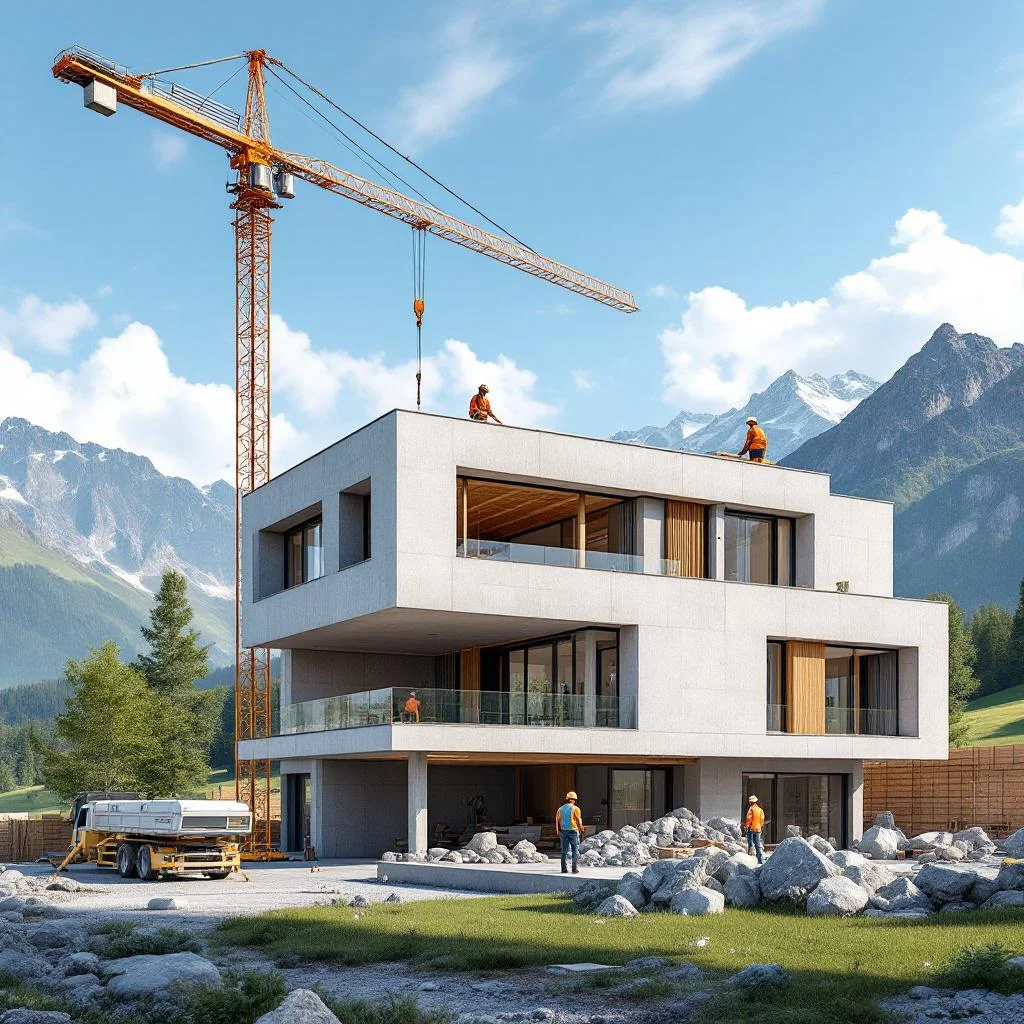
Building, extending, converting or renovating a building involves technical choices, administrative procedures and the coordination of many trades. The architect is the person who brings these elements together, from the first sketch to the handover of the finished work. On SOS Travaux, you describe your project online: your request is passed on to architects and firms in the region, who may contact you to prepare a free, no-obligation quote.
What the architect’s profession covers in Western Switzerland
An architect does more than draw plans. The work begins with listening: understanding how the space will be used, the constraints of the site or the existing building, the budget you wish to keep to and the regulatory requirements. The architect then turns this information into a project, first as sketches, then as increasingly precise plans.
Depending on what you entrust to them, their services may include:
- the feasibility study and first sketches;
- the detailed design and the permit application file;
- construction drawings, specifications and calls for tender to firms;
- the comparison of the offers received;
- site management and quality control on site;
- cost monitoring, acceptance of the work and the final statement of account.
You can entrust all of these phases or only some of them. An owner who only wants a permit application file does not have the same needs as one who wants full support through to moving in.
The most common architect projects in the region
The requests that come up most often cover projects of very different sizes:
- converting an apartment: opening up a partition, rearranging the rooms, a new open-plan kitchen;
- the complete renovation of an old house, including work on the building envelope and installations;
- raising or extending a villa;
- building an annexe, a conservatory or a garage;
- converting an attic, or turning a barn or farm building into a home;
- the energy renovation of a building, which requires coordinating insulation, heating and windows;
- projects for small businesses: fitting out premises, shops or workshops;
- work on a jointly owned building, for example a façade or roof renovation.
When to call in an architect
It is worth contacting an architect as soon as the project affects the structure, the façade, the use of the premises or several trades at once. The earlier you consult them, the easier it is to avoid costly mistakes: an idea the authority later judges unfeasible, a budget overrun for lack of coordination, plans that do not take the existing building into account.
An architect can also help you decide before you buy: examining a property, estimating its potential for conversion and spotting the delicate points. If you are a tenant, remember that any major change to the dwelling requires the written agreement of the landlord or the property management agency before you start a study.
For a small job with no effect on the structure or the exterior appearance, a single craftsperson is sometimes enough. If in doubt, an initial discussion with an architect lets you clarify your needs without committing you further.
Training and professional framework in Switzerland
In Switzerland, architects generally train at a university of applied sciences, a university or a polytechnic school, rather than through an apprenticeship. The CFC does exist, however, for the building draughtsperson, a neighbouring profession that often works alongside architects in their offices.
When you choose a professional, ask about their background, the projects comparable to yours that they have already carried out and how they organise site supervision. Also check that they have insurance cover suited to their activity: this is something to ask for in writing, and it is never a given.
Permits, energy and heritage by canton
French-speaking Switzerland does not have a single procedure. Permit rules and energy programmes differ from one canton to another, and the right approach is always to check with the municipality or the relevant cantonal department. Here are a few pointers.
Geneva
In Geneva, building permits are issued by the canton, through the Office des autorisations de construire (building permits office). On energy, the cantonal energy law (LEn) and the cantonal energy office (OCEN) oversee the subsidies of the Buildings Programme. Many rental buildings are managed by property agencies, which means their agreement is needed for a project in a rented property, and the old town as well as certain districts are protected.
Vaud
In the canton of Vaud, the building permit is issued by the municipality. Where cantonal departments must give an opinion, the file goes through the cantonal permits centre (CAMAC). Energy is governed by the Vaud energy law and the cantonal energy directorate, with a cantonal subsidy programme. Old towns and the Lavaux vineyards, a World Heritage site, call for particular attention.
Valais
In Valais, the building permit is issued by the municipality within the building zone, and by a cantonal commission outside it. The cantonal service for energy and hydropower manages the subsidy programme. For chalets and second homes, the federal law on second homes applies in the municipalities concerned: find out before considering an extension or a change of use.
Fribourg
Building permit applications are submitted on the cantonal platform FRIAC. The permit is issued by the prefecture or the municipality depending on the type of work. The cantonal energy service manages a subsidy programme, and the old towns are protected. As the canton is bilingual, some documents may be drafted in French or in German.
Neuchâtel
In Neuchâtel, applications go through the cantonal one-stop shop SATAC, with the decision taken by the municipality. The cantonal service for energy and the environment manages the subsidy programme. The watchmaking heritage of La Chaux-de-Fonds and Le Locle, listed by UNESCO, may influence projects located within those areas.
Jura
In the Jura, the building permit is issued by the municipality or by the canton depending on the scale of the project. The cantonal energy section manages a subsidy programme. The old towns of Delémont, Porrentruy and Saint-Ursanne call for particular attention when designing a project.
Bienne and the canton of Bern
Bienne belongs to the canton of Bern: the building permit is issued by the municipality or the prefecture depending on the project, and the cantonal office for the environment and energy manages the subsidy programme. The city is officially bilingual, French and German, which may be reflected in dealings with the administration.
The amounts and conditions of energy subsidies change: do not count on them until you have written confirmation from the department concerned, and ask your architect whether they know the scheme that applies in your municipality.
Preparing your architect request
The more precise your request, the more comparable the offers. Before describing your project, gather:
- the address and type of property (house, apartment, apartment building, business premises);
- your status: owner, co-owner, tenant with the landlord’s agreement, company;
- what you want to achieve and what is essential to you (number of rooms, accessibility, energy performance, style);
- existing documents: old plans, previous permits, co-ownership regulations;
- the phases you wish to entrust: design only, permit application file, site management;
- your preferred timetable, specifying what is flexible and what is not;
- known constraints: protected building, neighbours, difficult access.
You can then request a quote by describing your project with these details. A quote does not commit you, and you can compare several replies.
What a reliable architect’s quote spells out
A reliable quote is not just a lump sum. It specifies:
- the service phases included, and what each contains;
- what is not included, such as filing fees, surveys or specialist reports (engineer, surveyor, acoustician);
- how the fee is calculated: fixed fee, percentage of the cost of the work or hourly rate;
- the terms for changes if the project evolves along the way;
- the invoicing schedule;
- the reference contract, for example if the SIA 118 standard is mentioned.
If two quotes seem very far apart, first check that the services are the same before comparing the totals.
What makes the cost of an architect’s project vary
No figure means anything without knowing the project. The factors that matter most are:
- the size and complexity of the work;
- whether the building is new or existing: a conversion often requires more investigation than a new build;
- heritage protection or zoning constraints;
- the number of phases entrusted to the architect;
- the level of detail expected for the plans and specifications;
- the need for associated specialists;
- the quality of the information you provide from the outset.
Only a quote based on your situation allows the whole to be costed.
Statutory warranties once the work is finished
The Code of Obligations governs liability for defects in a work. Under Article 371, the warranty period is five years for a building work and two years for a movable work. If the contract refers to the SIA 118 standard, it applies in addition to what the contract provides.
In practice, keep the contract, the plans, the acceptance report and the correspondence. Report any defect in writing as soon as you notice it. In the event of a dispute, legal advice remains the best way to find out your rights.
Find an architect near you
No city page is available yet for this trade. Choose your canton to see local information:
- canton of Geneva
- canton of Vaud
- canton of Valais
- canton of Fribourg
- canton of Neuchâtel
- canton of Jura
- canton of Bern
To send your project directly, go to the request a quote page.
Updated 29 October 2026