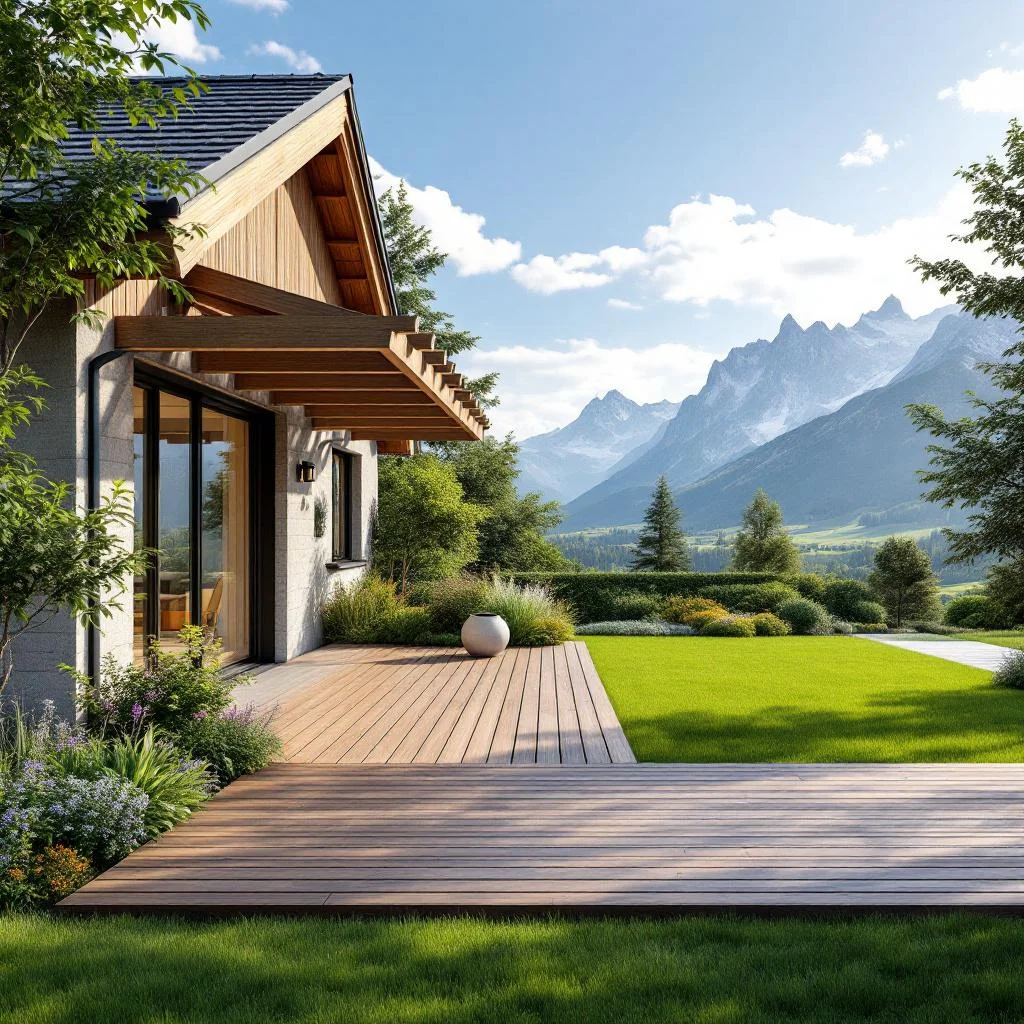
A conservatory extends the home towards the garden or the patio by creating a bright space enclosed by large glazed surfaces. It is a project that combines construction, joinery, glazing and sometimes heating, and it almost always requires a permit. This page explains what the trade covers, what you need to know in Western Switzerland and how to prepare a quote request.
What a conservatory involves and the most common projects
The term describes a glazed structure attached to an existing building. Its frame can be aluminium, timber, PVC or steel, with single, double or insulating glazing depending on the intended use. The professional often works on several fronts at once: foundations or slab, frame, roof, glazing, connections to the façade, waterproofing and, if the project includes them, electrics, heating or ventilation.
The most frequent requests are the following:
- enclosing an existing patio or balcony;
- extending a kitchen or living room outwards;
- the winter garden, used as a passage room or a space for plants;
- the open conservatory or one with sliding walls, usable for much of the year;
- replacing an old conservatory whose structure or glazing has aged.
The key distinction is between the unheated space, a simple sheltered extension, and the habitable room connected to the home’s heating. It changes the requirements for insulation and glazing and, often, the permit procedure.
When to call a professional for your conservatory
A conservatory cannot be improvised. It is fixed to the building, bears the weight of the glazing and the snow load, and must remain watertight where it meets the façade. An installation error often costs you later, through leaks, condensation or deformation of the structure.
It is wise to contact a company as soon as you have a clear idea of the intended use, even before submitting a permit application: the professional can help you define the dimensions, assess what the existing building allows and prepare the plans that will accompany the file. If you are a tenant, the written consent of the landlord or property agency comes first; in co-ownership, a decision of the owners’ meeting is also needed.
Training and professional framework in Switzerland
There is no single CFC (federal certificate of capacity, the Swiss vocational qualification) for a “conservatory builder”. The work draws on several trades that come together on site: joiners and metalworkers for the structure, masons for the foundations and connections, installers for heating or electrics. Many specialist companies coordinate these trades or include them.
When comparing offers, ask who actually carries out each part of the work and who remains your contact in case of a problem. A company that takes charge of coordination from start to finish simplifies follow-up, but the offer must state clearly what is included.
Permits and energy: what changes by canton
In every case, the basic rule is the same: check with the municipality or the competent cantonal department before starting. Procedures differ from one canton to another.
- Geneva: building permits are issued by the canton, through the Office des autorisations de construire. On energy, the cantonal energy law (LEn) and the cantonal energy office (OCEN) frame projects; the Programme Bâtiments subsidies in Geneva depend on them. As many rental buildings are managed by property agencies, their consent is an unavoidable step. The old town and protected districts impose particular requirements.
- Vaud: the permit is issued by the municipal authority of the commune, with the file going through the cantonal permit centre (CAMAC) when cantonal departments must give an opinion. The Vaud energy law and the cantonal energy directorate apply, with a cantonal subsidy programme. Old towns and the Lavaux vineyards, a World Heritage site, call for particular attention.
- Valais: the building permit is issued by the commune within the building zone, and by a cantonal commission outside it. The cantonal service for energy and hydropower manages the subsidy programme. For chalets and second homes, the federal law on second homes may apply in the communes concerned.
- Fribourg: applications are submitted through the cantonal FRIAC platform, and the permit is issued by the prefecture or the commune depending on the type of work. The cantonal energy service manages a subsidy programme. As the canton is bilingual and its old towns are protected, façade constraints should be checked early.
- Neuchâtel: applications go through the cantonal SATAC counter, with the decision taken by the commune. The energy and environment service offers a subsidy programme. In La Chaux-de-Fonds and Le Locle, the UNESCO-listed watchmaking heritage may weigh on projects visible from the street.
- Jura: the permit is issued by the commune or the canton depending on the scale of the project. The cantonal energy section manages a subsidy programme. Delémont, Porrentruy and Saint-Ursanne have old towns to preserve.
- Biel/Bienne and the canton of Bern: the permit is issued by the commune or the prefecture depending on the project, and the cantonal office for the environment and energy manages a subsidy programme. Biel/Bienne is officially bilingual, French and German.
Subsidy programmes concern mainly the thermal envelope and energy installations: their conditions change and must be checked with the cantonal service before the work starts, not after.
Preparing your quote request
The more precise your description, the more comparable the quotes will be. Gather the following before filling in the form:
- the intended location (patio, façade, garden) and approximate dimensions;
- the intended use: passage space, year-round living room, winter garden;
- the preferred structural material, or failing that your priorities (maintenance, appearance, insulation);
- your status: owner, tenant with the landlord’s consent, co-owner;
- the building’s context: protected area, building managed by a property agency, second home;
- photos of the existing structure, useful for assessing the connections to the façade.
To describe your work, use the form to request a quote. Your request is sent to craftspeople and companies in the region, who contact you to prepare a free, no-obligation quote.
What a reliable conservatory quote should detail
A useful quote is not limited to a single global line. It describes, item by item:
- the structure and its materials, as well as the type of glazing and roofing;
- the foundations or slab, and the work to connect to the existing façade;
- insulation, ventilation and, where applicable, heating or air conditioning;
- the planned electrical installations;
- what is included or not: plans, permit procedures, removal of rubble, interior finishes;
- the payment terms, the stages of the work and the agreed schedule;
- a reference to the warranties and the contractual framework applied.
If a service is not mentioned, request it in writing: a forgotten item quickly becomes an extra charge.
What makes the cost of a conservatory vary
The amount depends on several factors that add up: the dimensions, the shape of the roof, the quality of the structure and glazing, the level of insulation, the presence of heating, the nature of the floor or slab, site accessibility and the complexity of the connection to the building. The requirements of a protected area or of a particular façade may also impose more expensive choices of materials. No serious figure can be given without knowing your situation: that is the role of the quote, and it is better to compare several.
Legal warranties after handover
The Code of Obligations protects the client. For a building work, the warranty period for hidden defects is five years (art. 371 CO); for a movable work, it is two years. A conservatory fixed to the building generally falls into the first category, but the classification depends on the construction. If the contract refers to the SIA 118 standard, it applies: read the contract and make sure you know which regime yours falls under. A defect must be reported to the company as soon as it is noticed, preferably in writing.
Conservatory near you
No dedicated local page for this trade is available at the moment. See the canton pages for information specific to your region:
- canton of Geneva
- canton of Vaud
- canton of Valais
- canton of Fribourg
- canton of Neuchâtel
- canton of Jura
- canton of Bern
Whatever your commune, the simplest way is to describe your project through the form to request a quote.
Updated 29 October 2026