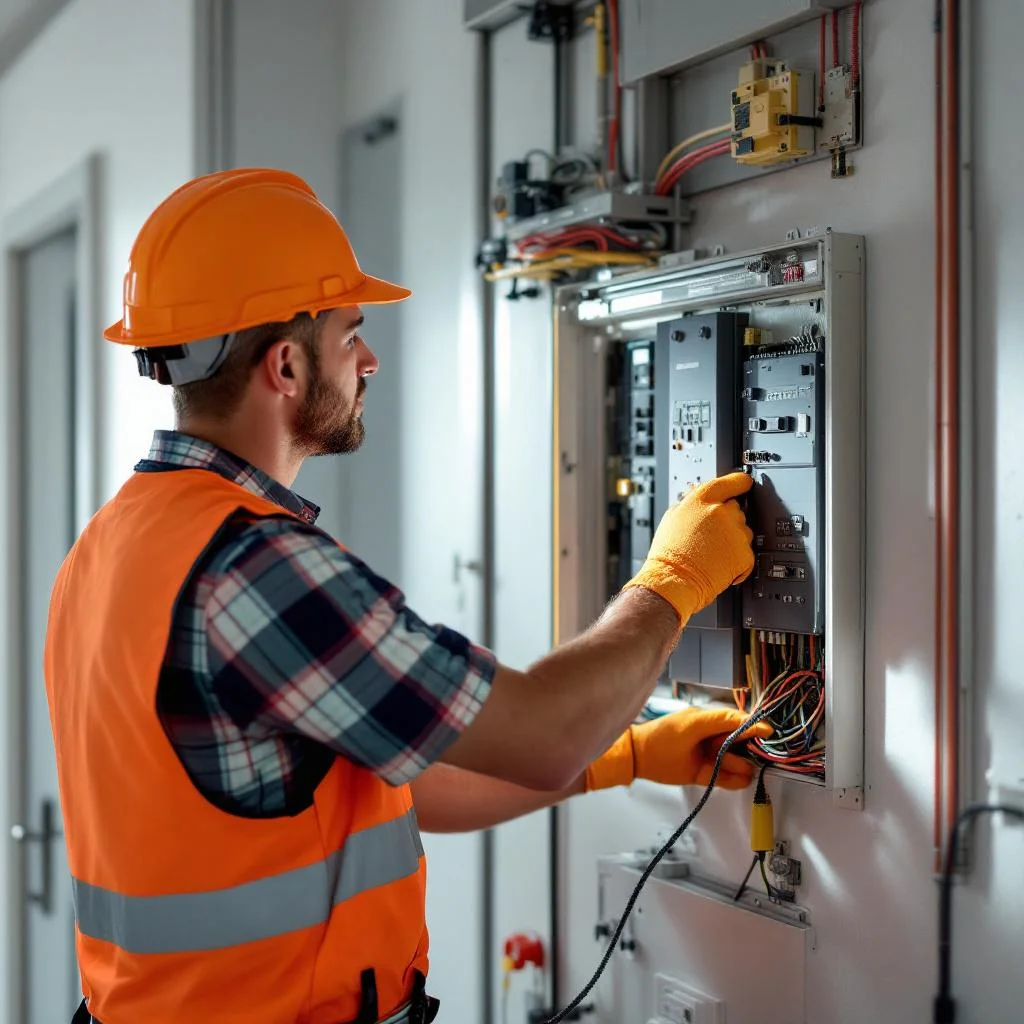
The electrical panel distributes the power coming into the building to the various circuits: sockets, lighting, kitchen, heating, machines. It also houses the protective devices that cut the power in the event of an overload or a fault. When it ages, runs out of space or your needs change, replacing or upgrading it becomes a matter to discuss with a professional.
On sos-travaux.ch, you describe your project online; the request is passed on to craftspeople and companies in the region, who contact you to prepare a free, no-obligation quote.
What an electrical panel job covers
The term covers several types of work, from adding a single component to replacing the whole cabinet. The most common situations are the following:
- replacing an old panel with a new one, with the circuit outlets reconnected;
- adding extra protection, for example for a new kitchen, laundry room or heat pump circuit;
- extending a panel that is full, or creating a secondary panel in an annexe, a garage or an attic;
- identifying and labelling the circuits, often missing or wrong in older installations;
- preparing the connection of recent equipment: EV charging station, solar installation, battery, electric heating appliances;
- putting things back in order after damage, a power surge or a recurring fault.
A job can be limited to half a day’s work in a flat, or affect a whole building when the riser and several floor panels are involved. That is why an electrician’s first reflex is to come and see the installation before pricing it.
When to call an electrician for your panel
Some situations justify not waiting:
- circuit breakers or fuses that trip repeatedly;
- a smell of burning, overheating or traces of blackening around the panel;
- screw-in fuses, or a panel whose components are no longer easy to find;
- a panel with no free space, when you want to add a circuit;
- a kitchen, bathroom or attic renovation project that changes your electricity needs;
- buying an older home, before undertaking other work.
In cases of overheating or an unusual smell, switch off what you safely can and call a professional without delay. Do not try to open or tinker with a live panel: the risk falls first on your own safety.
The electrician’s trade in Switzerland
In Switzerland, the trade is learned through vocational training leading to a federal certificate of proficiency (CFC) as an installation electrician or a related speciality. This dual training alternates practice in a company with classes at a vocational school. Work on electrical installations is governed by federal regulations, which the electrician applies and whose practical consequences for your building they will explain to you.
That does not mean you should not ask questions. Ask the company how it works, what will be replaced and what will be kept, and which documents it will hand over at the end of the work. A serious professional answers these questions simply.
Electrical panel in Geneva, Vaud, Valais and elsewhere: what varies
The trade is the same from one canton to another, but the administrative and energy framework differs. Always check with your municipality or the competent cantonal office before starting a project that goes beyond a simple replacement.
- Geneva: building permits are issued by the canton, through the Office des autorisations de construire (building permits office). On energy, the cantonal energy law (LEn) and the Office cantonal de l’énergie (OCEN, cantonal energy office) matter, because the subsidies of the Buildings Programme in Geneva depend on them. Many rental buildings are managed by property managers, the first contact if you are a tenant. The old town and protected districts may require additional precautions.
- Vaud: the building permit is issued by the municipality, with the file going through the cantonal permit centre (CAMAC) when cantonal services have to give an opinion. The Vaud energy law and the cantonal energy directorate govern the energy side, with a cantonal subsidy programme. The old towns and the Lavaux vineyards, a World Heritage site, call for particular attention.
- Valais: the building permit is issued by the municipality in the building zone, and by a cantonal commission outside the building zone. The cantonal energy and hydropower service manages the subsidy programme. For chalets and second homes, the federal law on second homes applies in the municipalities concerned.
- Fribourg: building permit applications go through the cantonal platform FRIAC, with the permit issued by the prefecture or the municipality depending on the type of work. The cantonal energy service manages a subsidy programme. The canton is bilingual, and the old towns are protected.
- Neuchâtel: applications go through the cantonal one-stop shop SATAC, with the decision taken by the municipality. The cantonal energy and environment service offers a subsidy programme. The watchmaking heritage of La Chaux-de-Fonds and Le Locle, a UNESCO site, should be kept in mind for the buildings concerned.
- Jura: the permit is issued by the municipality or by the canton depending on the scale of the project. The cantonal energy section manages a subsidy programme. The old towns of Delémont, Porrentruy and Saint-Ursanne may justify extra checks.
- Bern (Biel/Bienne): the permit is issued by the municipality or the prefecture depending on the project. The cantonal office for the environment and energy manages the subsidy programme. Biel/Bienne is officially bilingual, French and German, so documents and contacts may be too.
A simple panel replacement does not always trigger a procedure. However, as soon as the project includes energy production, a charging station or a wider transformation of the building, a prior check avoids unpleasant surprises. If you are aiming for a subsidy, find out before ordering: the conditions of each cantonal programme are read from the service concerned, and they rarely apply to work already carried out.
Preparing your quote request for an electrical panel
The more precise your description, the better the electrician can frame the offer. If possible, gather:
- the type of property (house, flat, business premises) and its approximate age;
- a photo of the current panel, door open, and of the meter;
- the list of what you plan to add: new kitchen, charging station, heat pump, solar;
- the problems noticed: tripping, overheating, lack of space;
- your status: owner, tenant (with the landlord’s agreement), co-owner or company;
- access to the technical room and the constraints on cutting the power, especially in a building with several occupants.
For a co-ownership, the common panel and the private panels are not subject to the same decisions: say so in the request and state who can approve the work.
What a serious quote details and what makes the cost vary
A good quote is easy to read and clearly separates its items. It generally specifies:
- the exact scope: what is replaced, what is kept, what is excluded;
- the planned equipment, with its characteristics, and not just a mention of “new panel”;
- the labour time and any power cuts to expect;
- ancillary work: drilling, making good the finishes, removal of the old equipment;
- the documents handed over at the end: diagrams, circuit labelling, useful certificates;
- the payment terms and the validity period of the offer.
The cost depends above all on the condition of the existing installation, the number of circuits to be reconnected and the size of the panel. Also involved are access to the room, the need to redo supply lines, the addition of recent equipment and bringing an older installation up to the applicable provisions. Two quotes are comparable only if their scope is the same: a lower amount may simply mean that an item has been left out. Ask in writing what is included before comparing.
Legal warranties after work on the panel
The Code of Obligations (CO) governs the warranty in the event of a defect in a work. For a building work, the limitation period for the rights of the buyer or the client is 5 years under art. 371 CO. For a movable work, it is 2 years. A panel built into a building falls in principle into the first category, but the classification depends on the case: if in doubt, seek advice.
If the contract refers to the SIA 118 standard (the Swiss Society of Engineers and Architects’ general conditions for construction work), its provisions apply in addition to the Code of Obligations. So check what your contract says before signing. Keep the accepted quote, the invoice, the documents handed over by the electrician and the photos of the site. In the event of a defect, report it in writing and without delay.
Electrical panel near you
City pages are not yet available for this trade. Choose your canton to see regional information:
- canton of Geneva
- canton of Vaud
- canton of Valais
- canton of Fribourg
- canton of Neuchâtel
- canton of Jura
- canton of Bern
Ready to describe your project? You can request a quote: free, no obligation, and passed on to craftspeople and companies in your region.
Updated 29 October 2026