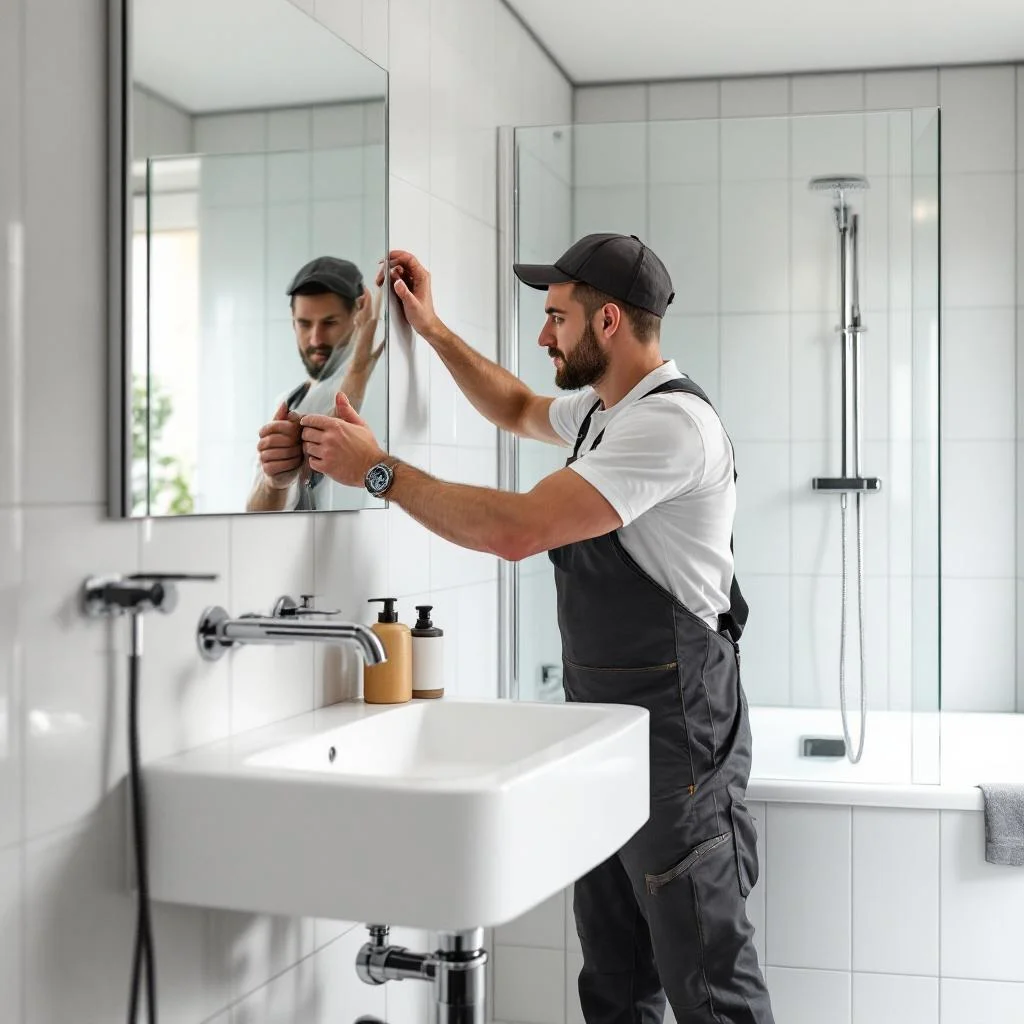
A leak under the sink, a drain that no longer clears, a water heater that has stopped heating: plumbing makes itself known when it fails. This page explains what emergency plumbing covers in French-speaking Switzerland, how to prepare your request and what to look out for in a quote.
The sos-travaux.ch site has no team or tradespeople of its own. You describe your problem online, your request is passed on to tradespeople and companies in the region, and they are the ones who contact you to prepare a free, no-obligation quote.
What emergency plumbing covers
The plumber’s trade, or sanitary installer, covers cold water, hot water, drainage and the appliances connected to them. Emergency plumbing means work on a fault that appears in an existing installation, as opposed to the complete renovation of a bathroom or a new build.
The most common situations:
- a leak on a tap, a hose, a fitting or a visible pipe;
- a blocked washbasin, shower, bath or drain;
- a toilet cistern that runs continuously or no longer fills;
- a water heater or boiler that no longer produces hot water, or that drips;
- a drop in pressure or water coming out in spurts;
- noises in the pipes, damp marks on a wall or ceiling.
Some of these faults are simple to fix, while others are only the symptom of a wider problem, for example an old pipe wearing out in several places. A good tradesperson tells you this after looking at the installation, not before.
When to call a plumber rather than wait
You can change a tap washer yourself or clear a trap with a plunger. As soon as the problem involves a concealed pipe, a riser shared by several flats, a water heater or a pressurised fitting, it is better to call a professional: a clumsy move can make the leak worse and multiply the damage.
Calling a tradesperson is justified in these cases in particular:
- water is flowing and you cannot find where it comes from;
- a damp patch is spreading or comes back after drying;
- the same blockage returns despite several attempts;
- the appliance concerned is connected to electricity or gas;
- the installation is old and you do not know what material the pipes are made of.
In the event of flooding or immediate danger to people, shut off the water supply, switch off the electricity if necessary and alert the emergency services. The form on this site is a quote request, not an emergency line: it does not replace these steps.
The sanitary installer’s trade in Switzerland
In Switzerland, basic training for this trade is through an apprenticeship leading to a federal vocational certificate (CFC) as a sanitary installer. This pathway exists throughout French-speaking Switzerland. On its own it says nothing about the quality of a specific piece of work, but it gives a pointer to the background of the person doing the job: you can ask the company that will carry out the work who will be on site and what their training is.
The relationship between you and the tradesperson falls under the contract for work and services in the Code of Obligations (CO). You can agree that the SIA 118 standard applies; if the quote or contract refers to it, it then supplements the legal rules. Read what you sign and have anything unclear explained.
Plumbing work by canton
Simple emergency repairs do not in principle require any permit. The rules change as soon as the work affects the structure, the use of the building or its energy performance. In every case, check with your municipality or the relevant cantonal department.
- Geneva: building permits are issued by the canton, through the Office des autorisations de construire. On energy, the cantonal energy law (LEn) and the cantonal energy office (OCEN) govern, among other things, the Buildings Programme subsidies. Many rental buildings are run by property managers, who must be told before you act. The old town and protected districts may impose constraints.
- Vaud: the building permit is issued by the municipality, with the file going through the cantonal permits centre (CAMAC) when cantonal departments need to give an opinion. The Vaud energy law and the cantonal energy directorate set the framework for subsidies. Old towns and the Lavaux vineyards, a World Heritage site, call for caution.
- Valais: the building permit is issued by the municipality inside the building zone, and by a cantonal commission outside it. The cantonal energy and hydropower department manages the subsidy programme. Chalets and second homes, subject in the municipalities concerned to the federal law on second homes, have their own particularities.
- Fribourg: permit applications go through the cantonal FRIAC platform, and the permit is issued by the prefecture or the municipality depending on the work. The cantonal energy department manages the subsidies. The canton is bilingual and its old towns are protected.
- Neuchâtel: applications go through the cantonal SATAC counter, with the decision taken by the municipality. The cantonal energy and environment department runs the subsidy programme. The watchmaking heritage of La Chaux-de-Fonds and Le Locle, listed by UNESCO, deserves attention.
- Jura: the permit is issued by the municipality or by the canton depending on the scale of the project. The cantonal energy section manages the subsidy programme. Delémont, Porrentruy and Saint-Ursanne have old towns that need to be treated with care.
- Biel/Bienne and the canton of Bern: the permit is issued by the municipality or the prefecture depending on the project, and the cantonal office for the environment and energy handles subsidies. Biel/Bienne is officially bilingual, French and German: a quote may reach you in either language.
Emergency work sometimes becomes a renovation: if the tradesperson finds that the hot water production must be replaced, the question of energy and possible subsidies may arise. Ask the cantonal energy department before ordering, because assistance is generally not retroactive.
Preparing your emergency plumbing request
The more precise your description, the closer the resulting quote will be to reality. Gather the following before writing:
- the exact location of the fault: kitchen, bathroom, cellar, laundry room, outdoors;
- what you observe: dripping, a jet, a smell, a noise, no hot water;
- since when, and whether the problem is constant or intermittent;
- what you have already tried, and whether you have turned off the water;
- the type of home, and the approximate age of the installation if you know it;
- your status: owner, tenant, co-owner, company;
- one or two photos, in particular of the appliance and its rating plate.
If you are a tenant, say that you have the landlord’s or property manager’s agreement, or that you are requesting it. In a co-ownership, specify whether the fault is in a private or a common part: the sharing of costs is not the same.
What a reliable quote details
Compare several quotes on their content, not just the total. A useful document mentions:
- the company’s identity and full contact details;
- the fault found and the planned work, described in plain terms;
- the materials and parts, with their type;
- the labour and call-out charges;
- what is excluded, for example opening up and making good walls or tiling;
- whether the price is fixed or estimated, and how long the offer is valid.
A vague line such as “sundries” or a job described in a single word should prompt you to ask for details.
What makes the cost of emergency plumbing vary
No amount is given here: it depends on too many parameters to be stated without seeing the installation. These are the factors that weigh most:
- the nature of the fault and how hard it is to reach the pipe or appliance;
- the time spent searching, especially for a leak whose origin is hidden;
- the price of parts and equipment, which varies with the brand and availability;
- the condition of the existing installation and its age;
- the need to open up a wall, a floor or a suspended ceiling, then make good;
- the timing of the call-out and the distance to travel;
- coordination with other trades, for example a tiler or an electrician.
The free quote is the tool that turns these parameters into a priced proposal suited to your situation.
Legal warranties after emergency plumbing
The Code of Obligations protects the client who finds a defect. The warranty runs for 5 years for work on immovable property (art. 371 CO), meaning work permanently incorporated into the building, such as a concealed pipe. It is 2 years for work on movable property, for example an appliance fitted without being integrated into the structure.
A few simple habits: keep the quote, the invoice and written exchanges; check the installation at the end of the job; report in writing, without delay, any defect that appears afterwards. If the contract refers to the SIA 118 standard, stick to what it provides.
Getting your emergency plumbing estimated
Once your description is ready, you can request a quote. Your request is passed on to tradespeople and companies in the region, who contact you for a free, no-obligation quote. You remain free to compare, to ask questions and to decline.
Emergency plumbing near you
Local rules, building types and heritage constraints differ from one canton to another. To find the details for your region, see the page for your canton:
Updated 29 October 2026