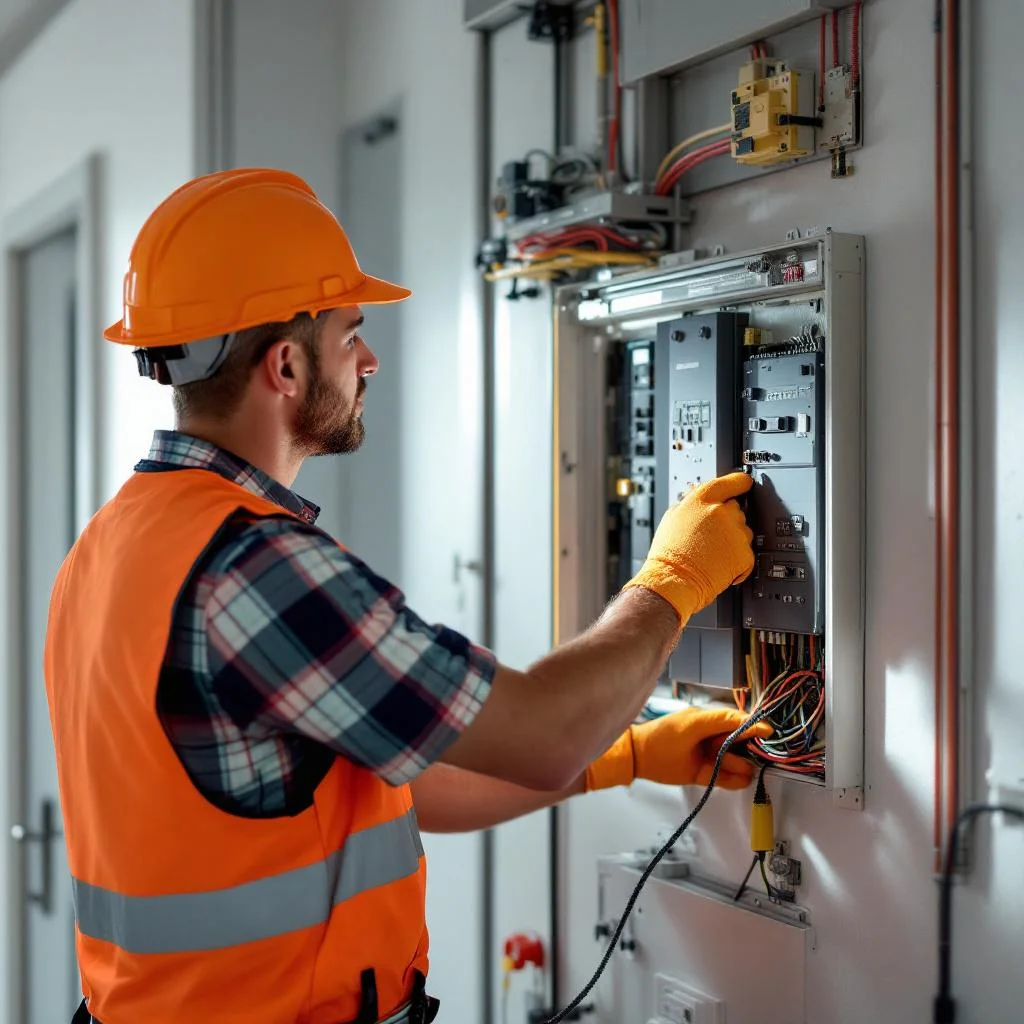
Installing a charging station means creating, at home or in a building, a dedicated electrical supply point for a vehicle. It is more than a simple connection: it needs a suitable line, proper protection and an accessible location. In western Switzerland, situations vary widely between a house, a shared garage and a company car park.
This page explains what the work involves, when to call a professional, how to prepare your request and what the legal warranties are for. The precise rules depend on your municipality and canton.
What installing a charging station in western Switzerland involves
The work falls under electrical installation. It generally includes assessing the existing setup, running a line from the electrical panel, fitting suitable protection, mounting the station, connecting it, and carrying out checks before commissioning.
The most common cases:
- a wall-mounted station in the garage of a detached house;
- an outdoor station, fixed to a facade or on a stand, in front of a carport or parking space;
- one or more stations in the underground car park of a rental building or a condominium building;
- stations for the spaces of a small business, intended for company vehicles or employees;
- adding a station to an existing installation, with or without solar panels on the roof.
Depending on the project, the professional may also work on the electrical panel, create chases or cable routes, fit a load management system or provide separate metering of consumption.
When to call a professional
A charging station connects to the building’s electrical installation. This work cannot be improvised: a poorly sized line or missing protection can cause overheating, an insulation fault or repeated tripping. The installation should therefore be entrusted to an electrical contractor.
Call a professional as soon as:
- you are considering buying an electric or plug-in hybrid vehicle and want to charge at home;
- your electrical panel is old, already heavily loaded or hard to access;
- the planned location of the station is far from the panel;
- several users have to share the installation, as in an apartment building;
- you want to link charging to solar production or to consumption management.
An initial discussion often shows whether the existing installation is sufficient or needs adapting. This visit takes place on site, because the distance, the cable route and the condition of the panel cannot be judged remotely.
Training, standards and rules: what is different in Switzerland
In Switzerland, the electrician’s trade is learned through vocational training, leading to a federal certificate of competence (CFC) in the electrical field. Electrical installations are subject to safety rules and to checks before and after commissioning. Do not settle for a verbal promise: ask the company how it documents and checks its installation.
If you own a house, you decide in principle on your own, subject to municipal and cantonal rules. If you are a tenant, the landlord’s consent is essential. In co-ownership, the decision is often taken at a meeting, because the station affects shared areas.
Permits, energy and heritage by canton
Rules differ from one canton to another. Here are the useful reference points, to be confirmed with your municipality or the relevant cantonal department.
Geneva. Building permits are issued by the canton, through the Office of Building Permits. On the energy side, the cantonal energy law (LEn) and the cantonal energy office (OCEN) frame the subject, and the Buildings Programme subsidies depend on them. As many rental buildings are managed by property agents, a tenant’s first contact is often the agent. The old town and protected districts may impose constraints for a station visible from public space.
Vaud. The building permit is issued by the municipality. The file goes through the cantonal permits centre (CAMAC) when cantonal departments need to give an opinion. The Vaud energy law and the cantonal energy directorate set the framework, with a cantonal subsidy programme. In old towns and in the Lavaux vineyards, a UNESCO World Heritage site, an outdoor installation deserves a prior check.
Valais. The building permit is issued by the municipality in the building zone, and by a cantonal commission outside it. The cantonal energy and hydropower service runs a subsidy programme. For a chalet or a second home, the federal law on second homes applies in the municipalities concerned: ask the municipality whether it affects your project.
Fribourg. Building permit applications go through the cantonal FRIAC platform, and the permit is issued by the prefecture or the municipality depending on the type of work. The cantonal energy service runs a subsidy programme. The canton is bilingual and its old towns are protected.
Neuchâtel. Applications go through the cantonal SATAC counter, with the decision made by the municipality. The cantonal energy and environment service handles the subsidy programme. In La Chaux-de-Fonds and Le Locle, the watchmaking heritage listed by UNESCO calls for caution with any visible change to a facade.
Jura. The building permit is issued by the municipality or by the canton depending on the scale of the project. The cantonal energy section runs a subsidy programme. In Delémont, Porrentruy and Saint-Ursanne, the old towns make it worth checking before installing anything outdoors.
Bern (Biel/Bienne). The permit is issued by the municipality or the prefecture depending on the project. The cantonal office for the environment and energy runs a subsidy programme. Biel/Bienne is officially bilingual: forms and correspondence can be in French or German.
In every case, do not assume a subsidy exists for charging stations: check the programme’s conditions before signing the quote.
Preparing your quote request for a charging station
The more precise your description, the more comparable the quotes will be. Gather the following:
- the type of home (house, flat, apartment building) and your status: owner, tenant, co-owner;
- the preferred location: garage, outdoor space, underground car park;
- the approximate distance to the electrical panel, and whether the cable route is easy;
- the vehicle concerned and the intended use (overnight charging, charging shared between several vehicles);
- any solar panels already present, or a plan to install some;
- photos of the electrical panel and of the location;
- the consent of the landlord or the community, if needed.
You can request a quote by describing your project: the request is passed on to tradespeople and companies in the region, who will contact you to prepare a free, no-obligation quote.
What a reliable quote details, and what makes the cost vary
A clear quote describes the scope of the work rather than a lump-sum total. Check that it mentions:
- the chosen station, with its brand, model and functions;
- the supply line: route, type of cable, protection;
- any work on the electrical panel;
- drilling, chases, fixings and making good;
- the checks and commissioning;
- the administrative procedures that are covered, or not;
- what is not included.
The cost varies mainly with the distance to the panel, how difficult the cable route is, the power chosen, the condition of the existing installation, the number of stations, any load management system and the finishing work. A shared car park generally requires more study than a station in a private garage. Without a visit, no reliable figure can be given: the quote is what counts.
Compare at least two offers based on the same description, and ask for explanations if any item seems unclear.
Legal warranties after installation
The Code of Obligations governs defects in construction work. For work on immovable property, which is the case for an installation fixed to the building, the period to report a hidden defect is five years under art. 371 CO. For movable property, it is two years.
If the contract refers to the SIA 118 standard, its provisions apply in addition. Read the quote and the contract to find out whether this is the case. In practice, keep the signed quote, the invoice, the inspection documents and the station’s manuals, and report any defect in writing as soon as you notice it.
Charging stations near you
Pages for this trade by town are not yet available. In the meantime, you can consult the general information for your canton:
- canton of Geneva
- canton of Vaud
- canton of Valais
- canton of Fribourg
- canton of Neuchâtel
- canton of Jura
- canton of Bern
To start your project, request a quote: describe the location, the type of home and your charging needs.
Updated 29 October 2026