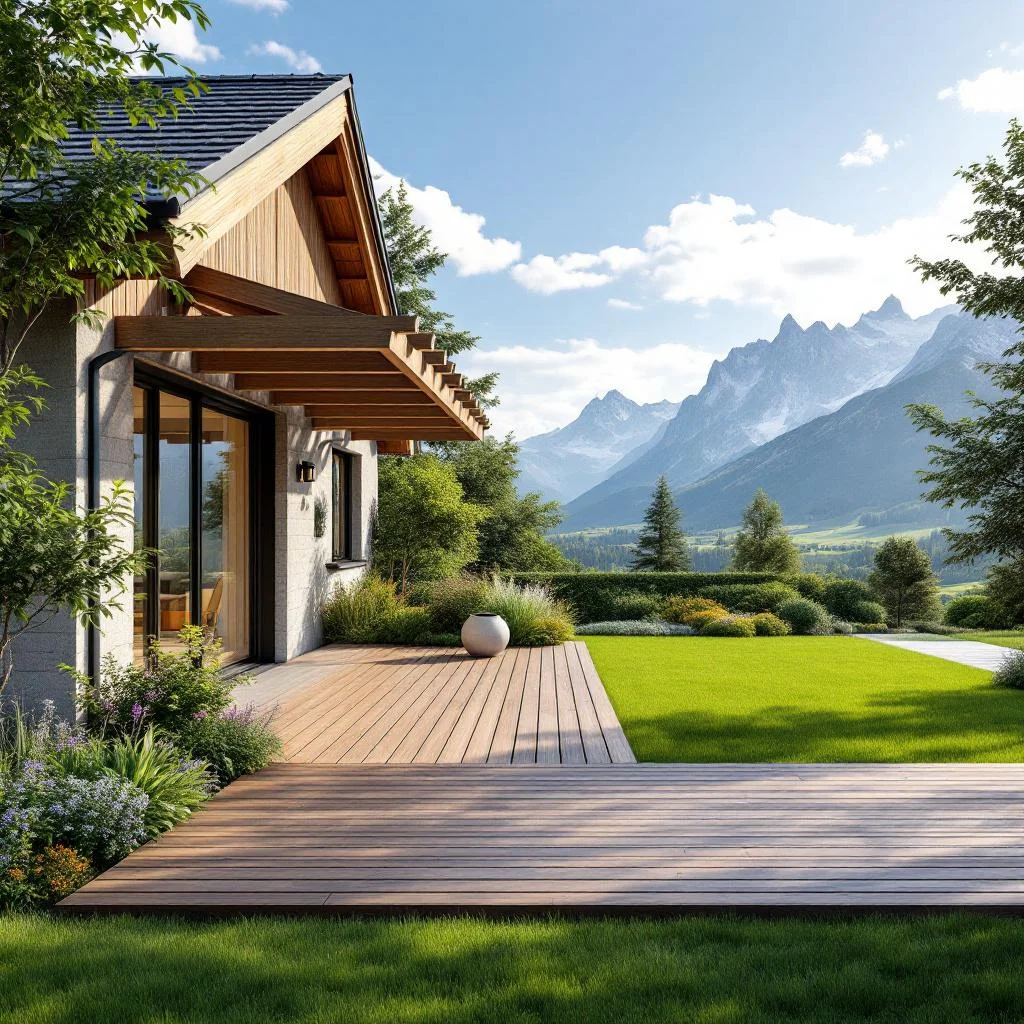
A pergola extends outdoor living at a house or apartment: it shades a terrace, marks out a dining corner, shelters a garden lounge or sits alongside a swimming pool. In Western Switzerland, where summers can be sunny and evenings cool, it is often thought of as an extra room, to be used for a good part of the year.
Building one involves timber framing, carpentry, metalwork and sometimes electrical work. SOS Travaux is a neutral matching service: you describe your project online, your request is passed to tradespeople and companies in the region, who contact you to prepare a free, no-obligation quote.
What a pergola covers, from a simple frame to a bioclimatic structure
The word actually describes several kinds of structure. The traditional pergola is a framework of posts and crossbeams, often in wood, that supports a stretched canvas, slats or climbing plants. It gives filtered shade without closing off the space.
The lean-to pergola rests against the facade of the house. It needs fewer posts, but the fixing must be done carefully: waterproofing where it meets the wall, respect for the insulation, and drainage of water. The freestanding pergola stands on its own posts and can be placed anywhere in the garden, beside a swimming pool or on a slab.
The bioclimatic pergola is fitted with adjustable slats, most often in aluminium. They open to ventilate and close to cover, and some models channel rainwater down hollow posts. This version requires a motor, and therefore an electrical connection, which must be made by a qualified professional.
The most common jobs are:
- installing a new pergola on an existing terrace;
- creating the slab or foundation pads that will receive it;
- replacing a canvas, slats or a motor on an older structure;
- adding options: side blinds, sliding glazing, lighting, supplementary heating;
- renovating or treating a wooden pergola that has aged.
When to hire a professional to install a pergola
A small, light structure can be assembled by yourself, but several situations justify calling in a tradesperson. The first is wind and load: a roof, especially a closed one, catches the wind and must be sized and anchored correctly. A poor fixing endangers people and neighbouring property.
The second is the connection to the building. Drilling into a facade, passing through insulation or fixing a beam to a wall carelessly creates leaks whose effects appear months later. The third is electricity: motorisation, lighting or heating are a job for an electrical installer. Finally, whenever a permit is needed, a professional knows the plans and supporting documents that are expected.
Pergolas in Switzerland: trades, training and warranties
Several trades may be involved. The timber framer and the carpenter build wooden structures; the metal fabricator or locksmith works steel and aluminium; a mason prepares the foundations; an electrician connects the motor. In Switzerland these trades are covered by vocational training leading to a federal certificate of proficiency (CFC). This does not remove the need to compare offers, ask for verifiable references and make sure the company is properly registered.
Legal warranties are set by the Code of Obligations (CO). For a work built into real estate, the warranty period for defects is five years under article 371 CO; for movable work, it is two years. A pergola anchored to the ground or fixed to the building generally falls into the first case, but the classification depends on the work actually carried out. If the contract refers to the SIA 118 standard, it applies in addition; check this point when you sign.
In every case, report a defect in writing as soon as you notice it and keep the quote, the invoice and the photos of the site.
Permits and energy: what changes from one French-speaking canton to another
The basic rule is simple: find out before you order. Whether a permit is needed depends on the size, the footprint, the height, the distance to property boundaries, the zone and whether the roof is closed or open. The municipality or the relevant cantonal department is the only body that can answer for your plot.
- Geneva: building permits are issued by the canton, through the Office des autorisations de construire. The old town and several protected districts impose additional requirements, and many rental buildings are managed by property agencies whose consent is required.
- Vaud: the permit is issued by the municipality. When cantonal departments must give an opinion, the file goes through the cantonal permits centre (CAMAC). The old towns and the Lavaux vineyards, a World Heritage site, call for particular attention to external appearance.
- Valais: the building permit is issued by the municipality within the building zone and by a cantonal commission outside it. For a chalet or a second home, the federal law on second homes may apply in the municipalities concerned.
- Fribourg: applications are submitted on the cantonal platform FRIAC, and the permit is issued by the prefecture or the municipality depending on the work. The old towns are protected.
- Neuchâtel: applications go through the cantonal one-stop shop SATAC, with the decision taken by the municipality. The watchmaking heritage of La Chaux-de-Fonds and Le Locle, a UNESCO site, may affect facades and surroundings.
- Jura: the permit is issued by the municipality or by the canton depending on the scale of the project. The old towns of Delémont, Porrentruy and Saint-Ursanne warrant early contact with the authorities.
- Biel/Bienne and the canton of Bern: the permit is issued by the municipality or the prefecture depending on the project. Biel/Bienne is officially bilingual, which applies to dealings with the administration.
On the energy side, a bioclimatic pergola or a blind that limits heating of a glazed opening can change a home’s thermal behaviour. Each canton has an energy department and a subsidy programme; in Geneva, aid from the Buildings Programme depends on the cantonal energy office (OCEN). A pergola alone does not necessarily qualify for aid: ask the cantonal department what is eligible before signing, because conditions must be checked beforehand.
Preparing your quote request for a pergola
The more precise the request, the more comparable the offers. Gather these details:
- the location: existing terrace, lawn, balcony, flat roof, with photos of the area and the facade;
- the dimensions you want, even approximate, and the height available beneath existing elements;
- the type of pergola you have in mind (lean-to, freestanding, canvas, fixed slats, bioclimatic) and your preferred material;
- exposure to sun and wind, any slope, the nature of the ground;
- whether or not there is an electrical supply nearby;
- your status: owner, tenant with the landlord’s consent, co-owner;
- the timetable you want and any access constraints for delivering the components.
If you do not know the permit situation, say so: the tradesperson can tell you what needs to be checked and whether the file is their responsibility or yours.
What a good quote details, and what makes the cost vary
A usable quote describes each item separately: supply of the structure, material and surface treatment, roof covering, foundations, fixings, installation, motorisation and connection, options, waste removal, transport and commissioning. It states how long the offer is valid, the payment terms, the planned timescales, what is excluded and what is your responsibility, for example the permit or masonry work.
The cost varies mainly with the area covered, the material, the type of roof (canvas, fixed or adjustable slats), the complexity of the connection to the building, the nature of the ground and foundations, the motorisation and the options. Site accessibility and the season of installation also play a part. Two offers that seem far apart often cover different services: compare them item by item rather than on the total.
Request a quote for your pergola
Describe your project using the form to request a quote. Your request is passed to tradespeople and companies in the region, who contact you to prepare a free, no-obligation quote. You remain free to compare, to ask questions and to take up none of the offers.
Pergolas near you: the canton pages
No city-level page is available yet for this trade. The canton pages bring together the local information useful for preparing your project:
Updated 29 October 2026