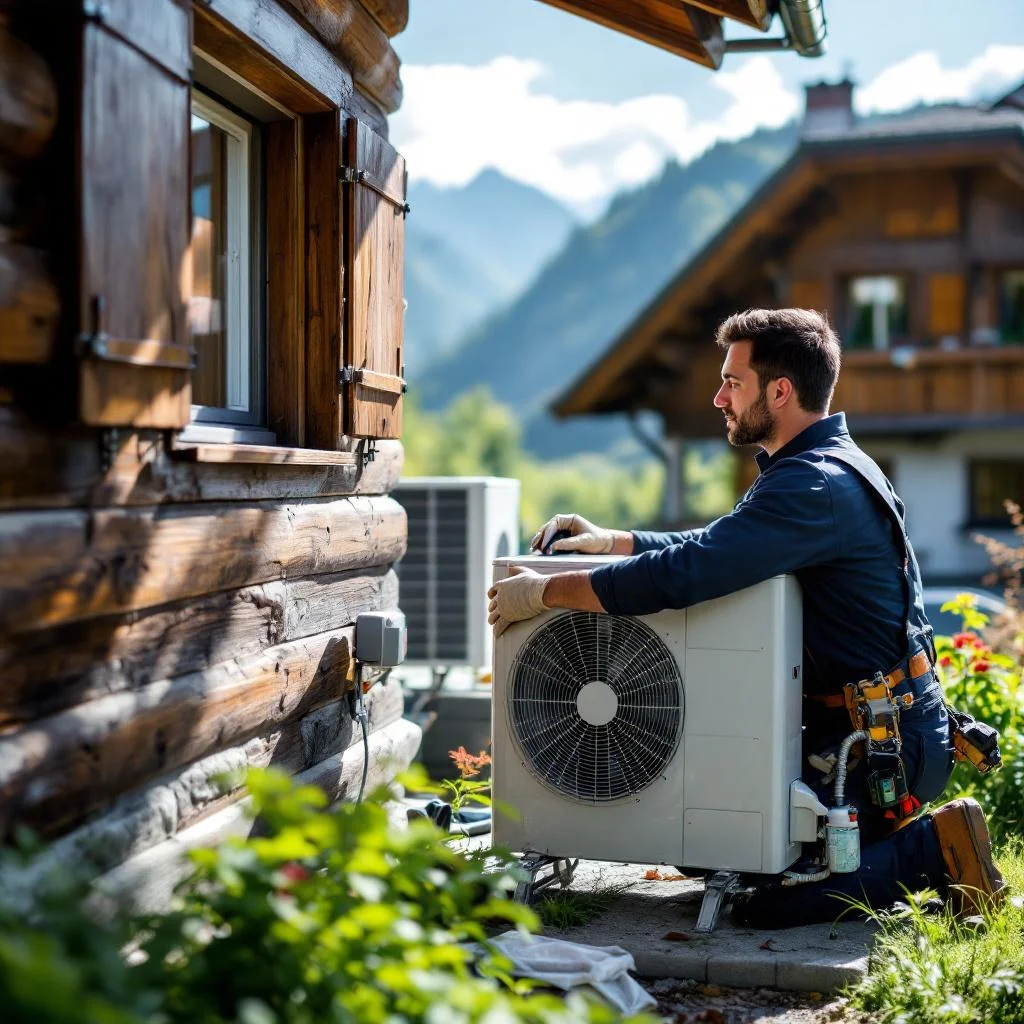
A radiator is only noticed when it fails: a room that no longer heats, a drip at the connection, circulation noises, rust stains on the wall. In Western Switzerland, where the heating season is long and many buildings are old, the subject comes up every autumn.
This page explains what the trade covers, the situations where a professional is needed, the differences from one canton to another and how to prepare a complete quote request.
What radiator work covers
The radiator is the last link in a hot-water circuit: a boiler, a heat pump or a district heating substation produces the heat, pipes carry it, and the radiators release it into the rooms. The professional who steps in is generally a heating installer, sometimes a plumber or a building services company that brings several trades together.
The most frequent jobs are the following:
- replacing one or more ageing radiators, in cast iron, steel or aluminium;
- fitting an additional radiator in a room that has been converted, enlarged or is poorly heated;
- changing thermostatic valves and regulating valves;
- bleeding a radiator and balancing the network, so that each room receives the intended heat;
- flushing the circuit, which means removing the sludge and deposits that have built up;
- repairing a leak at the connection, the valve or the radiator body;
- temporarily removing a radiator to allow painting or renovation work.
A radiator is not replaced on its own: the circuit has to be drained, then refilled and bled, and the water flow temperature checked to see that it suits the new unit. That is what separates careful work from a simple swap of parts.
When to call a radiator installer
Some tasks can be done yourself, such as bleeding a radiator whose top stays cold. Others need a professional, because they involve pressurised water, the tightness of the installation or its overall balance.
Call an installer in the following cases:
- a persistent leak, even a minor one, at the connection or on the radiator body;
- a radiator that is cold at the bottom while the rest of the installation works, a possible sign of sludge build-up;
- circulation noises or banging in the pipes;
- a room that stays noticeably colder than the others despite bleeding;
- a project to replace the heat source, which requires checking that the existing radiators suit the new operating temperature;
- a renovation that moves partitions or changes how rooms are used.
If water is running or you suspect damage, close the valve of the radiator concerned and inform the owner, the property management agency or the installer without delay.
Radiators and rules in Switzerland: training and standards
In Switzerland, the heating installer completes initial vocational training leading to a Federal Certificate of Proficiency (CFC). This training covers laying pipes, connecting heat generators and heating units, and commissioning them. The qualification describes a training path; it does not remove the need to ask the company to detail what it will do at your property.
Beyond that, the profile of this trade does not mention a specific standard. Keep mainly two principles in mind:
- work on a heating circuit must be consistent with the rest of the installation, and not only with the radiator itself;
- the obligations that apply to your building depend on its age, its status and its commune, which is why it is worth asking the question before ordering.
Geneva, Vaud, Valais: what changes by canton
Simply replacing a radiator is one thing. A broader heating renovation, an extension or a protected building is another. Procedures vary from one canton to another; here are the known reference points.
Geneva. Building permits are issued by the canton, through the Office des autorisations de construire. On energy, the cantonal energy law (LEn) and the cantonal energy office (OCEN) frame the field, and the Buildings Programme subsidies in Geneva depend on them. The old town and certain protected districts call for particular care, and many rental buildings are run by property management agencies: the agency’s agreement is the first step. See the page for the canton of Geneva.
Vaud. The building permit is issued by the municipality of the commune, with the file going through the cantonal permit centre (CAMAC) when cantonal services must give an opinion. Energy falls under the Vaud energy law and the cantonal energy directorate, which runs a subsidy programme. The old towns and the Lavaux vineyards, a World Heritage site, are reasons to find out before any visible change. See the page for the canton of Vaud.
Valais. The building permit is issued by the commune within the building zone, and by a cantonal commission outside it. The cantonal service for energy and hydropower runs the subsidy programme. For chalets and second homes, the federal law on second homes applies in the communes concerned: ask the commune. See the page for the canton of Valais.
Fribourg, Neuchâtel, Jura and Biel/Bienne: cantonal reference points
Fribourg. Building permit applications go through the cantonal platform FRIAC; the permit is issued by the prefecture or the commune depending on the type of work. The cantonal energy service runs a subsidy programme. The canton is bilingual and its old towns are protected. See the page for the canton of Fribourg.
Neuchâtel. Applications go through the cantonal counter SATAC, with the decision resting with the commune. The cantonal service for energy and the environment handles the subsidy programme. The watchmaking heritage of La Chaux-de-Fonds and Le Locle, listed by UNESCO, calls for caution for the buildings concerned. See the page for the canton of Neuchâtel.
Jura. The building permit is issued by the commune or by the canton depending on the size of the project. The cantonal energy section follows the subsidy programme. Delémont, Porrentruy and Saint-Ursanne have old towns that must be taken into account. See the page for the canton of Jura.
Biel/Bienne and the canton of Bern. The permit is issued by the commune or the prefecture depending on the project, and the cantonal office for the environment and energy runs the subsidy programme. Biel/Bienne is officially bilingual, French and German: a quote or a contract may be drawn up in either language. See the page for the canton of Bern.
In every case, these notes are reference points. Only the commune or the competent cantonal service can say whether your work requires a procedure, and whether a subsidy is possible for your project.
Preparing your quote request for radiators
An installer prices better what they understand well. Before filling in the form, gather a few items:
- the number of radiators concerned and where they are;
- their material and condition: cast iron, steel, aluminium, signs of rust, a visible leak;
- the type of heat production: oil, gas, heat pump, district heating;
- the approximate age of the installation, if known;
- photos of the radiators, the valves and the boiler’s data plate;
- your status: owner, tenant with the landlord’s agreement, co-ownership;
- your access and scheduling constraints, for example an occupied room or a painting job running in parallel.
The site is a matching service: the request is passed on to craftspeople and companies in the region, who contact you to prepare a free quote without obligation. You can request a quote by describing your situation online.
What a reliable radiator quote should detail
A useful quote is read line by line. It specifies:
- the radiators supplied: type, material, dimensions, make or reference;
- the valves, fittings and connections planned;
- the removal of the old units and their disposal;
- the draining, refilling, bleeding and balancing of the circuit;
- any related work, such as repainting or plastering repairs, or their exclusion;
- the payment terms, the expected duration of the job and the start date;
- any reference to the SIA 118 standard.
Compare several quotes on their content, not only on the total. An offer far below the others may simply leave out the balancing or the disposal of the old units.
What makes the cost of replacing radiators vary
The price of a radiator job cannot be guessed from a distance. It depends in particular on:
- the number of radiators and their size, since a large model requires more material and handling;
- the material chosen and the model, from basic units to designer models;
- the condition of the pipes and valves, which may require replacing them at the same time;
- accessibility: floor level, narrow passage, furniture to move;
- the need for flushing or a full balancing;
- the finishing work around: paint, sealant, wall repairs;
- the period and the company’s workload.
Only the quote sets the real cost of your project, once the site has been visited or precisely described.
Legal warranties after radiators are fitted
The Code of Obligations governs defects in construction work. For work on immovable property, meaning what is durably built into the building, the warranty period for defects is five years under Art. 371 CO. For movable property, it is two years. A radiator that is fixed and connected to the circuit is in principle attached to the building; if in doubt, ask the company which it considers it to be.
If the contract refers to the SIA 118 standard, it applies in addition to the Code of Obligations. Defects should be reported in writing as soon as they are noticed, keeping a record of the exchanges. Also keep the quote, the invoice and the handover documents for the work.
Radiators near you in Western Switzerland
No city page is available yet for this trade. In the meantime, the canton pages give the local context, the authorities to consult and the specific features of each region:
- canton of Geneva
- canton of Vaud
- canton of Valais
- canton of Fribourg
- canton of Neuchâtel
- canton of Jura
- canton of Bern
To receive proposals from craftspeople in your area, use the form directly: request a quote.
Updated 29 October 2026