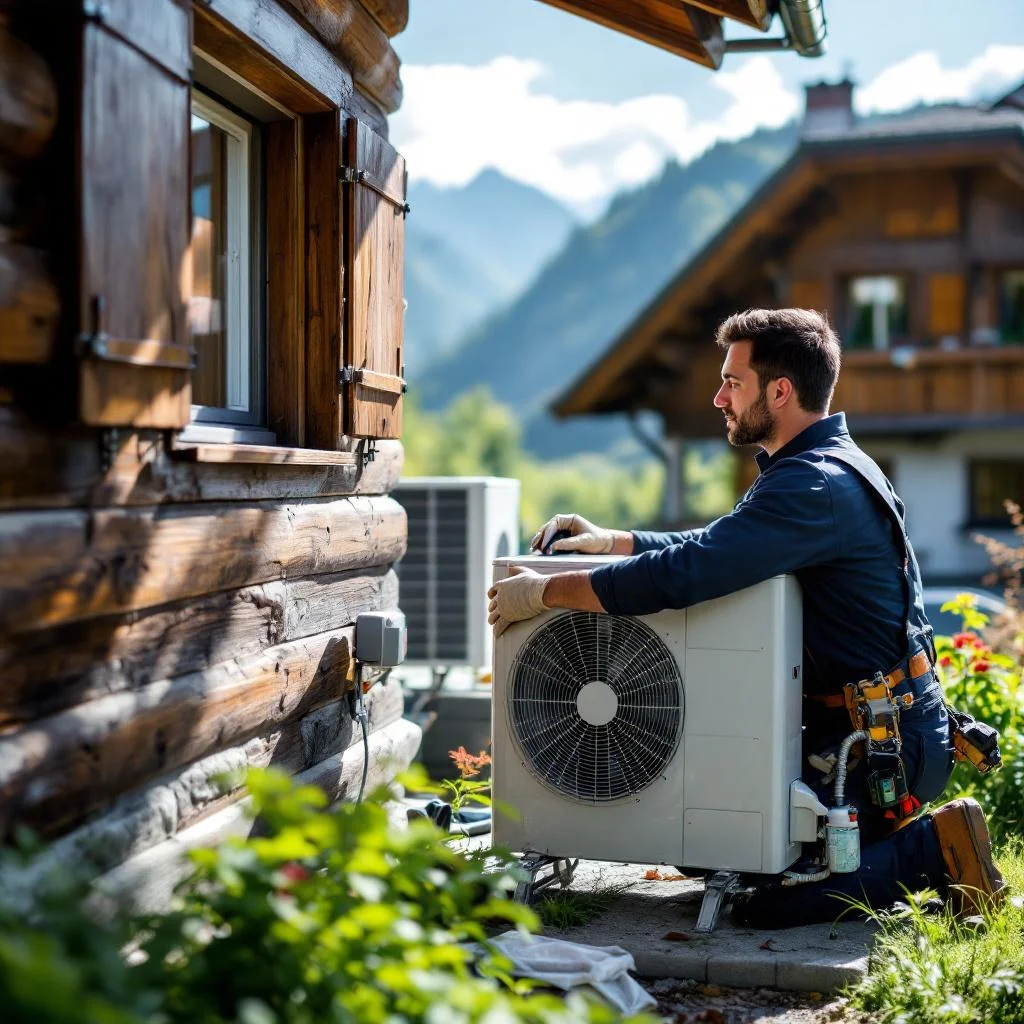
A controlled mechanical ventilation system, or VMC, renews the air in a home or premises using a fan and a network of ducts, rather than relying on opening the windows. In western Switzerland, where many buildings have been renovated and made more airtight, the question arises more and more often.
On sos-travaux.ch, you describe your project online. Your request is passed on to companies in the region, who get back to you to prepare a free quote with no obligation.
What VMC covers in homes and small premises in western Switzerland
The term covers several quite distinct installations. The most common works are the following:
- Single-flow ventilation: stale air is extracted from the damp rooms (kitchen, bathroom, toilet) and fresh air enters through vents placed in the living areas.
- Dual-flow ventilation: fresh air and extracted air pass through an exchanger, which recovers part of the heat from the outgoing air and transfers it to the incoming air.
- Decentralised units: small units fitted in a wall, suited to a room or an apartment where ducts cannot be run.
- Replacing a fan in a bathroom or kitchen, or replacing a connected cooker hood.
- Maintenance and cleaning: filters, vents, ducts, replacement of wear parts.
The trade belongs to ventilation and building services engineering, with overlaps with heating, plumbing, electrical work and sometimes carpentry or masonry, when walls have to be drilled or openings created. A somewhat larger project therefore often involves several trades, coordinated by the main contractor.
When to call a professional about ventilation in your home
Certain signs call for an opinion:
- persistent condensation on the windows, especially after new windows have been fitted;
- black patches of mould in corners, behind furniture or in the bathroom;
- a stale smell that does not go away despite manual airing;
- an energy renovation under way or planned, which will make the building envelope more airtight;
- a new build or an additional storey, where ventilation is planned from the outset;
- an existing installation that is noisy, clogged or broken down.
If you are considering insulating the facade, changing the windows or transforming a kitchen, talk about ventilation before the work begins. Fitting the ducts afterwards means more work and more disruption than planning them in during the structural or finishing work.
A specialist starts by examining the home: volumes, damp rooms, condition of the insulation, possible location of a unit and routes for ducts. It is this visit, rather than a standard model, that determines the suitable type of system.
Rules to know for a VMC in Switzerland, and professional training
In Switzerland, building ventilation is tied to energy requirements and indoor air quality, but the precise rules depend on the canton and the municipality. We only detail here what is certain: a major installation may require a permit, and the municipality or the relevant cantonal department remains the contact to confirm it.
It is reasonable to ask the company which professional qualifications it brings to the job, who will carry out the electrical connection and who will be responsible for commissioning. Adjusting the airflow rates when the work is handed over is part of a sound installation: without it, a well-fitted system can ventilate too much or too little.
If the home is rented or co-owned, the consent of the landlord, the managing agency or the co-owners’ assembly is essential before drilling through a facade, a slab or a shared duct. Air outlets in the facade and roof affect the outward appearance of the building, which also concerns the neighbours.
Permits, energy and heritage: what changes between Geneva, Vaud, Valais and the rest of the region
The rules vary from one canton to another, and sometimes from one municipality to another. Here are the useful points of reference; always confirm your case with the municipality or the relevant cantonal department.
Geneva. Building permits are issued by the canton, through the Office des autorisations de construire (building permits office). On energy, the cantonal energy law (LEn) applies and the Office cantonal de l’énergie (OCEN, the cantonal energy office) is the contact on which grants under the Buildings Programme depend. Many rental buildings are managed by agencies, which should be approached first. The old town and protected districts call for particular attention for any outlet in the facade or roof.
Vaud. The building permit is issued by the municipality’s authorities; the file goes through the cantonal permits centre (CAMAC) when cantonal departments must give an opinion. The Vaud energy law and the cantonal energy directorate govern the matter, with a cantonal grant programme. Old towns and the Lavaux vineyards, a World Heritage site, may limit what is visible from the outside.
Valais. The building permit is issued by the municipality within the building zone and by a cantonal commission outside it. The cantonal service for energy and hydropower manages a cantonal grant programme. Chalets and second homes, which in the municipalities concerned are subject to the federal law on second homes, require checking what a conversion allows.
Fribourg. Building permit applications go through the cantonal FRIAC platform, and the permit is issued by the prefecture or by the municipality depending on the type of work. The cantonal energy service offers a cantonal grant programme. The canton is bilingual and its old towns are protected.
Neuchâtel. Applications are filed at the cantonal SATAC desk, with the decision taken by the municipality. The cantonal service for energy and the environment manages a cantonal grant programme. The watchmaking heritage of La Chaux-de-Fonds and Le Locle, a UNESCO site, calls for caution on facades and roofs.
Jura. The building permit is issued by the municipality or by the canton depending on the scale of the project. The cantonal energy section has a cantonal grant programme. Delémont, Porrentruy and Saint-Ursanne have old towns to preserve.
Bernese Jura and Biel/Bienne. The permit is issued by the municipality or the prefecture depending on the project, and the cantonal office for the environment and energy manages a cantonal grant programme. Biel/Bienne is officially bilingual, which may affect the language of files and correspondence.
For grants, do not count on anything without having read the conditions of your canton’s programme: they are generally applied for before the work starts, and ventilation only features if it is part of a project that meets the criteria.
Preparing your quote request for ventilation: what to gather
The more precise your description, the more comparable the quotes will be. If possible, prepare:
- the type of building (detached house, apartment block, business premises), its approximate age and its surface area;
- the rooms concerned and the problems observed (humidity, odours, noise);
- the work already done or planned: windows, insulation, kitchen, bathroom;
- whether any ventilation is already in place, and its condition;
- the possible access routes for ducts: attic, suspended ceilings, technical shafts, cellar;
- your status (owner, tenant with the landlord’s consent, co-ownership);
- photos of the rooms and of the envisaged locations.
Also mention your constraints: acceptable noise level, whether occupants will be present during the work, and a schedule tied to a wider renovation.
What a sound ventilation quote should detail, and what makes the cost vary
A usable quote describes the proposed system (type, number of vents, location of the unit), the ducts and their material, the openings and their making good, the electrical connection, the adjustment of airflow rates, the commissioning and what is excluded. It specifies coordination services with other trades, waste removal and payment terms.
Several factors make the cost vary:
- the choice between single-flow, dual-flow or decentralised units;
- the size of the home and the number of rooms to serve;
- the length and routing of the ducts, depending on whether the work is in a new build or a renovation;
- the accessibility of the site and the need to open up or close partitions again;
- outlets in the facade or roof, which may require scaffolding or permits;
- the sound insulation quality of the unit and ducts;
- the finishes and repainting after the work;
- future maintenance: possible contract, replacement of filters.
Compare quotes item by item rather than on the total alone. A quote far less detailed than the others often hides omitted services.
Legal warranties after ventilation works
The Code of Obligations governs the warranty in the event of defects. For a building work, the client has five years to report defects (art. 371 CO); for movable work, the period is two years. A ventilation installation integrated into the building generally falls under the first case, but the classification depends on the nature of the work and the contract.
If the contract refers to the SIA 118 standard, it applies in addition to the rules of the Code of Obligations. Reread what the quote or contract says on this before signing, and keep the invoice, the accepted quote, the handover report and the commissioning documents. Report a defect in writing as soon as you notice it.
Ventilation: request a quote in western Switzerland
To receive proposals from companies in the region, request a quote by describing your home and your needs. The service is neutral: it passes on your request, with no craftspeople of its own and no named partner, and the quote remains free and with no obligation.
Ventilation (VMC) near you
City pages for this trade are not yet available. In the meantime, see the page for your canton:
Updated 29 October 2026