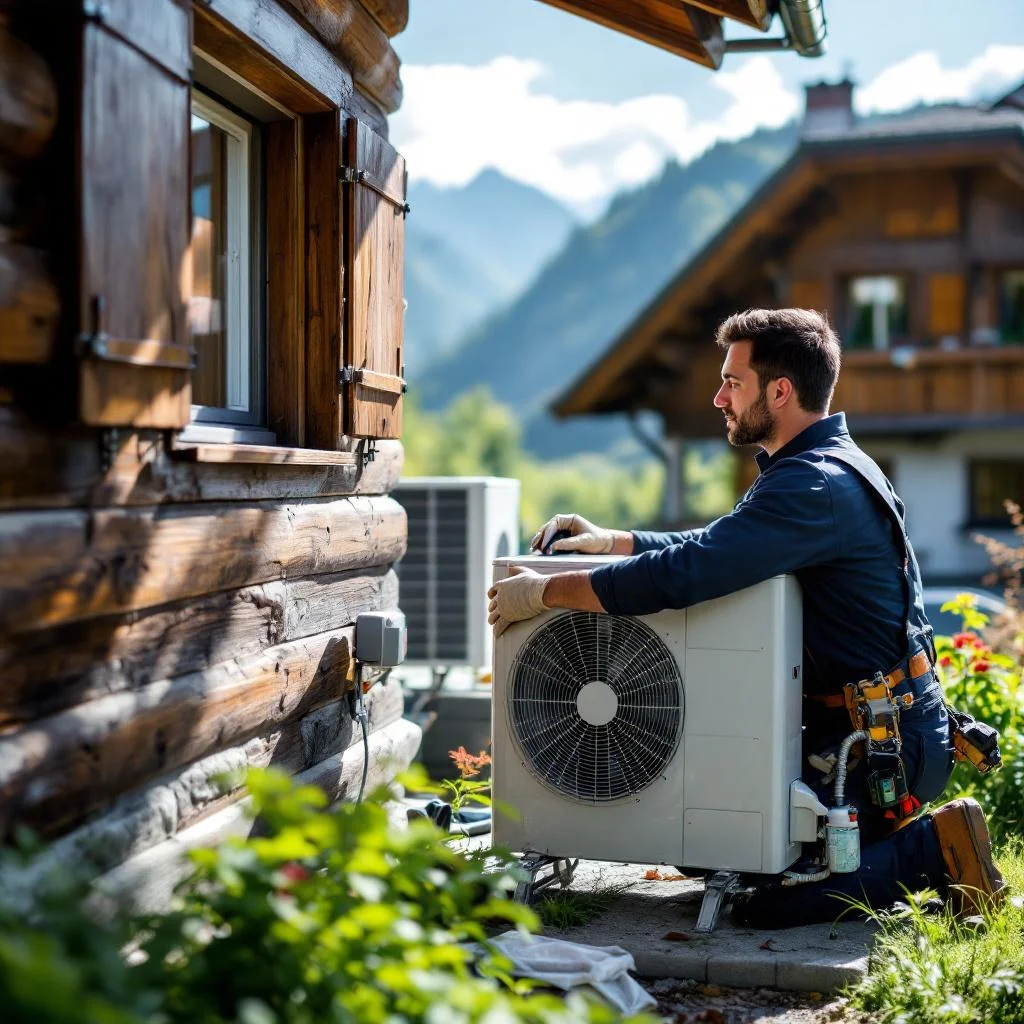
A wood or pellet stove heats a room, sometimes a large part of a home, and provides supplementary or main heat depending on the property. Installing one is more than putting an appliance in place: it involves a flue, safety clearances, and a suitable floor and walls.
On sos-travaux.ch, you describe your project online; your request is passed to craftspeople and firms in the region, who contact you to prepare a free, no-obligation quote.
What a stove fitter and flue specialist does in Western Switzerland
The stove fitter and flue specialist (poêlier-fumiste) deals with wood-burning appliances and their connection: log stoves, pellet stoves, masonry heaters, closed fireplaces. Depending on the firm, the same contact may also work on the flue, or collaborate with a chimney sweep, a mason or a plumbing installer for the points outside their trade.
The most common jobs in Western Switzerland:
- installing a new stove in a room that had none;
- replacing an old appliance with a more recent model;
- building or repairing a flue, with relining if necessary;
- cladding and protection around the appliance (floor slab, heat-resistant walls);
- connecting a pellet stove to electricity and to its air supply;
- servicing, cleaning and recommissioning before winter.
In Switzerland, training for this trade is a professional apprenticeship leading to a federal certificate of competence (CFC). Check the firm’s training and experience with the type of appliance you have in mind.
Wood stove or pellet stove: what changes for your project
A wood stove is loaded by hand and needs a stock of dry logs, stored under cover. It works without electricity, which appeals to owners of chalets and isolated houses. A pellet stove, by contrast, is controlled by a thermostat or a programme, burns wood pellets and generally needs a power socket, space for bags or a small silo, and regular cleaning of the burner.
In both cases, the flue is the central point. Its diameter, height, route, wall condition and tightness must suit the appliance. An excellent stove connected to a poorly matched flue draws badly, clogs quickly and can present a risk. This is why a professional almost always visits before pricing.
When to call a professional in Geneva, Vaud or the Jura
An on-site visit is needed in several situations:
- you do not yet have a flue and one must be created;
- the existing flue is old, cracked or of uncertain section;
- the floor or nearby walls are made of heat-sensitive material;
- you live in a shared building, where the flue and ventilation affect other homes;
- the house is well insulated and airtight, which affects the combustion air supply;
- the building is old or protected.
Avoid connecting an appliance yourself to a flue whose condition you do not know. Fumes, soot and fire risk cannot be sorted out by trial and error.
Procedures and energy rules by Western Swiss canton
Switzerland has no single rule: permits, possible subsidies and heritage protection depend on the canton and the commune. The points below are general guidelines; always check with your commune or the competent cantonal office before ordering.
- Geneva: building permits are issued by the canton, through the Office des autorisations de construire. On energy, the cantonal energy law (LEn) and the cantonal energy office (OCEN) govern, among other things, the subsidies of the Buildings Programme. Many rental buildings are run by managing agents, and the old town as well as some districts are protected.
- Vaud: the building permit is issued by the municipality; the file goes through the cantonal permits centre (CAMAC) when cantonal services must give an opinion. The Vaud energy law and the cantonal energy directorate set the framework, with a cantonal subsidy programme. Old towns and the Lavaux vineyards, a World Heritage site, call for particular attention.
- Valais: the building permit is issued by the commune in the building zone, and by a cantonal commission outside it. The cantonal service for energy and hydropower runs a subsidy programme. Chalets and second homes are common, with the federal second-homes law applying in the communes concerned.
- Fribourg: permit applications go through the cantonal platform FRIAC, and the permit is issued by the prefecture or the commune depending on the work. The cantonal energy service offers a subsidy programme. The canton is bilingual and its old towns are protected.
- Neuchâtel: applications go through the cantonal one-stop shop SATAC, with the decision taken by the commune. The cantonal service for energy and the environment runs a subsidy programme. The watchmaking heritage of La Chaux-de-Fonds and Le Locle, a UNESCO site, deserves to be taken into account for an old building.
- Jura: the permit is issued by the commune or the canton depending on the scale of the project. The cantonal energy section runs a subsidy programme. Delémont, Porrentruy and Saint-Ursanne have sensitive old towns.
- Biel/Bienne and the Bernese Jura: the permit falls to the commune or the prefecture depending on the project, and the cantonal office for the environment and energy runs a subsidy programme. Biel/Bienne is officially bilingual, which can affect the language of administrative exchanges.
One point holds everywhere: a new flue, a change to a façade or roof, or a protected building can trigger a procedure. Replacing an appliance on an existing flue does not always require one, but do not assume so: ask the question.
Tenants and co-ownerships: consent before the quote
If you rent, the stove affects the building. Ask for the written consent of the landlord or managing agent before contacting professionals, stating the model planned, its location and the route of the flue. In a co-ownership, the flue, roof or façade are often common parts: the decision may go to the owners’ meeting. The building’s insurer may also want to be informed.
Preparing your stove request
The more precise the request, the more comparable the quotes. Gather the following before filling in the form:
- the type of home (house, flat, chalet) and the room to be heated;
- your preference: wood, pellets, or a need for advice;
- whether a flue exists, its known condition and its location;
- photos of the room, the floor, nearby walls and the roof if a flue must come out through it;
- the intended use: supplementary heating, main source, second home;
- your status (owner, tenant with consent, co-ownership);
- the desired period, for example before winter.
Also say whether you want to keep an existing appliance, or simply replace it.
What a sound quote details for a stove
A good quote describes the items separately so that you can compare. Look for at least:
- the appliance: make, model, stated characteristics;
- the flue: materials, relining, roof terminal, any connector;
- protection of the floor and nearby walls;
- the connection, the air supply and, for pellets, the electricity supply;
- ancillary work: core drilling, masonry, repair of finishes;
- removal of site waste and of the old appliance;
- commissioning and instructions for use;
- payment terms and arrangements in case of the unexpected.
A large gap between two offers often comes from a forgotten item or a different scope, not only from a rate. Ask for details rather than choosing on the final line alone.
What makes the cost of a stove vary
A quote cannot be deduced from an average. Several factors weigh in:
- the choice of appliance, its type and level of equipment;
- whether a usable flue exists, or one must be created;
- the height of the building and access to the roof;
- the protection and finishing materials around the appliance;
- the distance between the appliance and the flue, and the complexity of the connection;
- site access: floor level, stairs, difficulty of carrying the appliance up;
- any procedures to plan with the commune;
- the season, and lead times for supplying the appliance.
Only a visit and a detailed estimate give a reliable amount for your case.
Legal warranties after a stove is installed in Switzerland
The Code of Obligations (CO) governs the warranty for defects in the work. For immovable work, which in principle covers a stove installed and connected to the building, the period to report a hidden defect is 5 years (art. 371 CO). For movable work, it is 2 years. The defect must be reported as soon as it is noticed, preferably in writing.
If the contract refers to it, the SIA 118 standard (Swiss Society of Engineers and Architects) also applies to the relationship between you and the firm. Read the quote and the conditions before signing, and keep the invoices, the appliance data sheets and your exchanges with the firm.
Wood or pellet stove near you
City pages for this trade are not yet available. The canton pages present the local context and lead to the request:
- canton of Geneva
- canton of Vaud
- canton of Valais
- canton of Fribourg
- canton of Neuchâtel
- canton of Jura
- canton of Bern
Is your project ready to be described? You can request a quote: the request is free and without obligation, and professionals in the region will contact you for the next steps.
Updated 29 October 2026