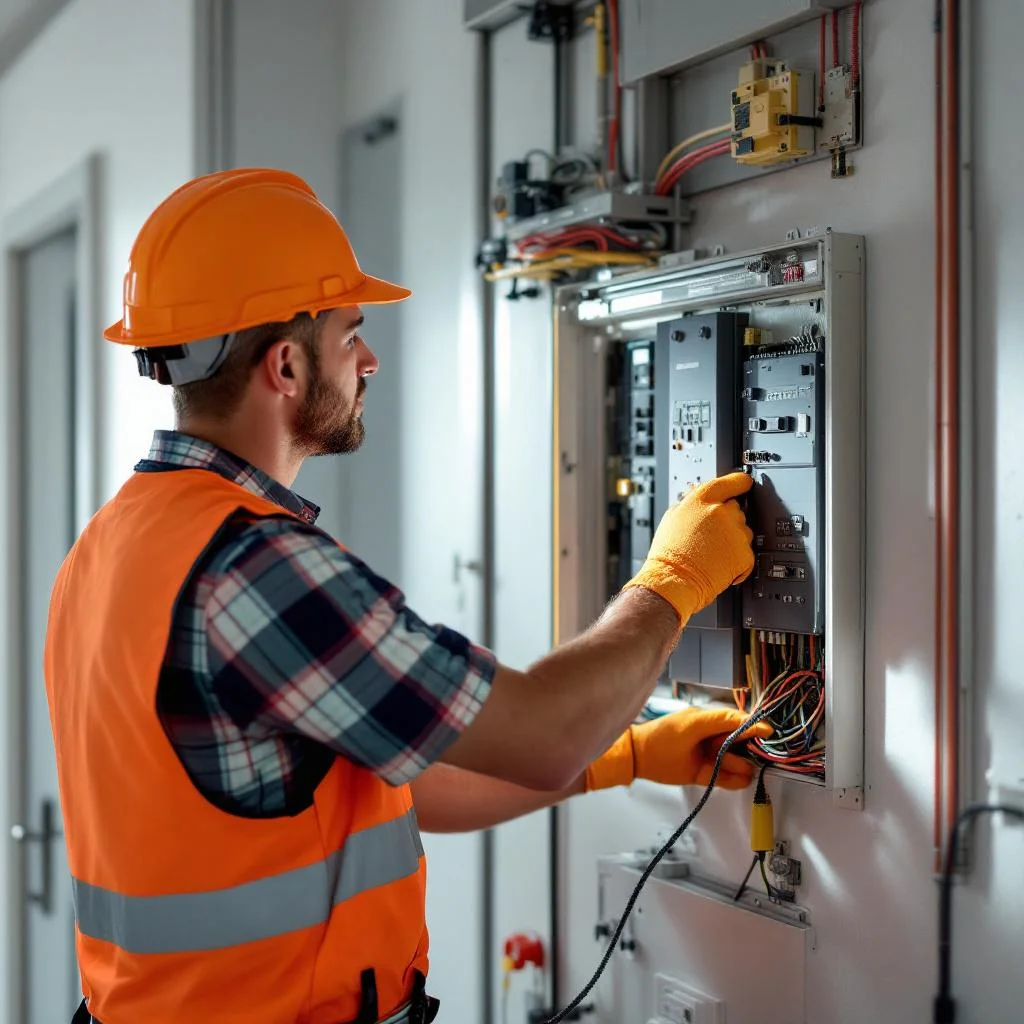
Sockets that run hot, a panel from another era, lighting to rethink, a charging point to connect: electrics is a field where you do not improvise. In French-speaking Switzerland, work on a fixed installation follows precise federal rules, with procedures specific to each canton on top.
SOS Travaux is a neutral matching service: you describe your project online, your request is passed on to electricians and firms in the region, who get back to you to prepare a free, no-obligation quote.
What an electrician’s trade covers
A building electrician works on the internal installation: conductors, sockets, switches, light fittings, distribution panel, protective devices and the connection of appliances. They create a circuit, replace a worn-out component or bring the whole installation up to current requirements.
The most common jobs:
- adding or moving sockets and switches;
- replacing or renovating an electrical panel;
- creating or redesigning the lighting, indoors and outdoors;
- connecting fixed appliances: cooker, washing machine, water heater, ventilation;
- bringing an old installation up to standard;
- fault finding and emergency repairs;
- running cables during a full renovation.
The trade increasingly overlaps with other projects: an electric vehicle charging point, solar panels, a heat pump or a new kitchen all require a suitable supply, and therefore an installation that can handle the load.
When to call an electrician
Some signs call for immediate action: a circuit breaker that trips regularly, a burning smell near a socket, a socket or cable that is hot to the touch, sparks, lights flickering for no reason. In these cases, switch off the circuit concerned and do not put it back into service until it has been checked.
Other situations can be planned in advance:
- buying an older property whose installation you know nothing about;
- a renovation, which is the right moment to redo the circuits rather than patch them up;
- the arrival of a new, power-hungry appliance;
- a request for a periodic inspection or a safety report for a sale or a letting.
In older buildings you still find installations designed for far more modest use than ours: few sockets, no residual-current protection, cables whose insulation is ageing. An assessment by a professional shows what can stay and what must be replaced.
What is different in Switzerland: permit, standard and inspections
The framework is set at federal level. Working on a fixed electrical installation requires an ESTI installation permit, under the low-voltage installations ordinance (OIBT). A firm without this permit is not allowed to carry out this type of work, and you should ask the question at the very first contact.
The installation must comply with the NIBT standard. After the work, the installer provides a safety report (RS): this is the proof that the work has been inspected. Installations are then subject to periodic inspections, the frequency of which depends on the type of building. Your electrician or managing agent can tell you the deadline that applies to your case.
As for training, the trade is learned through vocational education: an apprenticeship leading to a federal VET certificate (CFC) is the foundation of the profession. The CFC does not replace the installation permit, which concerns the firm or the authorised person who carries out and commits to the work.
Electricians and cantonal rules in French-speaking Switzerland
An interior installation is governed by federal law, but as soon as the work affects the façade, the roof, energy or heritage, the cantons and municipalities come into play. Here are the useful points of reference; always check with your municipality or the relevant cantonal department.
Geneva
Building permits are issued by the canton, through the Office des autorisations de construire. On energy, the cantonal energy law (LEn) applies and the Office cantonal de l’énergie (OCEN) is the contact for Buildings Programme subsidies. Many rental buildings are run by managing agents, who must be informed before any work. The old town and certain protected neighbourhoods require extra precautions. See the page for the canton of Geneva.
Vaud
The building permit is issued by the municipality, with the file going through the cantonal permits centre (CAMAC) when cantonal departments need to give an opinion. Energy falls under the Vaud energy law and the cantonal energy directorate, which runs a subsidy programme. Old towns and the Lavaux vineyards, a World Heritage site, may restrict work visible from the outside. See the canton of Vaud.
Valais
The building permit is issued by the municipality in building zones and by a cantonal commission outside building zones. The cantonal service for energy and hydropower runs the subsidy programme. For chalets and second homes, the federal law on second homes applies in the municipalities concerned. See the canton of Valais.
Fribourg
Permit applications go through the cantonal FRIAC platform, and the permit is issued by the prefecture or the municipality depending on the type of work. The cantonal energy service runs a subsidy programme. The canton is bilingual and its old towns are protected. See the canton of Fribourg.
Neuchâtel
Applications are filed at the cantonal SATAC counter, with the decision taken by the municipality. The cantonal service for energy and the environment handles the subsidy programme. The watchmaking heritage of La Chaux-de-Fonds and Le Locle, listed by UNESCO, deserves particular attention for any visible project. See the canton of Neuchâtel.
Jura
The permit is issued by the municipality or by the canton depending on the scale of the project. The cantonal energy section runs a subsidy programme. Delémont, Porrentruy and Saint-Ursanne have old towns that call for checks before work on the exterior. See the canton of Jura.
Biel/Bienne and the canton of Bern
In Biel/Bienne, the permit is issued by the municipality or the prefecture depending on the project, and the cantonal office for the environment and energy runs the subsidy programme. The city is officially bilingual, French and German: state which language you prefer for communication and the quote. See the canton of Bern.
Preparing your request
The more precise the request, the more precise the quote. Gather a few details before filling it in:
- the type of property (house, flat, business premises) and its approximate year of construction;
- your status: owner, co-owner or tenant, in which case the landlord’s consent;
- the nature of the work, in a few lines, with photos of the panel and the rooms concerned;
- related projects: charging point, solar panels, heat pump, kitchen renovation;
- constraints on access, occupancy of the premises and timing.
If a document already exists (an earlier safety report, a diagram of the panel), attach it: the electrician will save time assessing the condition of the installation.
What a reliable quote details
A useful quote describes the work, not just a total. Check that it mentions:
- the exact scope of the work and what is excluded;
- the materials planned: brands, types of sockets, protective devices, panel;
- labour and travel;
- any making good, such as chasing, drilling and finishing the walls;
- the issuing of the safety report after the work;
- the payment terms and the announced schedule.
What makes the cost vary
The price depends on the condition of the existing installation, the number of points to create or replace, how easily cables can be run (slab, stone wall, conduit available or not), the quality of the materials chosen, the power to be supplied and access to the site. An older building often requires more preparation work than a recent home. Only a quote drawn up for your situation gives a reliable figure: compare offers that cover the same scope.
Legal warranties after the work
The Code of Obligations (CO) protects the client. For work on an immovable structure, the warranty for defects runs for 5 years under art. 371 CO; for movable work, the period is 2 years. A defect must be reported in writing as soon as it is discovered. If the contract refers to the SIA 118 standard, it applies in addition. So read what the quote or contract provides, and keep the safety report, the invoice and the written exchanges.
Request an electrician’s quote
To describe your work and receive proposals from electricians in the region, go to the request a quote page. The service is free and without obligation: you remain free to compare, ask your questions and not follow up on any offer.
Electricians near you
Find the page dedicated to your town:
- electrician in Geneva, in Carouge, in Lancy and in Vernier;
- electrician in Lausanne, in Morges, in Nyon, in Vevey, in Montreux and in Yverdon-les-Bains;
- electrician in Sion, in Sierre, in Martigny and in Monthey;
- electrician in Fribourg and in Bulle;
- electrician in Neuchâtel and in La Chaux-de-Fonds;
- electrician in Delémont;
- electrician in Biel/Bienne.
Updated 29 October 2026