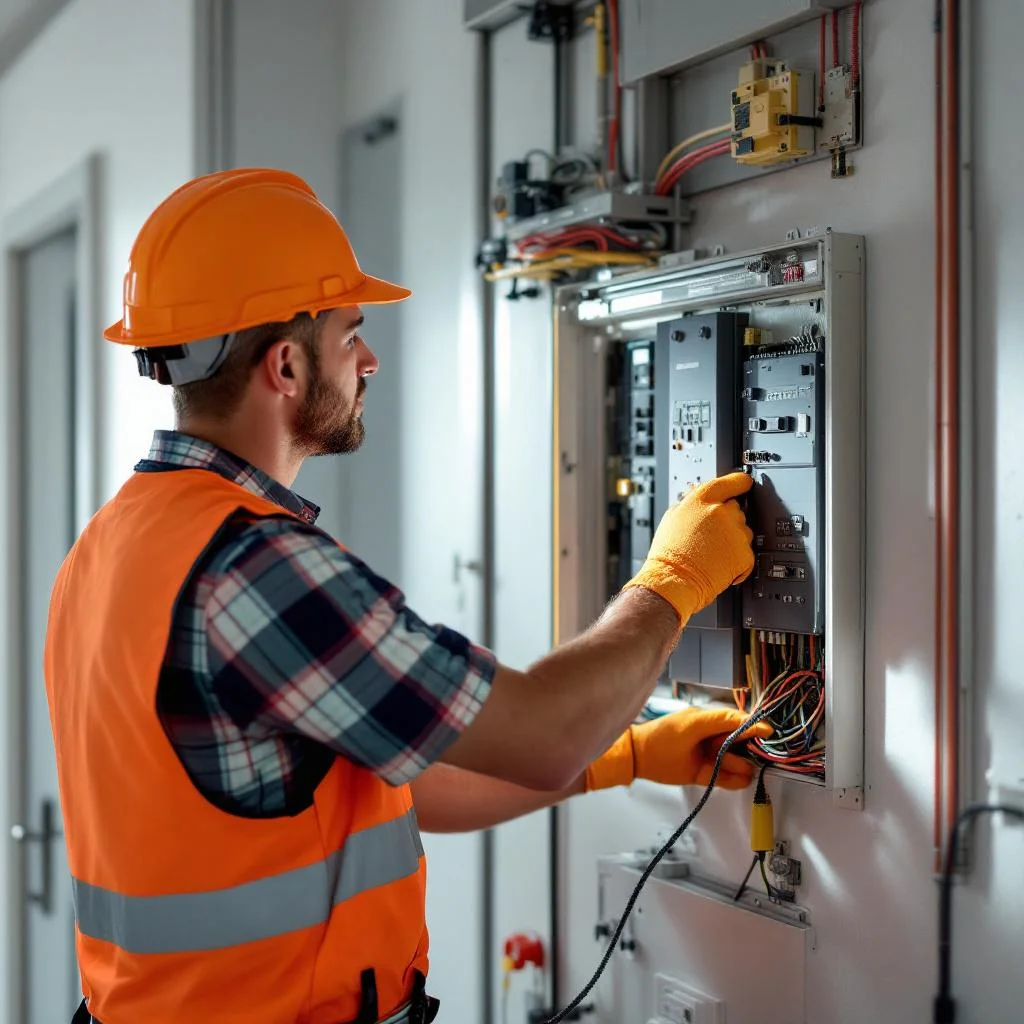
Are you looking for an electrician in Vernier for an extra socket, a panel to replace or an installation to bring up to standard? This page covers the most common electrical work in the commune, what the local building stock changes in practice and how to prepare your request. It helps you describe your project before you receive quotes from installers in the area.
Common electrical work in Vernier-village, Aïre and Châtelaine
Vernier brings together very different neighbourhoods, and electrical requests reflect that. In the village and at Aïre, there are more older or more modest buildings, sometimes with detached houses; at Châtelaine, the fabric is more urban and denser. The most frequent jobs are nonetheless the same:
- replacing or extending an electrical panel that has become too tight;
- adding sockets and lighting points in a room that has been converted;
- changing lighting, for example to switch to more economical light fittings;
- connecting appliances: oven, dishwasher, hob, water heater;
- bringing an older installation up to standard before a sale, a letting or a renovation.
In an older home, an electrician’s first instinct is often to look at the panel and the condition of the cables before talking about new sockets. An installation that has been added to in stages over the years may have unsuitable protection or overloaded circuits. The quote then starts from an assessment, not an assumption.
Le Lignon and its buildings: an installation shared by many
Le Lignon is known for its very long block of flats. In a complex of this size, most homes are rented flats or condominium units, and the electrical installation does not stop at your front door: risers, technical rooms and shared lighting concern the whole building. In practice, this changes two things.
First, your room for manoeuvre depends on your status. A tenant can generally work inside their own home with the landlord’s approval; anything affecting the common areas goes through the property manager or the community of co-owners. In Geneva, many rental buildings are run by property managers, so they are the first to ask.
Second, access and coordination matter. In a large building, the electrician sometimes has to cut the power to a riser, warn the neighbours or work at a time agreed with the caretaker or the property manager. Mention these points in your request: floor, presence of a lift, whether parking is available nearby.
EV charging, solar, heat pump: what they involve on the electrical side
Many current projects go through the electrician, even when they go by another name.
- EV charging station: the installer assesses the available power, the cable route from the garage or car park and the protection needed on the panel. In a building at Châtelaine or Le Lignon, the question of the shared panel and the approval of the co-ownership or property manager comes before the choice of charger.
- Solar panels: connection to the electrical network of the house or building is the electrician’s job, while installation on the roof involves the roofing and may require a permit. Detached houses in Aïre or the village are typically concerned.
- Heat pump: it needs a dedicated power supply and a suitable panel. If you are also considering changing your heating system, you can consult the heating engineer in Vernier page to coordinate the two jobs.
These projects tie in with the cantonal energy law (LEn) and the cantonal energy office (OCEN), on which the Buildings Programme subsidies in Geneva depend. Conditions and amounts change: check them with the competent cantonal office before signing anything.
Industrial zones and proximity to the airport: requests of a different kind
Vernier also has industrial zones and lies close to the airport. For a small business, a workshop or a commercial unit, the request looks less like a private individual’s: higher power, machinery, lighting for large spaces, bringing a unit into compliance before a new occupant arrives. If this is your case, specify the use of the premises and the equipment running there; an installer does not price an office and a workshop in the same way.
ESTI licence, NIBT standard and safety report
Whatever the neighbourhood, the federal framework is the same. In Switzerland, working on a fixed electrical installation requires an ESTI installation licence, under the low-voltage installations ordinance (OIBT). This is not an administrative detail: it is what separates an authorised installer from a DIYer, however experienced. Private individuals do not take this on lightly.
What you are entitled to expect from an electrician in Vernier:
- an installation that complies with the NIBT standard;
- an inspection at the end of the work;
- a safety report (RS) handed over once the work is finished.
Installations are then subject to periodic inspections, the frequency of which depends on the type of building. For a villa, a rental building or business premises, the schedule is not the same: ask your property manager or the installer what applies to your case.
Procedures in Vernier: commune, canton, landlord and co-ownership
For a simple replacement of sockets or light fittings, no building permit is generally discussed. As soon as the project affects the outside of a building or its appearance, the question changes. In Geneva, building permits are issued by the canton, through the Office des autorisations de construire. Solar panels, an outdoor charging point or cabling on a façade may therefore fall under this procedure, especially if the building is in a protected area. If in doubt, ask the commune or the competent cantonal office before ordering any equipment.
On the residents’ side, approvals go first to the right contact:
- tenant: written request to the property manager or landlord;
- co-owner: check the co-ownership regulations, then obtain the assembly’s approval if the common areas are affected;
- villa owner: no third-party approval, but watch property boundaries and easements for buried cables.
Preparing your request and comparing electrician quotes in Vernier
A useful quote is one based on a precise description. Before asking for offers, gather:
- the address, the type of home (flat, villa, premises) and the floor;
- the approximate age of the building and, if you know it, the date of the installation’s last renovation;
- a photo of the electrical panel with the cover open;
- the list of work wanted: number of sockets to add, appliances to connect, EV charging or solar project;
- your status (owner, tenant, co-owner) and any approval already obtained.
Once you have the offers, compare what they contain rather than the amount alone. A good quote separates materials, labour, the panel, the safety report and any making good after the cables have been run. The cost varies mainly with the condition of the existing installation, the difficulty of access, the amount of chasing or ducting needed and the power to be supplied. Two very different quotes often hide different scopes.
To get started, you can request a quote by describing your project: your request is passed on to tradespeople and companies in the area, who will contact you to prepare a free, no-obligation quote.
Useful pages around Vernier
- The trade in general: electrician
- The canton: canton of Geneva
- The commune: work in Vernier
- Other work in Vernier: heating engineer in Vernier, tiling in Vernier, masonry in Vernier
Updated 29 October 2026