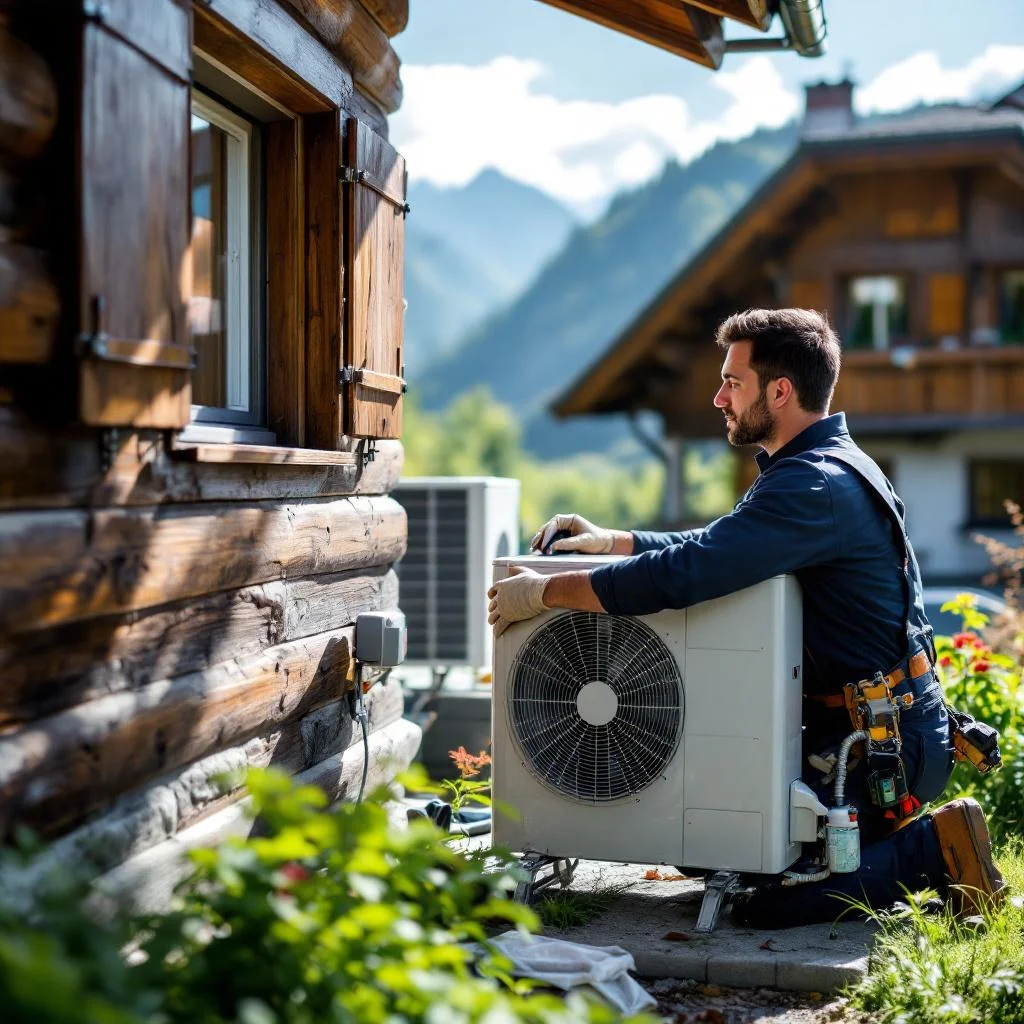
Are you looking for a heat pump in La Chaux-de-Fonds to replace an oil or gas boiler, or to heat a better-insulated building? In this town in the Neuchâtel Mountains, choosing a heat pump installation depends on the cold, the snow and the layout of the buildings far more than on the brand of the unit alone.
This page sets out the usual works, what the town changes in practice, the steps to plan for and how to compare quotes.
The most common heat pump works in La Chaux-de-Fonds
There are three families of unit: air-to-water, ground-to-water (with geothermal probes) and water-to-water. In La Chaux-de-Fonds, requests mostly concern replacing an existing heating system in buildings from the watchmaking era, often large rented apartment blocks, as well as detached houses on the outskirts.
Typical projects:
- replacing a building’s central boiler with a heat pump, with adaptation of the hot water production;
- installing an air-to-water heat pump in a house, with an outdoor unit and an indoor unit or tank;
- studying a ground-to-water solution where the plot allows drilling;
- adapting the distribution system: radiators, valves, controls, possibly underfloor heating;
- replacing an old heat pump that has reached the end of its life.
The watchmaking grid and large buildings
La Chaux-de-Fonds is known for its grid plan, listed as a UNESCO World Heritage site together with Le Locle. This regular layout lines up large rented apartment blocks, packed tightly against one another. For a heat pump, this density raises practical questions.
Where do you place an outdoor unit when the courtyard is narrow, the façade faces the street or the neighbours are a few metres away? An outdoor air-to-water heat pump must meet the noise values of the Noise Abatement Ordinance (OPB). In a dense neighbourhood, the distance to neighbouring windows, the orientation and the nature of the ground all matter. A unit placed in an echoing courtyard does not have the same effects as one installed in an open garden.
In houses and small homes in less cramped neighbourhoods, space is generally less limited: an outdoor unit can be considered at a distance from the plot boundaries, or even a geothermal probe if authorisation is granted.
Long, snowy winters: what changes
The climate of the Neuchâtel Mountains is cold and snowy, markedly harsher than that of the canton’s Littoral along the lake. Three practical consequences for your project.
Sizing. The output must be calculated for periods of severe cold, not for a mild average. An undersized unit compensates with a backup electric heater, which weighs on consumption. Ask how the professional established the building’s heat requirement.
The choice of unit type. An air-to-water heat pump draws its heat from the outside air, which here is precisely cold in winter. A ground-to-water solution benefits from a more stable source, but it is not permitted everywhere and requires drilling. The quote should explain why the proposed solution suits your building.
Snow and frost. The outdoor unit must stay clear: a location away from snowdrift areas, raised off the ground, and defrost water drainage that does not freeze on a walkway. These details are settled at installation, not after the first winter.
The building before the unit
A heat pump works better with moderate flow temperatures. In an older building with small radiators designed for very hot water, the installer will need to check whether the system is suitable or whether some radiators must be replaced. The building envelope (roof, windows, façades) also plays a part: insulation work and the heat pump should be thought through together. If you are also considering roofing in La Chaux-de-Fonds, it is useful to discuss it at the same time, as the condition of the envelope influences the output required.
If the building is covered by watchmaking heritage protection, work visible from the street, such as a façade unit or an opening cut through the wall, calls for particular attention. Ask the commune early.
Steps to take: permit, probes, subsidies and agreements
Building permit. An outdoor air-to-water heat pump may require a building permit depending on the commune. In Neuchâtel, building permit applications go through the cantonal SATAC office, with the decision taken by the commune. Check with the communal administration whether your project requires authorisation before ordering.
Geothermal probes. They require a cantonal authorisation linked to groundwater protection, and they are not permitted everywhere. Do not assume that drilling is possible on your plot: the answer comes from the competent cantonal department.
Subsidies. Aid may be available through the Buildings Programme and the cantonal subsidy programme, managed with the cantonal energy and environment department. Conditions change: check them before signing, as an application submitted too late may be refused.
Owner, landlord, co-ownership. If you are a tenant, a change of heating system is a matter for the owner. In co-ownership, the decision is taken according to the regulations and the owners’ meeting. Get this agreement in writing before requesting detailed quotes.
Preparing your request and comparing quotes
The more precise your description, the more comparable the quotes will be. State:
- the type of building (apartment block, house, terraced house) and its approximate year of construction;
- the current heating (oil, gas, electric, other) and the condition of the radiators or underfloor heating;
- the space available around the building and the distance to neighbours;
- access for equipment, the cellar or the technical room;
- whether a subsidy application is being considered.
A good quote details:
- the type of heat pump and its output, with the justification for the sizing;
- the associated works: removal of the old boiler, hydraulic and electrical connections, tank, controls;
- the steps taken care of (permit file, subsidy file) and those left to you;
- any masonry or drilling work;
- the maintenance and warranty terms offered.
The cost varies with the type of heat pump, the output required, whether drilling is needed, the condition of the existing heating system, access to the site and the extent of the associated works. This is why only a quote prepared for your building counts. Compare the content of each offer line by line, not just the total.
To launch your project, you can request a quote: describe your works, and your request is passed on to tradespeople and companies in the region, who will contact you for a free, no-obligation quote.
Useful pages around your project in La Chaux-de-Fonds
- The trade in general: heat pump
- The town: works in La Chaux-de-Fonds
- The canton: canton of Neuchâtel
- Other works in the same commune: roofing in La Chaux-de-Fonds, bathroom renovation in La Chaux-de-Fonds, air conditioning in La Chaux-de-Fonds
Updated 29 October 2026