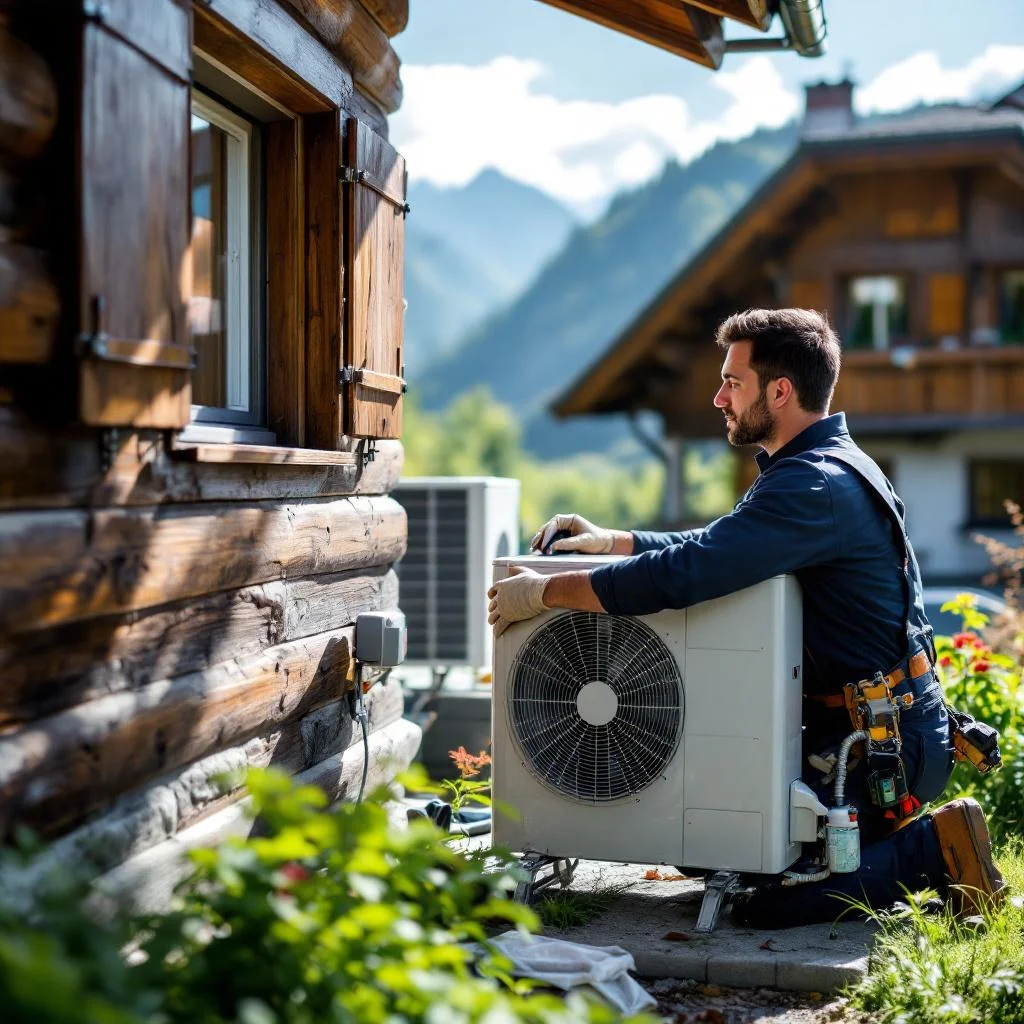
Replacing a boiler or heating a new build with a heat pump is a commitment for many years: the choice of system, its position and the permits are all settled before any ground is broken. Rules vary from one French-speaking canton to another, and sometimes from one municipality to another.
This page presents the main families of heat pumps, the points that change from canton to canton and how to prepare your request. To receive proposals from companies in your area, you can request a quote: it is free and without obligation.
Air-water, ground-water or water-water heat pump: three ways to draw heat
A heat pump does not create heat from nothing: it takes it from an outside source and delivers it to the building’s heating circuit. The source sets the three main families apart.
- Air-water: a unit draws heat from the outside air. It is placed outdoors, in the garden or against the facade, or indoors with ducting. It is the solution that requires the fewest earthworks.
- Ground-water: vertical geothermal probes, sunk by drilling, draw heat from the subsoil. The system requires a borehole, and therefore a cantonal permit linked to groundwater protection.
- Water-water: the heat comes from an underground water table or another body of water. It also requires a permit and a study of the site.
None of these solutions is the best in itself. The choice depends on the building, the land, the type of heat distribution (radiators or underfloor heating), the neighbours and what the canton allows on your plot.
The most common heat pump projects
In the region, requests cluster around a few situations:
- replacing an oil or gas boiler with a heat pump;
- equipping a new detached house or a full renovation;
- connecting to an existing system of radiators or underfloor heating, with adaptation of the distribution;
- installing a geothermal probe for a villa or a small apartment building;
- replacing an old heat pump at the end of its life;
- a collective project in a co-owned or rental building, with a decision by the owners’ meeting or the landlord’s agreement.
An installer does more than fit a machine. They size the installation, connect the plumbing and electrics, set up the system and explain how it works. The trade belongs to heating and building services, with vocational training of the CFC type (Federal Certificate of Proficiency) in this field; depending on the work, several trades are involved: heating engineer, electrician and sometimes a drilling company or a mason for the base of the outdoor unit.
When to call a professional
A heat pump is not a DIY job. It involves heat production, the hydraulic circuit, the electrical connection and, in some cases, a refrigerant. It is sensible to involve a professional as soon as you are considering:
- replacing your current heat generator;
- drilling the ground for a probe;
- placing an outdoor unit near a plot boundary;
- changing the heat distribution in the house.
Even if you are still undecided, an initial conversation with an installer helps you find out whether your building is suitable, what would need to be adapted and what steps lie ahead.
What Switzerland requires: noise, groundwater and permits
Three subjects come up in almost every heat pump project in French-speaking Switzerland.
The noise of an outdoor unit
An air-water heat pump placed outdoors must comply with the noise values of the Noise Abatement Ordinance (OPB). In a tight housing estate or a dense neighbourhood, the position makes the difference: distance from neighbours’ windows, orientation of the unit, and the presence of a wall or corner that reflects sound. Neighbours have a say if a permit procedure is opened, which is why it pays to plan ahead.
Groundwater and geothermal probes
A geothermal probe pierces the subsoil and may pass through layers that protect drinking water. It therefore requires a cantonal permit and is not allowed everywhere. The canton publishes maps or provides information on the areas where drilling is possible, restricted or excluded. Before setting your heart on a probe, have the situation of your plot checked.
The building permit
An outdoor air-water heat pump may require a building permit, depending on the municipality. What is straightforward in one place may be subject to public notice in another. Always check with the municipality or the competent cantonal department before ordering.
Heat pumps in Geneva, Vaud, Valais, Fribourg, Neuchâtel, Jura and Biel/Bienne: what changes
Each canton has its own procedure and its own subsidy programme. Here are the useful points of reference to place your project.
Geneva. Building permits are issued by the canton, through the Office des autorisations de construire. Energy falls under the cantonal energy law (LEn) and the cantonal energy office (OCEN), on which the Buildings Programme subsidies in Geneva depend. Many rental buildings are managed by property agents (régies): if you are a tenant, the project goes through the landlord. The old town and protected districts add heritage constraints. See the page for the canton of Geneva.
Vaud. The building permit is issued by the municipality; the file goes through the cantonal permit centre (CAMAC) when cantonal departments need to give an opinion. Energy depends on the Vaud energy law and the cantonal energy directorate, which runs a subsidy programme. The old towns and the Lavaux vineyards, a World Heritage site, call for particular attention. See the page for the canton of Vaud.
Valais. The building permit is issued by the municipality within the building zone, and by a cantonal commission outside it. The cantonal energy and hydropower department runs the subsidy programme. Chalets and second homes, subject to the federal law on second homes in the municipalities concerned, are common. See the page for the canton of Valais.
Fribourg. Building permit applications are filed through the cantonal platform FRIAC; the permit is issued by the prefecture or the municipality depending on the type of work. The cantonal energy department offers a subsidy programme. The canton is bilingual and has protected old towns. See the page for the canton of Fribourg.
Neuchâtel. Applications go through the cantonal one-stop shop SATAC, and the decision rests with the municipality. The cantonal energy and environment department runs the subsidy programme. The watchmaking heritage of La Chaux-de-Fonds and Le Locle, a UNESCO site, is a setting to take into account. See the page for the canton of Neuchâtel.
Jura. The building permit is issued by the municipality or by the canton depending on the scale of the project. The cantonal energy section runs the subsidy programme. Delémont, Porrentruy and Saint-Ursanne have old towns that call for care. See the page for the canton of Jura.
Biel/Bienne and the canton of Bern. The permit is issued by the municipality or the prefecture depending on the project. The cantonal office for the environment and energy runs the Bernese subsidy programme. Biel/Bienne is officially bilingual, French and German: your contacts will be able to speak either language. See the page for the canton of Bern.
Space, neighbours, altitude: what guides the choice of heat pump
Four factors often weigh more than the make of the machine.
- Space around the villa. An outdoor unit needs a clear position with access for maintenance. A probe needs access for a drilling rig and distance from boundaries and other structures.
- Apartment buildings. In co-ownership or rental buildings, the decision involves several people: the owners’ meeting, the property agent or the landlord. The plant room, hot water production and the existing distribution all weigh on the project.
- Dense neighbourhoods. When houses are close together, the noise of an outdoor unit becomes the first issue, and a probe, which is silent, may seem more suitable if the subsoil allows it.
- Altitude. In resorts and mountain villages, winter is longer and colder than by the lake. Sizing must take this into account, and the feasibility of a probe or an outdoor unit is something to discuss with the installer.
Preparing your heat pump quote request
The more precise your description, the more comparable the proposals will be. If possible, gather:
- the type of building (detached house, apartment building, co-ownership) and its approximate year of construction;
- the current heating system and its condition;
- the heat distribution: radiators or underfloor heating;
- photos of the boiler room and of the outdoor space under consideration;
- your status: owner, co-owner, tenant with the landlord’s agreement, or company;
- your preferences on the heat source, or your openness to several options;
- any known constraints: protected zone, neighbours, difficult access.
To get started, requesting a quote takes a few minutes. Your request is passed on to tradespeople and companies in the region, who will contact you to prepare a free quote without obligation.
What a reliable heat pump quote details
A useful quote is more than a single total line. Look for:
- the type of heat pump proposed and its principle (air-water, ground-water or water-water);
- removal of the old system and disposal, if planned;
- the hydraulic and electrical connections;
- ancillary work: base, drilling, trenches, adaptation of the plant room;
- domestic hot water production and the tank, if any;
- adjustment, commissioning and an explanation of how it works;
- the formalities handled for you (permit file, subsidy application) and those left to you;
- what is not included;
- the warranty and payment terms.
Compare quotes item by item rather than by the total: two offers that seem far apart sometimes do not cover the same scope.
What makes the cost of a heat pump vary
No serious price can be given without seeing the building. The cost depends mainly on:
- the heat source: drilling a probe is nothing like placing a unit outdoors;
- the power required, linked to the size and insulation of the building;
- the condition of the heat distribution, which may need adaptations;
- site access and how difficult the land is;
- the formalities and studies required by the canton or the municipality;
- ancillary work (plant room, electrics, removal of the old boiler);
- any cantonal support, which reduces the final burden but depends on conditions to be checked before work begins.
Only a quote prepared after an inspection of the building gives a reliable amount.
Subsidies: apply before you start
The French-speaking cantons offer support through their subsidy programmes, including the Buildings Programme. Conditions vary by canton and change over time. As a rule, the application must be filed before work begins: an order placed too early can forfeit the right to support. Contact the energy department of your canton, or ask the installer whether they handle the file.
Legal warranties after the work
The Code of Obligations (CO) governs the warranty for defects in the work. Art. 371 CO provides for 5 years for work on immovable property and 2 years for movable work. A heat pump integrated into the building (probe, fixed installation) is more readily treated as work on immovable property; this point is settled in the contract. If the contract refers to the SIA 118 standard (the Swiss Society of Engineers and Architects’ standard for construction contracts), it applies. In every case, report a defect in writing as soon as you notice it, and keep the contract, the quote and the invoices.
Heat pumps near you: city pages
Find the page dedicated to the trade in your municipality or urban area:
- heat pump in Geneva, in Carouge, in Lancy, in Vernier
- heat pump in Lausanne, in Nyon, in Morges, in Vevey, in Montreux, in Yverdon-les-Bains
- heat pump in Sion, in Martigny, in Monthey, in Sierre
- heat pump in Fribourg, in Bulle
- heat pump in Neuchâtel, in La Chaux-de-Fonds
- heat pump in Delémont
- heat pump in Biel/Bienne
Is your project elsewhere? See the page for your canton: Geneva, Vaud, Valais, Fribourg, Neuchâtel, Jura or Bern. When your description is ready, request your quote.
Updated 29 October 2026