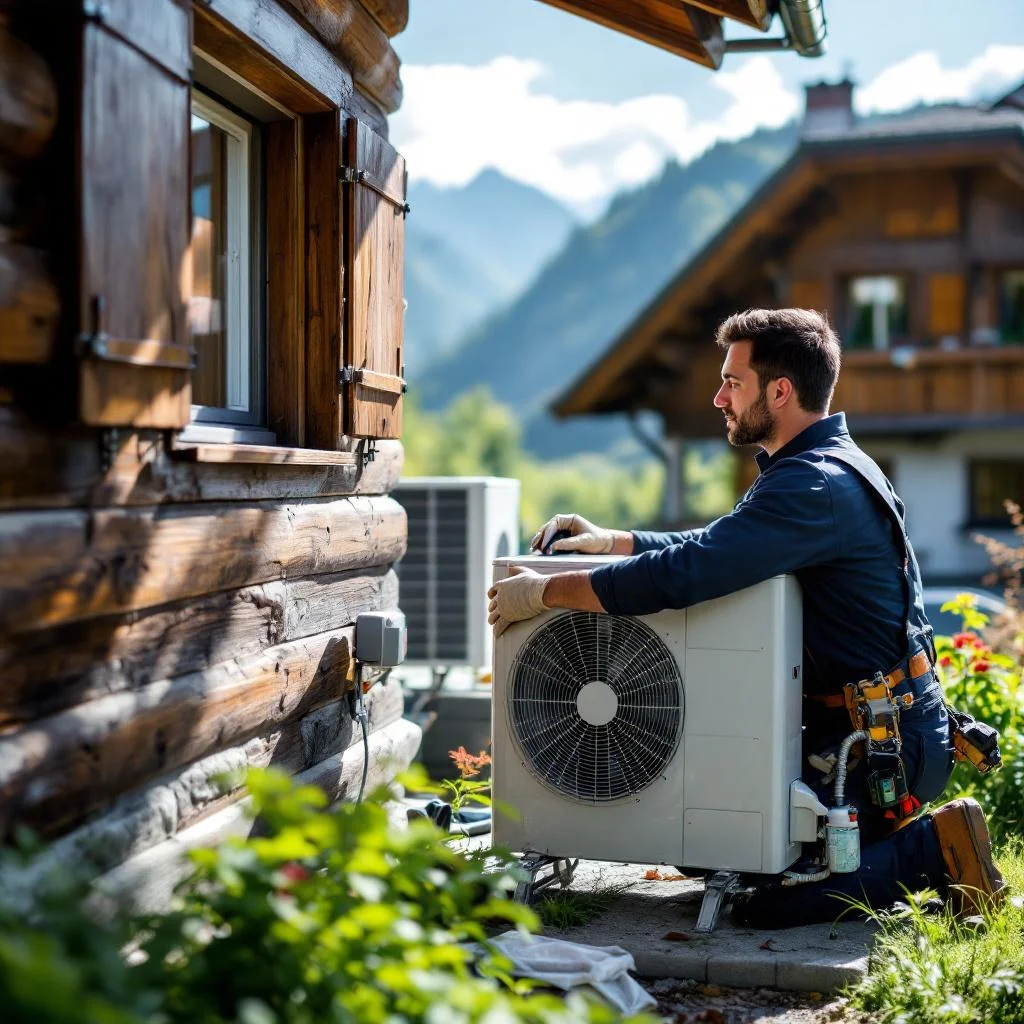
Are you looking for a heat pump in Yverdon-les-Bains to replace a boiler or to heat a new build? The second-largest town in the canton of Vaud, at the end of Lake Neuchâtel, combines a tight old centre with more open districts: the same appliance cannot be installed the same way on both sides. This page explains what the location changes for a heat pump heating installation, and how to approach a quote request.
Which system to choose for your building in Yverdon-les-Bains
There are three families of heat pump. The most common is the air-to-water pump, whose outdoor unit draws heat from the air. The ground-to-water pump takes heat from the ground through one or more geothermal probes. The water-to-water pump uses an underground body of water.
The choice depends first on what you have around the house or building. With an accessible garden, a probe is possible, but it requires drilling and a permit. With a narrow plot or an inner courtyard, air-to-water often becomes the only realistic option.
In Yverdon-les-Bains, these situations exist side by side. A villa surrounded by greenery has room for an outdoor unit at a good distance from the neighbours, and even for a borehole. A rental building or a terraced house near the centre leaves much less room for manoeuvre.
Yverdon-les-Bains buildings seen by a heat pump installer
The town is known for its castle, its old town, its thermal centre and its engineering university (HEIG-VD). For a heating project, what matters is the diversity of the building stock that results.
Houses and villas
Owners of detached houses most often replace an oil or gas boiler. The job goes beyond simply fitting the machine: you need to check whether the existing radiators suit water that is cooler than that of an old boiler, which depends on the building’s insulation and the size of the radiators. In a poorly insulated house, the installer may advise dealing with the building envelope first, for example the roof, before sizing the appliance.
Apartment buildings and co-ownerships
In an apartment building, the heat pump replaces a central boiler room. The decision is taken at the co-owners’ meeting or by the building’s owner, and tenants are affected through rents and service charges, not through the choice of technology. The plant room, the routing of the pipework and the position of the outdoor unit are settled before the order is placed.
Old centre and surroundings of the castle
Around the castle and the old town, a building may be protected or located in an area where outward appearance is monitored. A unit fitted on a façade or a visible roof may then raise questions. In this area, ask the commune whether a constraint of this kind applies to your address before choosing a model.
Commercial buildings and small businesses
The presence of a university, a thermal centre and many shops also means business premises, with heat needs that differ from those of a home: large quantities of hot water, irregular occupancy hours. If you manage business premises, mention it in your request.
Noise, neighbours and available space near Lake Neuchâtel
The town’s climate, on the shore of Lake Neuchâtel, is not that of a mountain resort. That does not remove the need to ask about winter performance: ask the installer to explain how the appliance behaves on the coldest days, and whether a backup heating element is included.
The real point of vigilance for an air-to-water pump in an urban setting is noise. The outdoor unit must meet the values of the Noise Protection Ordinance (OPB). The closer the houses, the more the position matters: avoid a wall corner that reflects sound, and keep away from bedroom windows, including the neighbour’s.
If outdoor space is lacking, the installer may suggest an indoor unit with air ducts, or another solution. Each variant has a price and constraints that they must set out for you.
Permits and procedures in Yverdon-les-Bains
In the canton of Vaud, the building permit is issued by the municipality. The file goes through the cantonal permit centre (CAMAC) when cantonal departments need to give an opinion. What requires a permit depends on the project, and it is the commune that decides.
- Outdoor air-to-water pump: it may require a building permit depending on the commune, and it must comply with the OPB. Contact the municipality to find out whether your case is concerned.
- Geothermal probe: it requires a cantonal permit for the protection of groundwater, and is not allowed everywhere. The installer cannot promise it before the authority has ruled.
- Subsidies: they go through cantonal programmes, including the Buildings Programme. Energy matters in the canton fall under the Vaud energy law and the cantonal energy department. Check the conditions and the right time to file the application with them.
- Landlord’s or co-ownership’s agreement: essential if you are not the sole owner of the heating system.
Do not rely on a rule heard second-hand: confirm each point with the commune or the relevant cantonal department.
Preparing your request and comparing quotes
The more precise your description, the more comparable the quotes will be. State:
- the type of building (detached house, terraced house, apartment building, business premises) and its approximate age;
- the current heating system and the location of the boiler room;
- the space available outside, the distance to the neighbours and the access for a lorry or a drilling machine;
- the state of the insulation and the radiators, if you know it;
- your status: owner, co-owner, tenant with the landlord’s agreement still to be requested.
A serious quote details the type of pump and its output, the sizing, the removal of the old installation, the hydraulic and electrical connection, the commissioning and the administrative procedures that are handled. It also specifies the position of the outdoor unit and what is charged extra if conditions change on site.
The cost varies with the type of pump (a probe involves drilling), the state of the distribution system, the difficulty of access, the output required and the subsidies you obtain. That is why no figure can replace a quote: ask for several and compare line by line, not just the total.
To get started, you can request a quote: describe your building and your constraints, and your request is passed on to tradespeople and companies in the region, who will contact you for a free, no-obligation quote.
Useful pages for your project in Yverdon-les-Bains
- The trade in general: heat pump
- All the work in the town: works in Yverdon-les-Bains
- The cantonal framework: canton of Vaud
- Other work in the same commune: roofing in Yverdon-les-Bains, bathroom renovation in Yverdon-les-Bains and air conditioning in Yverdon-les-Bains
Updated 29 October 2026