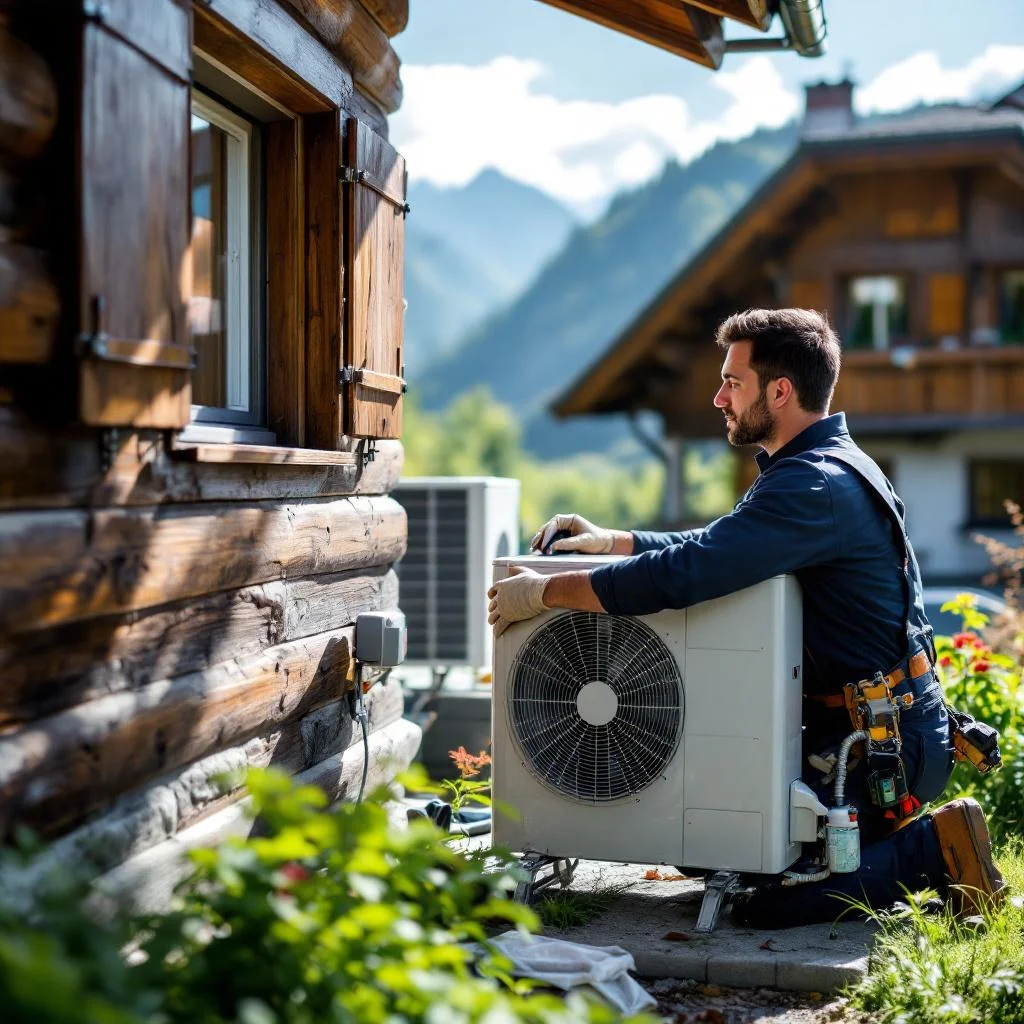
Are you looking for a heating engineer in Bulle to replace a boiler, install a heat pump or restore a radiator system? As the main town of the Gruyère, Bulle is growing and its building stock is becoming more varied: older apartment blocks, houses, recent construction. A heating installer therefore does not approach any two jobs in the same way.
This page helps you place your project, find out what to check with the canton and prepare a clear quote request.
The most common heating work in Bulle
In a fast-growing town, heating engineers work on buildings of very different ages. Requests generally fall into a few main cases:
- Boiler replacement: an oil or gas boiler at the end of its life, in a house or an older apartment block.
- Switching to a heat pump, which means looking at the insulation, the heat emitters and the space available for the outdoor unit. A project of this kind has its own page: heat pump in Bulle.
- Wood heating (stove, log or pellet boiler), common in a region close to the Pre-Alps, with its storage and flue requirements.
- Radiators and underfloor heating: replacing radiators, balancing the system, fitting underfloor heating during a renovation or in a new build.
- Controls: sensors, thermostats and programming, which avoid heating for nothing when the home is empty.
- Maintenance and inspection of the existing installation, within the framework set by the canton for chimney sweeping and boiler checks.
In a recent neighbourhood, the job often consists of adapting or optimising an installation that is already modern. In an older building, you first have to understand what is there: pipework, circulation pumps, the location of the boiler room, the chimney.
Winters at the foot of the Pre-Alps: what it changes for your installation
Bulle lies at the foot of the Pre-Alps, and the Gruyère sees snow in winter. For a heating engineer, this context affects several practical choices.
First, output: an installation must be sized according to the building’s real needs in the cold season, not according to habit. An oversized boiler costs more to buy and runs poorly in mild weather; an undersized one struggles during prolonged cold spells. Sizing is done on site, with the condition of the building envelope in mind.
Next, the heat pump. Its efficiency depends on the flow temperature of the circuit and on the insulation. A serious heating engineer will therefore look at your radiators or underfloor heating before proposing a machine. If the insulation is poor, it may be worth considering work on the building envelope first: see also thermal insulation in Bulle.
Finally, access. An outdoor unit, a tank, a pellet silo or an exposed chimney must remain reachable when snow builds up. State in your request where the boiler room is and how to get to it.
Around the castle and the Musée gruérien: heating an old building without damaging it
Bulle is known for its castle and the Musée gruérien. If your home is in an older building in the centre, the question is no longer only about the boiler: thick walls, irregular volumes, and sometimes little room to run pipes. The canton of Fribourg has protected old towns; if your building is in a protected area or has heritage features, check with the municipality what is possible before any visible change, for example a chimney outlet or an outdoor unit on the façade.
In this kind of building, a heating engineer will sometimes suggest a discreet solution: suitable heat emitters, pipes routed through existing ducts, a unit placed at the rear. Describe the building precisely in your request, including its type and period of construction if you know it.
District heating or an individual installation?
In a town, a connection to district heating can be an option, but its availability depends on where your building is in relation to the network. No general rule can confirm it for a given address: ask the municipality or the local network operator. If this connection is not possible, you will compare individual installations (heat pump, wood, gas depending on what the law allows).
House, rental building, co-ownership: who decides?
In Bulle as elsewhere, the heating belongs to the building, and who decides depends on your situation.
- House owner: you decide, in compliance with the cantonal energy law and municipal rules.
- Co-ownership: replacing a shared heating system is decided at a meeting, according to the association’s regulations. Allow time to gather offers and decisions.
- Tenant: you cannot undertake work on the installation without the landlord’s written agreement. If the heating is broken or inadequate, report it to the property manager first.
- Small business: the agreement of the owner of the premises is still required if you do not own them.
Permits and subsidies: what to check in the canton of Fribourg
Replacing a fossil-fuel heating system is governed by the cantonal energy law, which may require or restrict it. Before choosing a new oil or gas boiler, ask the cantonal energy office what applies to your building: it is the one that can answer, not an information website.
For permits, building permit applications are submitted through the cantonal FRIAC platform. The permit is issued by the prefecture or by the municipality, depending on the type of work. Not every heating replacement requires a permit, but a new installation or a change of energy source may need one: ask the municipality of Bulle before placing an order.
The canton offers a subsidy programme. Its conditions, amounts and timetable are set by the cantonal energy office: consult them before signing, because aid is generally requested before work begins. Your heating engineer often knows the procedure, but the decision rests with the canton.
Chimney sweeping and boiler checks are also regulated by the canton. After an installation, ask the company which inspection formalities apply.
Preparing your heating engineer request in Bulle and comparing quotes
The more precise your description, the more comparable the quotes will be. State:
- the type of building (house, apartment block, business premises), its approximate age and its heated area;
- the current heating: energy source, age, location, known condition;
- the type of distribution: radiators, underfloor heating, or both;
- your goal: simple replacement, change of energy source, adding controls;
- access constraints (narrow staircase, low cellar, winter access);
- your status: owner, co-owner or tenant, with the agreement obtained or still to be requested.
A good quote details the equipment (make and model), removal and disposal of the old installation, hydraulic and electrical connections, controls, commissioning and what is included for the formalities. It also states what is not included: masonry work, chimney adaptation, electrical panel work.
The cost varies according to the energy source chosen, the output, the condition of the existing installation, ancillary work, site access and any aid. No amount can be given seriously without a visit: it is the quote that sets the price of your project. Compare at least two offers line by line rather than just the total.
When your description is ready, you can request a quote. Your request is passed on to tradespeople and companies in the region, who contact you to prepare a free, no-obligation quote.
To complete your project in Bulle
- The trade in general: heating engineer
- The town: work in Bulle
- The canton: canton of Fribourg
- In the same municipality: heat pump in Bulle, kitchen renovation in Bulle, thermal insulation in Bulle
Updated 29 October 2026