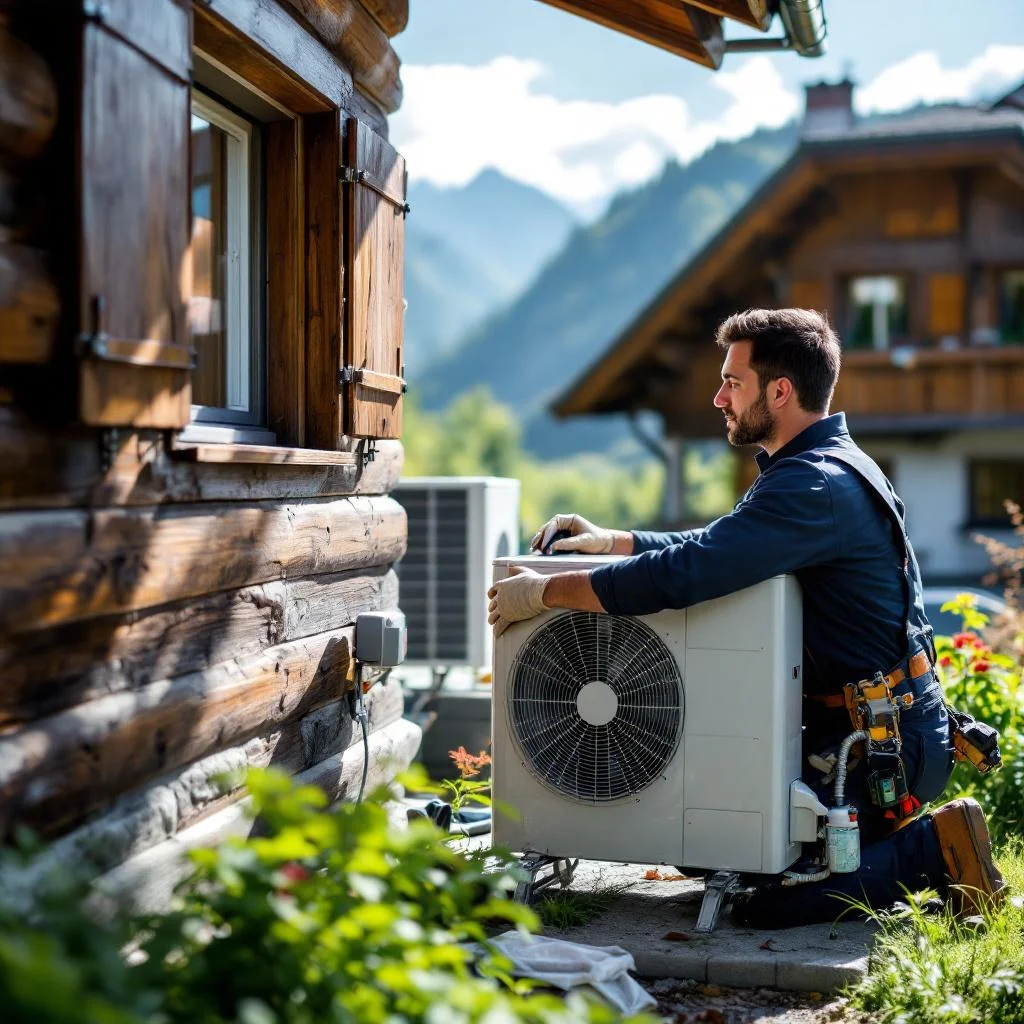
Looking for air conditioning in Bulle usually means wanting to cool a home, office or shop that overheats in summer, or choosing a reversible heat pump able to heat in winter and cool in summer. Installing an air conditioner in Bulle is nothing like a supermarket purchase, though: the location, the noise, co-ownership rules and any permit count as much as the appliance.
This page helps you prepare your project so that the quotes you receive can be compared with one another.
What air conditioning work in Bulle, depending on the building?
Bulle is the main town of the Gruyère region, a fast-growing town at the foot of the Prealps. This growth shows in the buildings: recent apartment blocks, villa districts and, around the castle and the Musée gruérien, an older fabric. Each type of home calls for a different solution.
- The wall-mounted split: an indoor unit fixed to the wall, connected to an outdoor unit. This is the usual solution for cooling one or two rooms, for example a living room under the roof or a bedroom facing south.
- The multisplit: a single outdoor unit feeds several indoor units. Handy in a villa or a large flat, it avoids multiplying appliances on the facade.
- The reversible heat pump: it heats in winter and cools in summer. It mainly concerns owners who are replacing a heating system or renovating, and is discussed with a heating engineer, see heating engineer in Bulle.
- Air conditioning for business premises: shop, practice, workshop, small office. Usage constraints (opening hours, noise for customers) weigh more heavily on the choice.
In a rented building or in condominium ownership, the question of the facade comes before the technical question. In a villa, you decide the location yourself, but you remain subject to the noise rules and, depending on the case, to a permit.
Summer heat and Gruyère winters: what Bulle changes for an installation
Air conditioning is readily associated with lakesides, the Rhône plain or dense urban centres, where heat builds up. Bulle, at the foot of the Prealps, is not quite in that situation, but hot summers also affect poorly protected homes: badly insulated attics, large south-facing windows, through-flats with no draught. It is the exposure of the home, more than the town, that decides whether a machine is needed.
In winter, the Gruyère gets snow. For an outdoor unit, this has very concrete consequences:
- the appliance must be mounted high enough not to disappear under accumulated snow;
- avoid any spot where snow or ice falls from the roof;
- if you plan to use the heat pump in heating mode, ask the installer how the appliance behaves in cold weather and how defrost water is drained, as it can freeze on a terrace or access path.
These points are settled at fitting, but they must appear in the quote rather than be discovered in the first winter.
Alternatives to air conditioning: sun protection and insulation
Before installing a machine, look at what heats the home. A large share of the heat comes in from the sun, through the glazing and the roof. External blinds, shutters, a film on the windows or better insulation under the roof can reduce the need, sometimes enough to do without air conditioning, sometimes to choose a smaller appliance.
A serious installer will ask about exposure, glazing and insulation. If they do not, ask yourself: it changes the sizing, and therefore the price. If the project also aims to generate your own electricity, see also solar panels in Bulle, since cooling needs fall in the middle of the sunny season.
Permit, noise and landlord’s consent: the rules in Bulle
Three questions arise before any order.
Permit and cantonal energy law
In Switzerland, installing air conditioning may require a permit or a justification, depending on the cantonal energy law. In the canton of Fribourg, building permit applications are filed through the cantonal FRIAC platform, and the permit is issued by the prefecture or by the commune depending on the type of work. For energy, the competent cantonal body is the energy office. Do not presume the answer: ask the commune of Bulle, or this office, whether your specific project is concerned, and keep the confirmation.
If your building lies within a protected perimeter or near a historic building, mention it. The canton has protected old towns, and fitting an outdoor unit on a visible facade may be treated differently there. The commune will tell you whether your street is concerned.
Noise from the outdoor unit
The outdoor unit must comply with the limits of the Noise Abatement Ordinance (OPB). In practice, avoid placing it against a neighbour’s bedroom window, in a narrow courtyard that reflects sound, or under a balcony. The installer should be able to justify the choice of appliance and its location.
Co-ownership and renting
In a building, the consent of the co-owners or the landlord is required. In condominium ownership, the facade and roof are often common parts: the outdoor unit may require a decision of the owners’ meeting. As a tenant, send the landlord a written request stating the type of appliance, its location and the installer you have in mind.
Preparing your request and comparing quotes
The more precise your request, the more comparable the quotes. Describe:
- The rooms to cool: number, use, exposure, presence of an attic or large windows.
- Your status: villa owner, co-owner, tenant (with the landlord’s consent), operator of business premises.
- Whether you also want heating or only cooling.
- The possible location of the outdoor unit: facade, balcony, flat roof, garden, with a photo if possible.
- Known constraints: protected building, co-ownership rules, close neighbours.
A good quote details: the make and model, the number of indoor and outdoor units, the routing of the refrigerant lines and condensate drainage, the electrical connection, commissioning, removal of the old equipment where applicable, and the maintenance terms. Be wary of a single “supply and installation” line with no breakdown.
The cost depends mainly on the power required, the number of units, the length and difficulty of the pipe routing, access for the outdoor unit, electrical work and any administrative procedures. No serious figure can be given without a visit: compare several quotes drawn up on the same description. You can start your project online to request a quote, free and without obligation.
If a wider renovation is planned (floors, partitions, kitchen), have the work coordinated: running ducts can affect finishes, see tiling in Bulle.
Useful pages for your project in Bulle
- air conditioning: the general page for the trade;
- work in Bulle: the town page;
- canton of Fribourg: the canton and its rules;
- solar panels in Bulle, heating engineer in Bulle and tiling in Bulle: other work in the commune.
Updated 29 October 2026