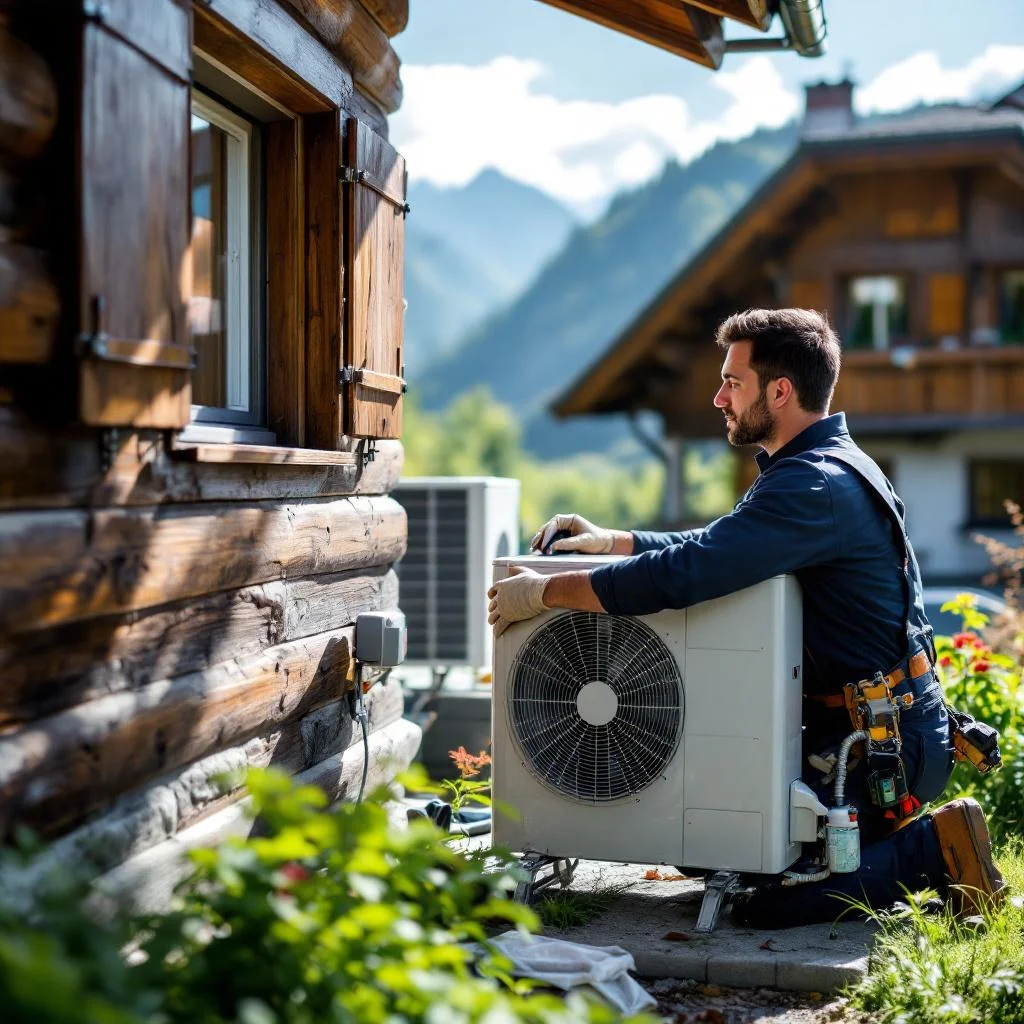
Are you looking for a heating engineer in Neuchâtel to replace a boiler, install a heat pump or rework a radiator network? Between the lake, the old town and the districts rising towards Chaumont, situations differ greatly from one building to the next. Describe your project on the site: your request is passed on to craftspeople and companies in the region, who will get back to you with a free, no-obligation quote.
Heating in Neuchâtel: the most common jobs
Neuchâtel is the capital of the canton, on the lakeshore, with a university and a varied building stock: rental blocks in town, houses on the slopes, old buildings in the centre. Requests to a heating engineer fall into a few families.
- Replacement of an oil or gas boiler at the end of its life, with a choice of what comes next: a new boiler, wood, a heat pump, or a connection to a heating network if there is one near you.
- Heat pump installation, often tied to a wider renovation; the subject is covered in more detail on the heat pump in Neuchâtel page.
- Maintenance and repairs: bleeding, replacing a circulator, an expansion vessel, a valve or a sensor.
- Radiators and underfloor heating: replacing heating units, adding a circuit in a converted room, adapting emitters to a new heat source.
- Controls: outdoor sensor, thermostats, heating curve settings, balancing of circuits.
Lakeside, Chaumont slopes: what the terrain changes for your installation
The canton combines two atmospheres: a mild shoreline along the lake and the cold, snowy Neuchâtel Mountains. Neuchâtel belongs to the shoreline, but the municipality stretches from the lake up towards the heights of Chaumont, and the need for heating is not the same at the bottom and at the top. A house exposed at altitude, on an open slope, does not have the same needs as a sheltered flat in the town centre. The sizing of an installation must therefore start from your actual building, its insulation and its exposure, not from an average.
The slopes also have a very practical consequence: access. Delivering a boiler, a buffer tank or a cylinder to a cellar below a narrow lane, or placing an outdoor unit on terraced ground, needs planning. In your request, mention access to the plant room, the presence of stairs or a lift, and the space available for manoeuvring.
If you are considering a heat pump, the position of the outdoor unit, close neighbours in dense districts and the question of noise are part of the thinking from the start, as is the insulation of the building: see the thermal insulation in Neuchâtel page if your building envelope is old.
Yellow stone façades and the collegiate church: heating an old building
The old town is recognisable by its yellow stone façades, its castle and its collegiate church. In this type of building, thick walls, vaulted cellars and narrow stairwells make it harder to run new pipes. A centralised boiler room often sits alongside partial solutions, and every opening must be thought through so as not to damage the stone.
If your building is protected or located in a sensitive area, what is visible from outside (chimney, façade outlet, outdoor unit) may be restricted. These are points to clarify with the municipality before choosing a technique. A heating engineer experienced with older buildings will also be able to tell you whether your current radiators can work with another heat source or must be replaced.
Merged districts: Corcelles-Cormondrèche, Peseux, Valangin
Since 2021, the municipality of Neuchâtel has also included Corcelles-Cormondrèche, Peseux and Valangin, which merged with it. One territory now brings together town-centre buildings, village houses and villas on the outskirts. Depending on where your property is, the starting installation differs: an individual boiler in a villa, a shared boiler room in a block, an old stove or wood heating in a village house. Specify the district or former village in your request: it helps the company picture the access and the type of installation in place.
Procedures: energy, permit and owner’s agreement
Energy law. Replacing a fossil-fuel heating system is governed by the cantonal energy law, which may require or restrict it depending on the canton. In Neuchâtel, the cantonal energy and environment service is the contact to consult before choosing a new heat generator. Do not rely on a rule heard elsewhere: confirm it with the service, as it may change.
Building permit. Some installations may require an authorisation application. Applications go through the cantonal SATAC one-stop shop, with the decision remaining with the municipality. Ask the municipality whether your project (new flue outlet, outdoor unit, probes, change of energy source) is affected.
Chimney sweeping and inspection. Chimney sweeping and boiler inspection are regulated by the canton. Find out which deadlines apply to you and keep the reports: they also serve as a starting point for judging the condition of the installation before a replacement.
Subsidies. A cantonal subsidy programme exists, attached to the cantonal energy and environment service. Check the conditions before signing the quote: support is sometimes subject to an application filed before work begins.
Tenant or co-owner. The heating is part of the building. A tenant needs the landlord’s agreement; in co-ownership, a change to a collective system goes through a decision of the co-owners’ community. Secure this agreement before launching the consultation of companies.
Describing your heating to get comparable quotes
The more precise your description, the more comparable the quotes. Please state:
- the address or district, the type of building (block, villa, village house, old town) and the approximate year of construction;
- the current energy source (oil, gas, wood, electricity, district heating if your street has it) and the age of the boiler;
- the type of emitters: radiators, underfloor heating, or a mix;
- the heated surface area and the state of the insulation, even roughly;
- access to the plant room, constraints of the cellar or the plot;
- whether your building is protected, and whether you have already contacted the municipality;
- what you want: replace like for like, switch to another energy source, add a circuit.
A good quote details the removal of the old installation, disposal (tank, cistern, waste), the new heat production, connections, controls, commissioning and making good of the premises. Also note what is excluded: masonry, electrical work, painting, administrative procedures. The cost depends mainly on the chosen technique, the size of the home, the condition of the emitters and pipes, access and ancillary work. Only a quote drawn up on site gives you a reliable figure: requesting a quote takes a few minutes, with no obligation.
Compare at least two offers on the same scope, and ask about anything unclear before signing. A written guarantee on the equipment and on the installation, as well as a schedule of work, are points to request in black and white.
Useful pages for your project in Neuchâtel
- The trade in general: heating engineer
- All the work in the city: works in Neuchâtel
- The cantonal context: canton of Neuchâtel
- Another possible heating system: heat pump in Neuchâtel
- Reducing heat needs: thermal insulation in Neuchâtel
- A parallel project: kitchen renovation in Neuchâtel
Updated 29 October 2026