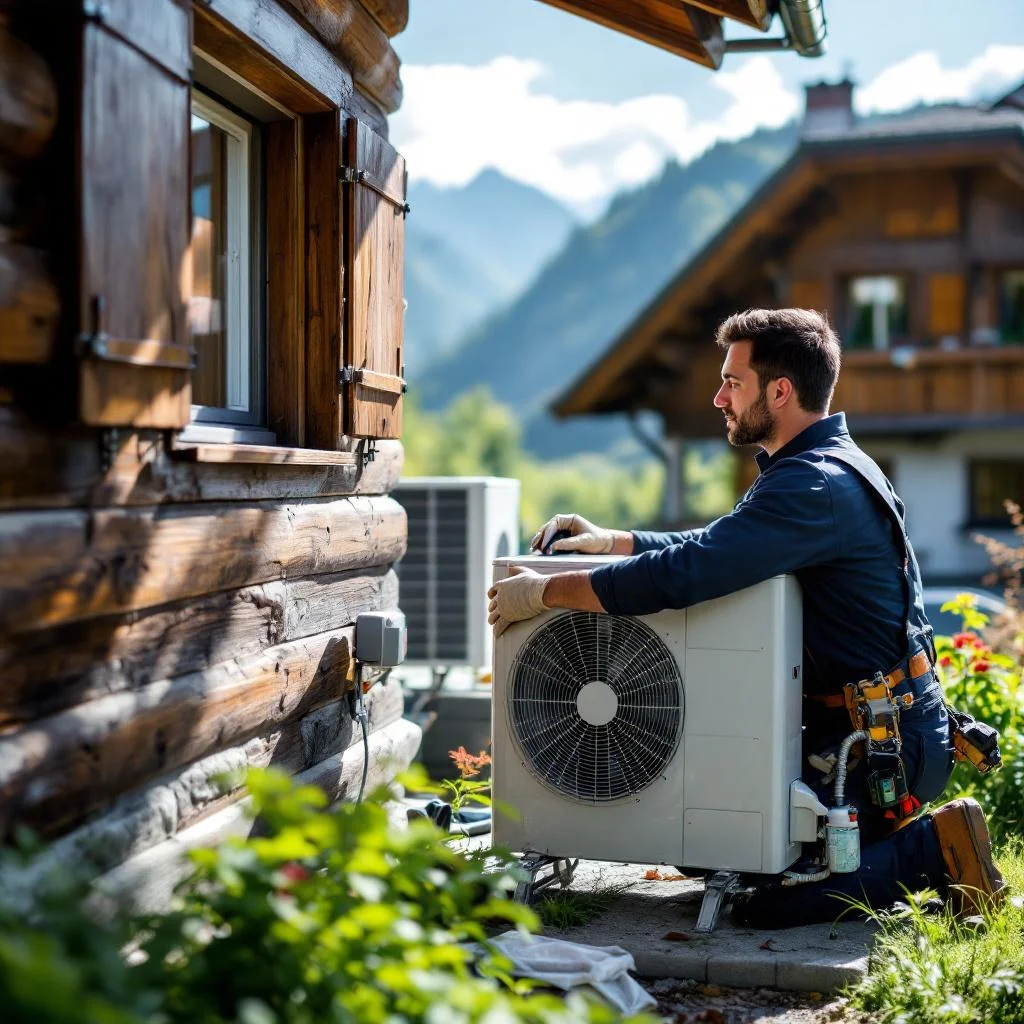
Looking for air conditioning in Neuchâtel? Between the lakeside, the old town of yellow stone and the districts climbing towards Chaumont, situations vary greatly from one home to another. Installing a cooling system means first choosing the right appliance, then knowing where to put it and what to ask before drilling into a wall.
The most common air conditioning installations in Neuchâtel
The fixed split unit remains the most widespread solution: an indoor wall unit, an outdoor unit, and a refrigerant connection between the two. It suits one room or a few rooms. For a whole home, you would rather look at a multi-split system, or a reversible heat pump that cools in summer and heats in winter.
In Neuchâtel, the cantonal capital set on the lake and at the foot of Chaumont, requests mostly come from specific situations:
- an attic apartment in a town building, where heat builds up in summer;
- an office or a practice, for example near the university, where workstations and screens heat the premises;
- a villa where one room, often the living room or a south-facing bedroom, becomes unbearable during heatwaves;
- a business or commercial premises in the town centre.
The communes of Corcelles-Cormondrèche, Peseux and Valangin joined Neuchâtel in 2021: the municipal territory now covers villa districts, old village centres and more recent buildings. The same trade is therefore practised in very different ways there.
Lakeside, old town, slopes: what Neuchâtel changes for air conditioning
Neuchâtel enjoys the mild climate of the Littoral, on the lake. The canton also includes the cold, snowy Neuchâtel Mountains, but that is not the situation of a home down by the lake: here, the issue is summer comfort rather than cold. The lake tempers the climate, but does not stop rooms poorly protected from the sun from overheating.
The old town. Its yellow stone facades, its castle and its collegiate church make it a sensitive ensemble. Fitting an outdoor unit on a facade visible from the street, or drilling through dressed stone for pipework, is not a trivial matter. Before any project in an old or protected building, ask the commune what is possible: a discreet location, inner courtyard, roof or balcony may be considered, but the decision is not yours alone.
Town buildings. Narrow courtyards and closely spaced facades create a noise problem: the outdoor unit can echo between two walls and disturb neighbours. The choice of location weighs as much as the choice of appliance.
Sloping districts and villas. On the heights, the outdoor unit is easier to place on the ground, in a garden or on a terrace. You must still plan for access to bring in the equipment and for condensate drainage, which is handled differently on sloping ground.
The old villages of Corcelles-Cormondrèche, Peseux and Valangin. Their old centres call for the same precautions as the old town: a discreet outdoor unit and a check of municipal rules.
Permits, noise and co-owners’ consent
Several rules overlap, and none can be guessed: they need to be checked.
- Authorisation or justification. In Switzerland, air conditioning may require authorisation or a justification under the cantonal energy law. In Neuchâtel, the cantonal energy and environment service is the contact for the energy side.
- Building permit. Applications go through the cantonal SATAC one-stop office; the decision is made by the commune. Depending on where the outdoor unit goes, notably on a facade or in a sensitive area, an application may be needed. Ask the commune before ordering.
- Noise. The outdoor unit must comply with the OPB (Noise Abatement Ordinance) limits. A reliable installer tells you where they plan to put it and why.
- Landlord or co-ownership. As a tenant, you need the landlord’s consent. As an apartment owner, you need that of the co-ownership, because the facade and common parts are not yours alone. Get these consents in writing.
If you are also changing your heating, the canton has a cantonal energy subsidy programme. Check before work starts: aid generally has to be requested before, not after.
Cooling in other ways, or as a complement
Air conditioning is not always the first answer. External blinds or shutters, night-time ventilation, glazing better protected from the sun or a better-insulated roof reduce heat at the source. In a very exposed home, these measures can lower the power needed, or even be enough. A good professional will tell you so rather than sell you one appliance too many.
If your project also involves the building’s energy, look at solar panels in Neuchâtel: on-site solar production can power an air conditioner in summer, when the need is greatest. And if your heating needs replacing, talk to a heating engineer in Neuchâtel: a reversible heat pump sometimes settles both questions at once.
Preparing your request and comparing quotes in Neuchâtel
The more precise your description, the more comparable the quotes. Indicate:
- the type of home (apartment, villa, business premises), the floor and the orientation of the rooms to be cooled;
- the number of rooms concerned and their use;
- whether you are an owner, tenant or co-owner, and whether consent has already been obtained;
- the planned location for the outdoor unit (balcony, roof, garden, facade, courtyard);
- the building context: old, in the old town, protected or not;
- whether you have heating to replace, if you are hesitating over a reversible heat pump.
A useful quote details the equipment (brand, model, number of units), installation, electrical connection, routing of the lines, condensate drainage, commissioning and what remains at your expense. It states the location of the outdoor unit and mentions compliance with noise limits. Be wary of a quote that says nothing about permits: knowing who deals with them is part of the job.
The cost depends mainly on the number of units, the power required, the length and route of the lines, site access, whether scaffolding or a lifting platform is needed, the constraints of an old building and the electrical connection. Only a quote based on your own case allows a comparison; compare line by line rather than the total alone.
To start your project, you can request a quote: you describe your work, your request is passed on to tradespeople and companies in the region, who contact you to prepare a free, no-obligation quote.
To complete your project in Neuchâtel
- the trade page: air conditioning;
- the town page: works in Neuchâtel;
- the canton page: canton of Neuchâtel;
- other works in the commune: heating engineer in Neuchâtel, solar panels in Neuchâtel and tiling in Neuchâtel.
Updated 29 October 2026