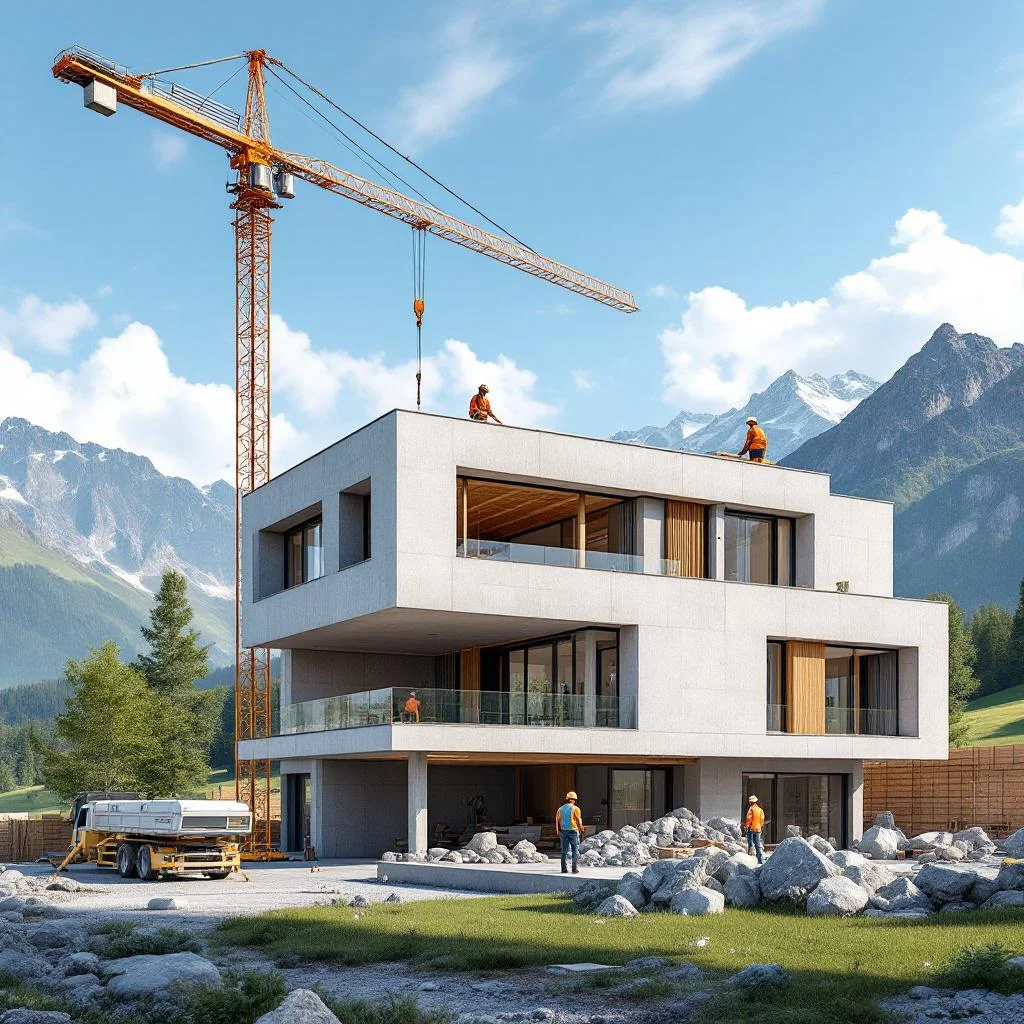
Building a house is a long-term project that brings together a plot, a permit, a budget and many trades. In Western Switzerland, building and energy rules vary from one canton to another, which changes both the timetable and the file you need to put together.
This page covers what the trade involves, what to prepare before asking for offers and what a sound quote should set out. To describe your project, go straight to the request a quote page.
What building a detached house involves
Building a house is more than putting up walls. The site is generally divided into broad phases that recur from one project to the next:
- studies and paperwork: plans, calculations, the permit application file;
- site preparation: earthworks, connections, foundations;
- structural work: slab, walls, load-bearing structure, timber frame, roof;
- the building envelope: insulation, windows, facades;
- technical installations: electrics, heating, plumbing, ventilation;
- finishing trades: plastering, floors, kitchen, painting, interior joinery;
- the surroundings: access, patio, outdoor landscaping.
Depending on the method of construction, the structure will be masonry, concrete, timber or a mixed system. This choice affects the length of the build, insulation, environmental footprint and, of course, the budget. A professional can explain the advantages and limits of each option for your plot and your needs.
When to call a professional to build
For a new house, using professionals is not optional: the work involves structural soundness, safety, installations and planning rules. The earlier you get support, the less likely you are to discover along the way that a project cannot be carried out on the plot.
It is useful to have support from the moment of:
- buying or considering a plot, to understand what can be built on it;
- choosing the delivery method: an architect with separate trades, or a company that coordinates everything;
- drafting the brief: number of rooms, desired floor areas, level of insulation, type of heating;
- comparing offers, to make sure the quotes cover the same services.
An extension or an additional storey on an existing house follows the same logic, with the condition of the starting building to take into account as well.
Training and rules: what is different in Switzerland
Swiss construction rests on a well-structured vocational training system. Several site trades are learned through an apprenticeship that leads to a federal certificate of capacity (CFC), for example mason, carpenter or sanitary installer. Ask each company what training and experience the people working on your site hold.
Legally, the contract for work is governed by the Code of Obligations (CO). Many building contracts also refer to the SIA 118 standard (issued by the Swiss society of engineers and architects), which applies only if the contract mentions it. Before signing, check whether the document refers to this standard and what that means for you.
Building permit and energy rules by canton
No construction starts without a permit, but the authority and the process depend on the canton. The following points are guidelines: always confirm the procedure with your municipality or the competent cantonal department.
- Geneva: the building permit is issued by the canton, through the building permit office. On energy, the cantonal energy law (LEn) applies, and the cantonal energy office (OCEN) is the contact for subsidies under the Buildings Programme. The old town and certain protected districts add constraints.
- Vaud: the building permit is issued by the municipality. The file goes through the cantonal permit centre (CAMAC) when cantonal departments need to give an opinion. The Vaud energy law and the cantonal energy directorate frame the energy aspect, with a cantonal subsidy programme. Old towns and the Lavaux vineyards, a World Heritage site, call for particular care.
- Valais: the permit is issued by the municipality in building zones, and by a cantonal commission outside building zones. The cantonal department for energy and hydropower manages the subsidy programme. For chalets and second homes, the federal law on second homes applies in the municipalities concerned.
- Fribourg: applications are submitted on the cantonal platform FRIAC. The permit is issued by the prefecture or by the municipality depending on the type of work. The cantonal energy department runs a subsidy programme. Old towns are protected, and the canton is bilingual.
- Neuchâtel: applications go through the cantonal desk SATAC and the decision is made by the municipality. The cantonal department for energy and the environment handles the energy side. The watchmaking heritage of La Chaux-de-Fonds and Le Locle, a UNESCO site, may weigh on a project in these towns.
- Jura: the permit is issued by the municipality or by the canton depending on the scale of the project. The cantonal energy section runs a subsidy programme. The old towns of Delémont, Porrentruy and Saint-Ursanne call for caution.
- Biel/Bienne and the canton of Bern: the permit is issued by the municipality or the prefecture depending on the project. The cantonal office for the environment and energy runs the subsidy programme. Biel/Bienne is officially bilingual, French and German: documents may therefore exist in both languages.
Energy subsidies depend on the conditions set by each canton and do not apply automatically. Find out before ordering any work: some programmes require a prior application.
Preparing your house-building request
The more precise your description, the more comparable the offers will be. Gather the following before filling in the form:
- the location of the plot: municipality, condition of the parcel, whether there is a building to demolish;
- the type of project: detached house, semi-detached, chalet, extension;
- the desired brief: number of rooms, floors, garage, basement;
- your preferences for structure (timber, masonry, other) and heating;
- your timetable: desired start and end dates, moving constraints;
- the progress of the file: existing plans, permit already submitted or not.
If you are in co-ownership or if the project affects shared land, say so. A tenant cannot in principle build on land they do not own: the owner’s agreement is essential.
What a sound quote sets out for a house
A building quote is more than a total. It should let you understand what is included and what is not. Look for the following:
- the exact scope: what is covered (studies, demolition, earthworks, connections) and what is excluded;
- the breakdown by item: structural work, roof, installations, finishes;
- materials and equipment: brands or quality levels, not vague terms;
- the pricing method: fixed price, unit prices, time and materials, and what may change during the build;
- the planned timetable: phases, dependencies, conditions for any extension;
- the payment terms: deposits, due dates, retentions;
- insurance and how changes requested along the way are handled.
Be wary of offers without detail: they prevent comparison and leave the door open to extras.
What makes the cost of a house vary
The price of a build depends on many factors and it would be misleading to give a figure without knowing your project. The main elements affecting the cost:
- the size of the house and its shape: a simple volume is cheaper to build than a complex design;
- the nature of the plot: slope, access, type of ground, retaining or connection works;
- the method of construction and the materials chosen;
- the level of insulation and the heating system;
- the quality of the finishes and interior fittings;
- local constraints: protected zones, architectural requirements of the municipality;
- the time of year and the availability of companies.
Only quotes drawn up from your file can place your project. Always compare offers covering an identical scope.
Legal warranties after construction
For a building work, the Code of Obligations provides a five-year warranty period from acceptance: defects must be reported within that period (art. 371 CO). For movable work, the period is two years. Visible defects must be reported without delay at acceptance or shortly after, preferably in writing.
If the contract refers to the SIA 118 standard, it applies in addition to, or in place of, some of the rules of the Code of Obligations. Have it made clear, before signing, which regime your contract falls under. Keep the contract, the plans, the invoices and the acceptance records: they will be useful in the event of a dispute.
House building near you
Pages by town are not yet available for this trade. In the meantime, see the canton pages for the local framework:
- canton of Geneva
- canton of Vaud
- canton of Valais
- canton of Fribourg
- canton of Neuchâtel
- canton of Jura
- canton of Bern
Do you have a plot, an idea or already some plans? Describe your project on the request a quote page: your request is passed to companies in the region, who contact you to prepare a free, no-obligation quote.
Updated 29 October 2026