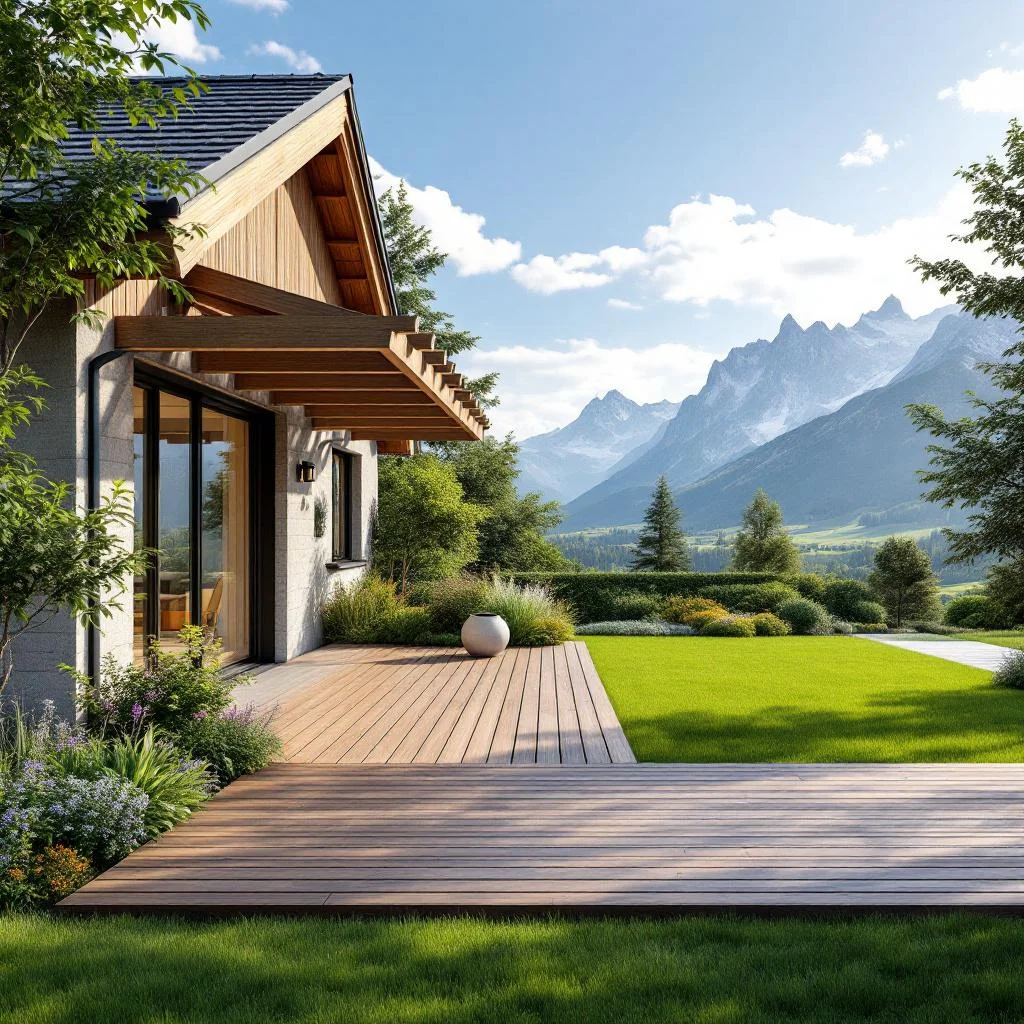
A terrace extends the home outdoors: summer meals, a place to relax, access to the garden. Building one combines masonry, earthworks, waterproofing, carpentry or slab laying, and it is rarely as simple a job as it looks. This page presents the most common terrace works, the rules to check in Western Switzerland and how to prepare a useful quote request.
What terrace works involve
The word “terrace” covers very different situations. It may be a ground-level surface laid on the soil, a raised platform on a frame, a roof terrace or a terrace above a living space. Each case brings its own constraints for load-bearing capacity, waterproofing and water drainage.
The most frequent works are the following:
- building a new terrace, with ground preparation and suitable foundations;
- renovating a damaged surface: greyed timber boards, cracked slabs, worn joints;
- replacing a supporting structure whose timber has suffered from damp;
- redoing the waterproofing and falls when water pools or seeps through;
- adding a guardrail, an access staircase or outdoor lighting;
- installing a pergola, an awning or a light covering.
Depending on the job, several trades may be involved: groundworker, mason, timber framer, carpenter, tiler, landscaper, waterproofing specialist. Some companies take on the whole job, others concentrate on one part. State in your request what you expect.
When to call a professional for your terrace
Laying a few slabs on stable ground is within reach of a careful DIYer. As soon as the project becomes more complex, a professional is the better choice:
- a raised terrace or one reached from an upper floor, where people’s safety is at stake;
- sloping ground, soft soil or running water;
- a terrace above a heated room or a cellar, where a leak is costly;
- a junction with the façade, the threshold of a French window or a roof;
- a project that requires a permit or lies in a protected area.
A waterproofing or foundation defect often shows up months, sometimes years later. A professional’s work also covers what can no longer be seen once the surface is laid: compaction, drainage, falls, fixings.
Terraces in Switzerland: training, standards and choice of materials
There is no single trade in Switzerland called “terrace builder”. The works fall under building trades with initial vocational training leading to a federal certificate of proficiency (CFC): mason, timber framer, carpenter, tiler, landscaper, among others. Ask the company which trade will actually carry out your job.
The climate of Western Switzerland weighs on the choice of materials. A terrace is exposed to rain, frost, direct sun and sometimes snow depending on altitude. A surface that suits the lowlands will not necessarily behave the same way in the mountains. Find out how the material reacts to frost, persistent damp and slipperiness, and what upkeep it requires.
Timber needs regular protection; composite limits upkeep but heats up in the sun; slabs on pedestals make it easy to reach what lies beneath; outdoor tiles and stone demand a well-prepared base. No choice is good in itself: it depends on the use and the situation.
Permits for a terrace: what changes from one Romandy canton to another
Switzerland has no single rule: each canton has its own procedure, and the municipality keeps an important role. A modest ground-level terrace, a large raised platform or a covering are not necessarily treated in the same way. In every case, check with your municipality or the competent cantonal office before starting work.
- Geneva: building permits are issued by the canton, through the Office des autorisations de construire (building permits office). The old town and protected districts add requirements. Many rental buildings are managed by agents, whose consent is required.
- Vaud: the building permit is issued by the municipality. The file goes through the cantonal permit centre (CAMAC) when cantonal services need to give an opinion. Old towns and the Lavaux vineyards, a World Heritage site, call for particular attention.
- Valais: the permit is issued by the municipality in building zones and by a cantonal commission outside building zones. Chalets and second homes are numerous; the federal law on second homes applies in the municipalities concerned.
- Fribourg: applications are filed through the cantonal platform FRIAC, and the permit is issued by the prefecture or the municipality depending on the type of work. Old towns are protected.
- Neuchâtel: applications go through the cantonal desk SATAC, with the decision taken by the municipality. The watchmaking heritage of La Chaux-de-Fonds and Le Locle, listed by UNESCO, deserves to be taken into account.
- Jura: the permit is issued by the municipality or by the canton depending on the scale of the project. Delémont, Porrentruy and Saint-Ursanne have old towns.
- Biel/Bienne and the canton of Bern: the permit is issued by the municipality or the prefecture depending on the project. Biel/Bienne is officially bilingual, so you may deal with the administration in French or in German.
If your terrace affects the building envelope, for example when the roof or the façade is altered, energy rules may come into play. Each canton has its own energy office and subsidy programme, such as the Office cantonal de l’énergie in Geneva or the cantonal energy directorate in Vaud. These programmes do not cover every terrace: find out before you begin, as conditions often apply before work starts.
Preparing your terrace quote request
The more precise your description, the more comparable the quotes will be. Gather these details:
- the address or at least the municipality, and the type of property: house, flat, jointly owned building;
- site access: ground-level garden, upper floor, narrow passage, need for a crane or a lorry;
- the approximate surface area and the shape you want;
- the current situation: bare ground, old slab, existing structure to dismantle;
- the surface material you have in mind, or your criteria if you are undecided: upkeep, appearance, slipperiness;
- photos of the location;
- your constraints: joint ownership, landlord’s consent for a tenant, protected area.
If you are a tenant, obtain the written consent of the landlord or the managing agent before taking any step. In a jointly owned building, the terrace may be part of the common areas: a decision by the owners’ meeting may be needed.
What a reliable terrace quote spells out
A good quote describes the work, not just an overall price. It should make clear what is included:
- preparation of the ground or base, removal of excavated material;
- the foundations or the type of fixing for the structure;
- drainage, falls and waterproofing where applicable;
- the exact nature of the surface, its laying and its finishes;
- accessory items: guardrail, staircase, lighting, edging;
- waste management and making the site good afterwards;
- administrative procedures included, or not;
- payment terms and the validity of the offer.
A vague line or a missing item is a reason to ask for clarification before signing.
What makes the cost of a terrace vary
The cost of a terrace is not just a matter of surface area. Several factors come into play:
- the nature of the ground and the amount of preparation needed;
- how easy it is to bring materials and machines to the site;
- the height and complexity of the structure, especially for a raised terrace;
- the surface material and how it is installed;
- waterproofing and water drainage works;
- accessories: guardrail, lighting, covering;
- permit procedures and any preliminary studies.
A quote can only be prepared reliably after a full description, sometimes after a site visit. Be wary of a price quoted without knowing the site.
Legal warranties after terrace works
Under Swiss law, the Code of Obligations governs the contractor’s warranty. For a fixed structure, defects can be invoked for 5 years under art. 371 CO; for a movable work, the period is 2 years. A terrace fixed to the ground or to the house generally counts as a fixed structure, but the classification depends on the specific case.
If the contract refers to the SIA 118 standard, it applies. Check what your contract says. At handover, inspect the work and note visible defects in writing. If a defect appears later, report it in writing as soon as you discover it.
Terraces near you: canton pages
The city pages for this trade are not yet available. You can, however, consult the canton pages to learn about the local context:
- canton of Geneva
- canton of Vaud
- canton of Valais
- canton of Fribourg
- canton of Neuchâtel
- canton of Jura
- canton of Bern
Ready to describe your project? You can request a quote online: the request is passed on to tradespeople and companies in the region, who will contact you to prepare a free, no-obligation quote.
Updated 29 October 2026