Summer heat is felt in Western Switzerland, especially in the Rhône plain, along the lakes and in dense urban centres, where buildings release at night the heat they have stored during the day. To cool a home or an office, a fixed air conditioner is the obvious thought, but the installation affects the façade, noise, electrics and sometimes building law.
On this page you will find what the trade covers, the points that change from one canton to another and how to prepare a request. To receive quotes, requesting a quote is free and without obligation.
What fixed air conditioning covers: split, multi-split and reversible heat pump
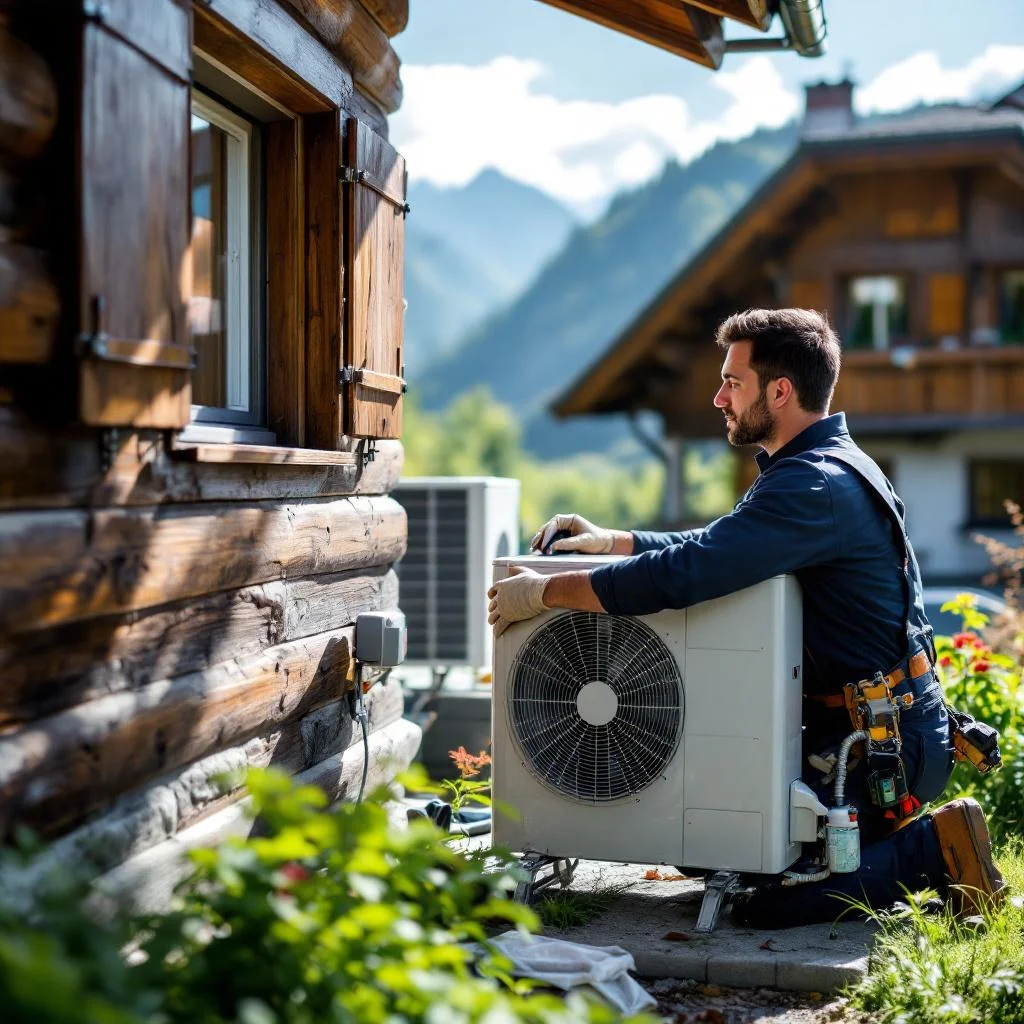
The most common case is the fixed split air conditioner: an indoor unit, mounted on the wall or ceiling, is connected by refrigerant pipes to an outdoor unit. Some installations have a single indoor unit, while others serve several rooms from a single outdoor unit.
The reversible heat pump works on the same principle, but it can also heat. It becomes a serious option when the heating has to be replaced and you also want to cool the home in summer.
The most frequent jobs:
- fitting a split air conditioner in a bedroom, living room or office;
- installing several indoor units connected to one outdoor unit;
- replacing an old unit at the end of its life;
- drilling the wall, running the pipes and draining the condensate;
- electrical connection and commissioning;
- regular servicing and repairs.
When to call a professional to cool a home
Fixed air conditioning is not a DIY job. The refrigerant circuit contains a fluid that requires precise handling, the electrical connection must be compliant, and drilling through a load-bearing wall or an insulated façade cannot be improvised. A poorly chosen position can also cause noise, condensate dripping onto a neighbour’s balcony or poor performance.
Call a professional as soon as you are considering a fixed unit, replacing your heating with a reversible heat pump or an installation in an apartment building. The best time to ask for offers is before summer, when schedules are still open, rather than in the middle of a heatwave.
Before deciding, ask yourself whether the problem really comes from a lack of coolness or rather from too much sun. A top-floor flat under the roof, a large south-facing window or missing blinds often explain overheating. External solar shading remains an alternative, or a complement, to discuss with the professional.
Training and rules to know in Switzerland
Depending on the case, the installation involves refrigeration, heating, ventilation and electrical trades. In Switzerland, these trades are generally learned through an apprenticeship leading to a Federal Certificate of Proficiency (CFC). Do not hesitate to ask the company which professionals will work on your site and what training they have completed.
Two federal and cantonal rules almost always come up:
- Noise. The outdoor unit must comply with the limits of the Noise Abatement Ordinance (OPB). Its position, its distance from neighbouring windows and its orientation matter as much as the model chosen.
- Energy. Depending on the canton, installing air conditioning may require a permit or a justification under the cantonal energy law.
In every case, check with your municipality or the relevant cantonal office what applies to your project before signing a contract.
Permits and energy, canton by canton
Procedures differ from one canton to another. The information below is a guide, not legal advice: always confirm with the municipality or the cantonal office.
Geneva, Vaud and Valais
- Geneva. Building permits are issued by the canton, through the Office des autorisations de construire. On energy, the cantonal law (LEn) and the Office cantonal de l’énergie (OCEN) provide the framework, and Buildings Programme subsidies depend on them. There are many rental buildings, often managed by property agencies whose agreement must be obtained; the old town and protected districts add further constraints for any unit visible on the façade.
- Vaud. The building permit is issued by the municipality, with the file going through the cantonal permits centre (CAMAC) when cantonal services need to give an opinion. The Vaud energy law and the cantonal energy directorate set the framework, with a cantonal subsidy programme. Old towns and the Lavaux vineyards, a World Heritage site, call for particular attention.
- Valais. The building permit is issued by the municipality within the building zone and by a cantonal commission outside it. The cantonal energy and hydropower service manages the subsidy programme. For chalets and second homes, the federal law on second homes may apply in the municipalities concerned.
Fribourg, Neuchâtel, Jura and Biel/Bienne
- Fribourg. Building permit applications go through the cantonal FRIAC platform, and the permit is issued by the prefecture or the municipality depending on the type of work. The cantonal energy service manages a subsidy programme. The canton is bilingual and its old towns are protected.
- Neuchâtel. Applications are submitted to the cantonal SATAC counter, with the decision taken by the municipality. The cantonal energy and environment service handles energy and subsidies. The watchmaking heritage of La Chaux-de-Fonds and Le Locle, a UNESCO site, should be mentioned from the very start of the project.
- Jura. The building permit is issued by the municipality or by the canton depending on the scale of the project. The cantonal energy section oversees the subsidy programme. The old towns of Delémont, Porrentruy and Saint-Ursanne need to be considered for any unit visible from the street.
- Biel/Bienne and the canton of Bern. The permit is issued by the municipality or the prefecture depending on the project, and the cantonal environment and energy office manages the subsidy programme. Biel/Bienne is officially bilingual: discussions in French or German are possible.
For a regional overview, see the pages for the canton of Geneva, the canton of Vaud or the canton of Valais.
Tenant, co-owner or owner: whose agreement is needed
The outdoor unit is fixed to the façade, on a balcony, on a roof or in a garden. In all these cases, the agreement of whoever decides on the building envelope is required.
- Tenant: written agreement from the landlord or property manager before any commitment.
- Co-owner: agreement of the co-ownership, because the façade and common areas are affected.
- Owner of a detached house: no third-party agreement to request, but municipal rules, noise for the neighbours and any heritage constraints still need to be checked.
Attach this agreement to your file; it avoids back-and-forth once the company has been chosen.
Preparing your request and reading an air conditioning quote
The more precise your request, the more comparable the offers. Please state:
- the type of property (flat, house, commercial premises) and your status (owner, tenant, co-owner);
- the rooms to be cooled and their exposure to the sun;
- the planned position of the outdoor unit, with a photo if possible;
- whether you also wish to replace the heating with a reversible heat pump;
- the period when you would like the work to be done.
A reliable quote details:
- the make and model of each unit, indoor and outdoor;
- the materials (pipes, bracket, cabling, condensate drainage);
- labour, shown separately from materials;
- the electrical connection and commissioning;
- any formalities (permit, subsidy application) and who handles them;
- the recommended servicing and the maintenance contract, if one is offered;
- the payment terms and any reference to the SIA 118 standard.
The cost varies with the number of indoor units, the power required, the length and route of the pipes, how difficult the façade or roof is to access, the type of wall to be drilled, the electrical work needed and the noise level sought. Always compare several quotes on the same basis rather than on a single total.
Legal warranties after air conditioning is installed
The Code of Obligations protects the client. For work on immovable property, defects can be reported for five years (art. 371 CO); for work on movable property, the period is two years. A fixed air conditioner integrated into the building generally falls into the first category, but the contract and the circumstances matter: if in doubt, ask before signing.
If the contract refers to the SIA 118 standard, its rules supplement the Code of Obligations. Report any defect in writing and keep the contract, the signed quote, the invoices and photos of the site.
Air conditioning near you: towns in Western Switzerland
Find the page for your town for more local information:
- air conditioning in Geneva, air conditioning in Carouge, air conditioning in Lancy, air conditioning in Vernier
- air conditioning in Lausanne, air conditioning in Morges, air conditioning in Nyon, air conditioning in Vevey, air conditioning in Montreux, air conditioning in Yverdon-les-Bains
- air conditioning in Sion, air conditioning in Sierre, air conditioning in Martigny, air conditioning in Monthey
- air conditioning in Fribourg, air conditioning in Bulle
- air conditioning in Neuchâtel, air conditioning in La Chaux-de-Fonds
- air conditioning in Delémont, air conditioning in Biel/Bienne
To describe your project and receive proposals, go to the request a quote page.
Updated 29 October 2026