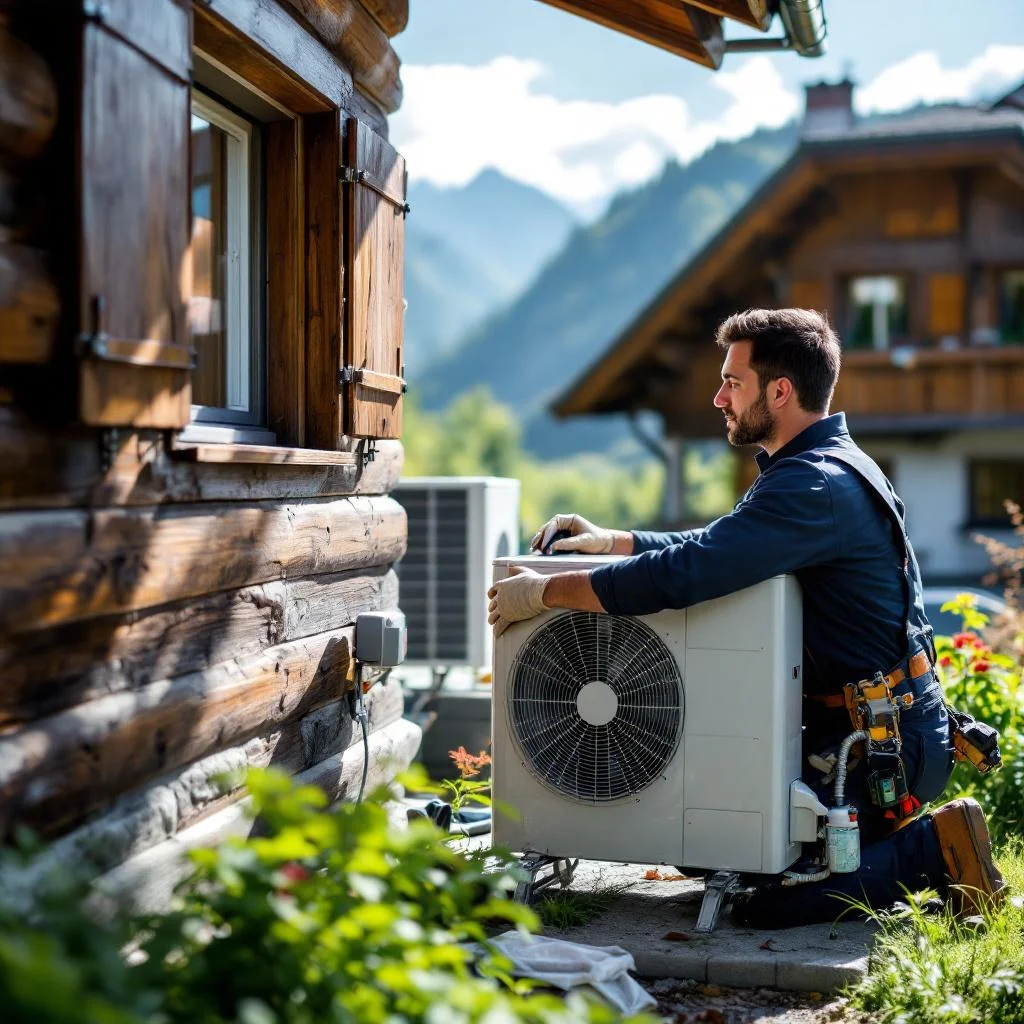
If you are looking for air conditioning in Geneva, you have probably already felt the hot summers of a very urban canton at the end of Lake Geneva. Installing air conditioning in a city means choosing an appliance, but also finding where to put the outdoor unit, obtaining the necessary consents and respecting your neighbours. This page describes what the location changes for this type of work.
What air conditioning work is done in Geneva?
Requests most often concern fixed split air conditioners: an indoor wall or ceiling unit, connected by pipework to an outdoor unit. They come as mono-split for a single room, or multi-split for several rooms with a single outdoor unit. Some requests also concern reversible heat pumps, which cool in summer and heat in winter.
Situations vary greatly from one neighbourhood to another:
- Flats in dense buildings in Pâquis, Eaux-Vives, Plainpalais or Jonction: little room for the outdoor unit, close neighbours, and the consent of the co-ownership or the managing agent is almost always essential.
- Top-floor flats under the roof, often the most exposed to summer heat: cooling one or two living rooms is a classic request.
- Houses and small buildings in areas such as Champel: more flexibility to position the outdoor unit, but the noise heard by neighbours still needs checking.
- Business premises: offices, practices, small shops, where cooling also benefits the people who work there.
In a city that hosts many international organisations, part of the housing stock is occupied by tenants who change regularly. This makes it all the more important to document the landlord’s consent properly before any work.
City heat and the lakeside: what it changes for your project
Geneva is a city-canton: winters are mild on the plain and summers are hot in the city. Mineral surfaces, narrow streets and inner courtyards retain heat. In a room facing south or west, without external blinds, the indoor temperature can become uncomfortable. The lake moderates the climate, but it does not remove the need to think about protecting the home.
Before choosing an appliance, ask yourself three questions:
- Which room is really the problem? A bedroom in the evening, a living room in the afternoon, a home office? The answer guides the capacity and the type of unit.
- Why does the room heat up? Large glazed areas, no solar protection, poorly insulated attic space: some faults can be corrected before buying an appliance.
- Where should the outdoor unit go? On a balcony, on the façade, on the ground in a garden or on a roof. Each option has its own constraints for noise, access and appearance.
The old town and protected areas: an outdoor unit is not trivial
Around Saint-Pierre Cathedral, the old town rises up the hill, with façades, roofs and courtyards that are part of the landscape. The known facts indicate that the old town and certain neighbourhoods are protected. In these areas, fixing an outdoor unit to a façade or a roof may be refused or made subject to conditions, even if the appliance is discreet.
If your home is within a protected perimeter, do not count on an installation “like anywhere else”. Ask first, before any priced quote, whether an installation visible from the street or the courtyard is possible, and in what form. An installer who knows the city can tell you which questions to ask, but only the competent authority decides.
Permit, energy, noise: the procedures to plan for
In Geneva, building permits are issued by the canton, through the Office of Building Permits. On the energy side, the cantonal energy law (LEn) applies, and the Cantonal Energy Office (OCEN) is the contact for these questions. Air conditioning may require a permit or a justification depending on the canton; check your case with the competent office or the municipality before signing.
Three points come up almost every time:
- The permit or the energy justification. Depending on the capacity, the use and the nature of the building, the cantonal law may require the need for cooling to be justified. Do not assume that the absence of an obligation in another canton also applies to Geneva.
- Noise. The outdoor unit must comply with the values set by the Noise Protection Ordinance (OPB). In an inner courtyard, noise echoes and the neighbours’ windows are close: the position matters as much as the brand.
- The consent of the co-ownership or the landlord. In a building, it is required. Geneva has many rental buildings run by managing agents, so a tenant addresses them first. A co-owner goes through the assembly or the administrator, depending on the building’s rules.
If you are considering a reversible heat pump, the energy question is broader. The Buildings Programme, on which energy-related subsidies in Geneva depend, mainly concerns heating and the building envelope. Ask the OCEN whether your project qualifies and on what conditions, before starting the work.
Solar protection: the alternative to consider before deciding
An air conditioner uses electricity and produces noise. Before going ahead, check whether external solar protection (blinds, shutters, brise-soleil) might already bring temperatures down noticeably. They block the sun before it passes through the glass, which an interior curtain does less well.
In a building, this protection also affects the façade and sometimes requires the consent of the co-ownership. It does not always replace an appliance, particularly in a room under the roof, but it can reduce the capacity you need. And if you already have solar panels or plan to install them, the summer consumption of an air conditioner takes on a different meaning.
Preparing your quote request for air conditioning in Geneva
A useful quote rests on a precise description. To obtain comparable offers, state:
- the type of property (flat, house, business premises), the floor and the orientation of the rooms;
- the rooms to be cooled and how they are used;
- the planned position of the outdoor unit, or the fact that you do not know where to put it;
- whether the building is rented or co-owned, and whether consent has already been obtained or still has to be requested;
- whether the building is in the old town or a protected area;
- whether you want cooling only, or heating as well.
A good quote itemises the equipment (type of appliance, number of units), the installation, the route of the pipework and the condensate drainage, commissioning, the procedures handled or not, and the planned maintenance. Also check who handles the permit application if one is needed.
The cost depends mainly on the number of rooms to cover, the capacity, the difficulty of access for installing the outdoor unit, the length of the pipework, façade or drilling work, and the procedures. Only a quote drawn up after describing your situation allows a serious comparison. To start the process, you can request a quote: your request is passed on to tradespeople and companies in the region, who contact you to prepare their offer, with no obligation.
Going further in Geneva
- The trade page: air conditioning
- The city page: work in Geneva
- The canton page: canton of Geneva
- Other work in the municipality: solar panels in Geneva, heating engineer in Geneva, tiling in Geneva
Updated 29 October 2026