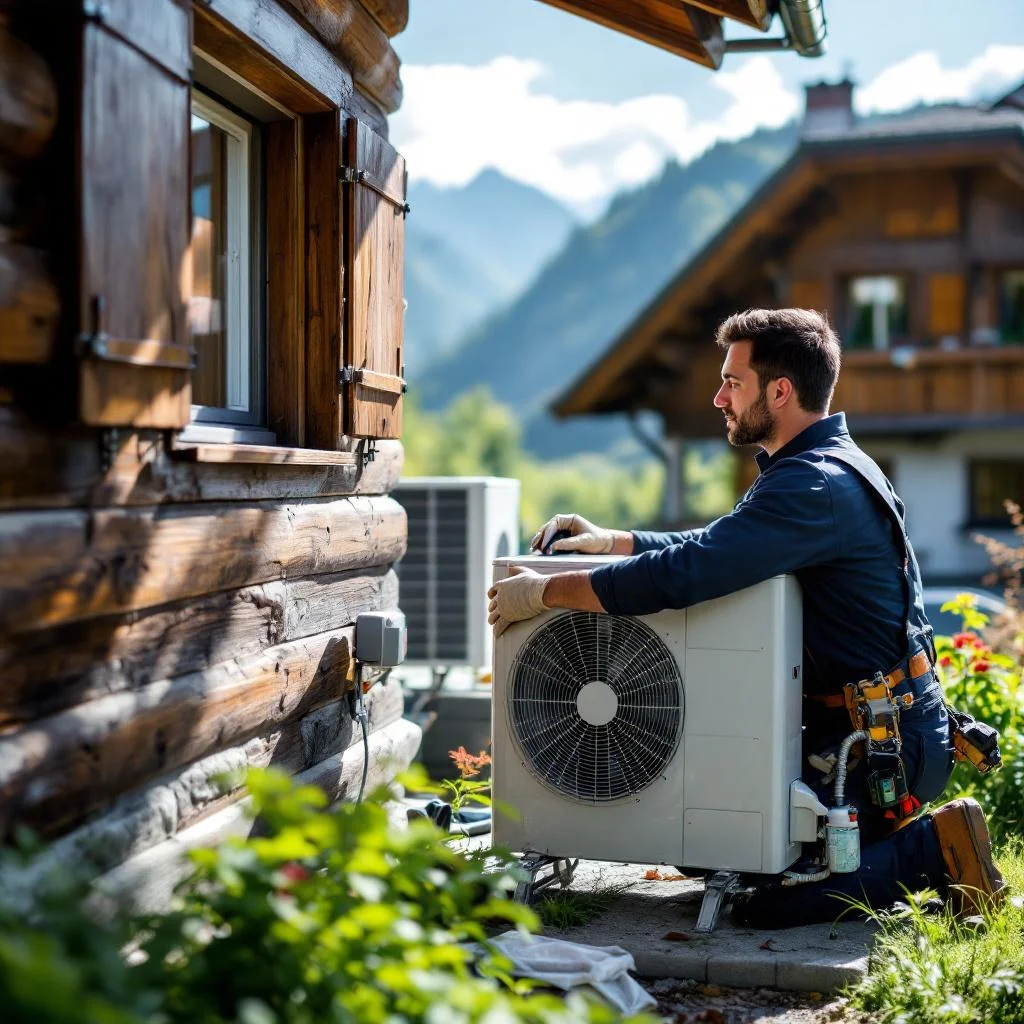
Looking for a heat pump in Lausanne means first coming up against geography: the city slopes down between the upper districts and Lake Geneva, at Ouchy, and each neighbourhood offers very different space, neighbours and ground. Installing a heat pump in the capital of the canton of Vaud is therefore not just a matter of choosing a brand. This page describes what the location changes about an installation, the steps to plan for and how to prepare your request.
The most common heat pump work in Lausanne
Three families of heat pump exist: air-to-water, ground-to-water with geothermal boreholes, and water-to-water. In Lausanne, the choice mostly depends on the space available and on how dense the surroundings are.
- Replacing an existing boiler with an air-to-water pump: this is the most frequent case in rental buildings and in houses already fitted with central heating, using radiators or underfloor heating.
- Installing a ground-to-water pump with boreholes, when the land around the house allows it and the authorisation is granted.
- Including the pump in a wider renovation: insulation, roof, windows. The sizing of the pump depends on the condition of the building envelope.
- Completing or adapting the distribution system: radiators, circulation pumps, hot water tank.
The starting point of a serious project is always the same: the installer assesses the building as it stands, before proposing a type of pump.
Slope, lake and apartment blocks: what Lausanne imposes on the installation
Lausanne is built on a slope, and it shows on site. On sloping ground, the position of an outdoor unit, access for a drilling lorry or the route of pipes between the ground and the plant room all call for an on-site survey. A quote drawn up without a visit cannot take them into account.
The central districts and those near the m2 metro, which is itself very steep, have many multi-unit buildings. In these buildings, the question is not only technical: the boiler room, the existing chimney, access for bringing in a machine and the split of costs between co-owners all weigh on the decision. A shared heat pump is discussed at a meeting of owners, and the quote has to speak to several readers at once.
In the villa areas of the upper city, there is more room. This opens the door to an air-to-water pump placed well away from the plot boundaries, or even to a geothermal borehole if the authorisation allows it. Lower down, towards the lakeside, plots are tighter and buildings touch one another: the outdoor unit of an air-to-water pump then ends up near a neighbour’s window, and noise becomes the first issue.
Lausanne’s climate is that of a lakeside town, fairly mild, but the canton stretches up to the Jura and the Vaud Alps, where snow changes the constraints. For a Lausanne address, it is the insulation level of the building, far more than the thermometer, that determines the power to install.
The Cité old town and sensitive buildings
Around the cathedral, the Cité old town is an area where outward appearance matters. An outdoor unit on a facade or a visible roof is not a trivial matter there, and a project affecting a protected building or a sensitive site may require additional opinions. In such cases, discreet solutions are compared: a unit installed in a courtyard or a room, an indoor pump, a connection that leaves the facade unchanged. What the commune will accept exactly depends on the building: ask before ordering.
Boreholes, noise and permits: the rules to check
Several rules govern this work, and they differ depending on the solution chosen.
- Geothermal borehole: it requires cantonal authorisation under groundwater protection rules, and it is not permitted everywhere. This is the first check for a ground-to-water pump.
- Outdoor air-to-water pump: it must meet the noise limits of the Noise Protection Ordinance (OPB) and may require a building authorisation depending on the commune.
- Building permit: in Lausanne, it is issued by the municipality. When cantonal services need to give an opinion, the file goes through the cantonal authorisation centre (CAMAC).
- Energy: the canton of Vaud relies on its energy law and its energy directorate, which also manages a cantonal subsidy programme. Support may be available through the Buildings Programme; confirm the conditions with the competent service before any commitment.
Ask the installer who handles the filing of the applications: the quote may not include them.
Owner, tenant, co-ownership: who decides in Lausanne
Lausanne is a city of tenants as much as of owners, and this split changes the approach. A villa owner decides alone, within the rules above. In co-ownership, replacing a shared heating system is voted on according to the rules of the owners’ association, and the split of costs must be clear in the documents. A tenant has no control over the heating system: the landlord’s consent is needed, preferably in writing, before making a request.
Students, UNIL or EPFL staff, families or small businesses: situations vary, but the logic stays the same. Without the agreement of whoever owns the building, a quote leads nowhere.
Preparing your request and comparing heat pump quotes
A useful request describes your situation without jargon. Please state:
- the type of building (villa, apartment block, commercial premises) and the approximate address, so that the slope and access are taken into account;
- the current heating (oil, gas, electric, other) and the distribution system (radiators, underfloor heating);
- the state of the insulation and the work already done or planned;
- the space available outside and inside, and the presence of close neighbours;
- your status (owner, co-owner, tenant with the landlord’s consent).
A good quote names the type of pump and the heat source, details the related work (drilling, piping, removal of the old installation, electrical connection), specifies which administrative steps the company takes on and what remains at your expense. The cost depends mainly on the type of pump, the size and condition of the building, access to the site, whether drilling is needed and the commissioning time. Compare quotes that describe the same thing, not just totals.
Once your description is ready, you can request a quote: your request is passed on to craftspeople and companies in the region, who will contact you to prepare a free, no-obligation quote.
Useful pages for your project in Lausanne
- The trade in detail: heat pump
- The city: work in Lausanne
- The canton: canton of Vaud
- Other work in Lausanne: roofing in Lausanne, bathroom renovation in Lausanne, air conditioning in Lausanne
Updated 29 October 2026