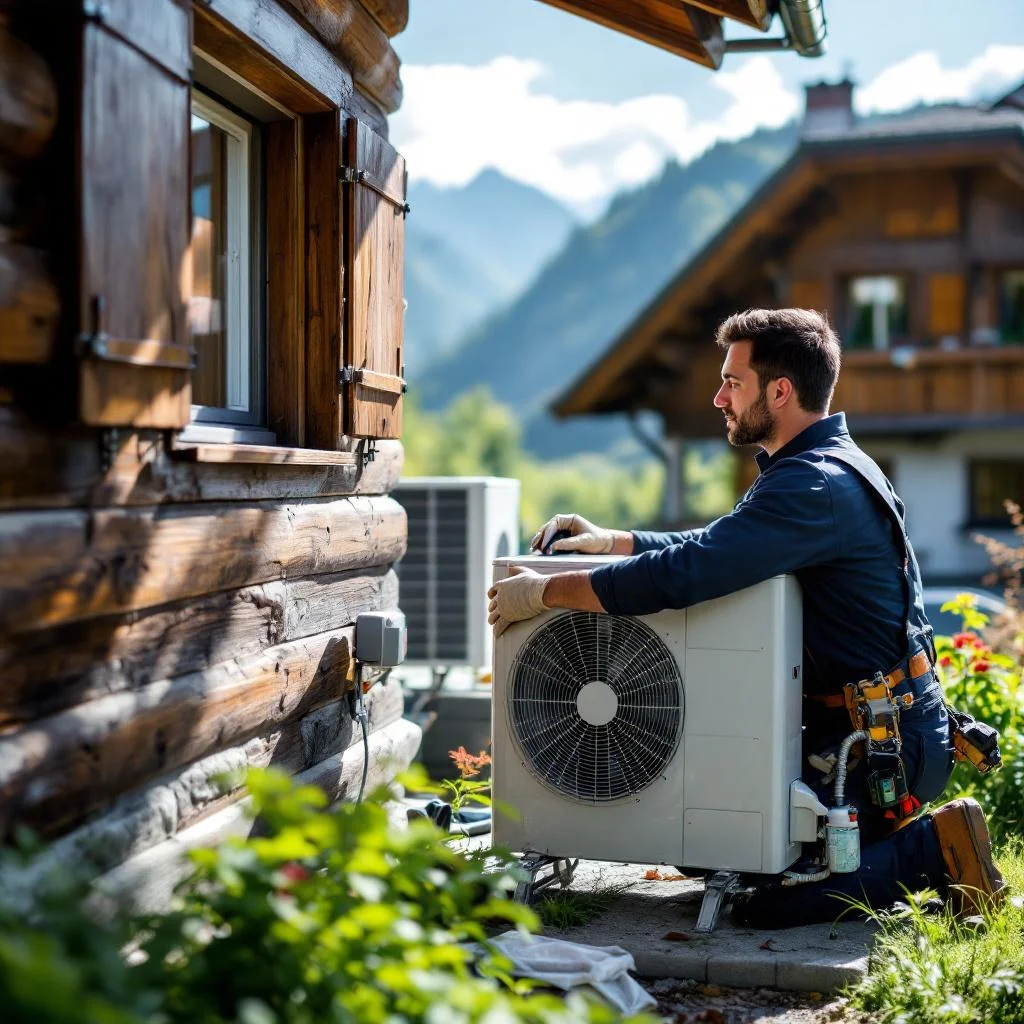
Looking for air conditioning in Lausanne is often a reaction to a summer when the flat no longer cools down at night, or part of a renovation where you want to anticipate the heat. Whether you are considering having an air conditioner installed in Lausanne in a bedroom under the roof or comparing a reversible heat pump for a whole house, the city’s setting affects the choice of appliance, its position and the permits needed.
This guide links air conditioning work to what makes Lausanne what it is: a city built on a slope between the lake and the upper districts, an old town, rental buildings and villas. It does not replace an installer’s advice, but it helps you arrive at the comparison of quotes with the right questions.
What air conditioning work is done in Lausanne, from Ouchy to the upper districts?
Requests revolve around a few types of installation, which Lausanne’s buildings steer in different ways:
- The fixed split air conditioner: a wall-mounted indoor unit connected to an outdoor unit. It is the most common solution for cooling one or two rooms, for example a south-facing living room or an attic bedroom.
- The multi-split: several indoor units connected to a single outdoor unit, useful when several rooms need cooling without multiplying appliances on the façade.
- The reversible heat pump: it heats in winter and cools in summer. It is of most interest to owners who have to renew their heating and want to deal with both needs together.
- Maintenance and replacement of an existing appliance, sometimes in a commercial premises or a practice.
Near the lake, around Ouchy, homes benefit from the proximity of the water, but flats on high floors facing due south can still build up heat. In the upper districts, villas and small buildings often have more room for an outdoor unit, but its position must remain discreet with respect to the neighbours.
Slope, façades and roofs: what Lausanne’s topography changes for the installation
Lausanne descends towards Lake Geneva in successive tiers, and the very steep m2 metro is its best-known image. For an installer, this topography raises practical questions:
- Access to the site. In steep or narrow streets, parking the van, carrying the outdoor units and getting past a staircase or lift must be looked at in advance.
- The position of the outdoor unit. On a sloping façade or a terrace, a unit can end up at the level of the windows of a neighbour just below or opposite. This matters for noise as well as for appearance.
- Views and landscape. Many Lausanne buildings overlook the lake; a badly placed appliance can bother the neighbours or the co-owners.
- Routing the refrigerant lines and condensate drainage. In an older building, a route must be found that does not damage the façade or the common areas.
A good installer visits the site before pricing. A quote drawn up without a visit, for a sloping façade or difficult access, risks ignoring these constraints.
The Cité, rental buildings, villas: three situations in Lausanne
In the old town of the Cité, around the cathedral, the buildings are old and heritage protection rules may apply. An outdoor unit visible from the street or a pierced façade may be refused or made subject to conditions. Before any detailed study, it is prudent to check with the municipality what is possible at your address. For a small home with character, solar shading and night-time ventilation often remain the first things to consider.
In rental buildings, which are very common in the city, the decision is not yours alone. A tenant needs the consent of the landlord or the managing agent, because the appliance alters the façade, the balcony or the common areas. In a building under condominium ownership, the co-owners’ meeting may have to decide, in particular on the position of the outdoor unit.
In villas and small houses, there is more leeway: an outdoor unit can often be placed on the ground or against a wall, away from the property boundaries. A reversible heat pump is easier to consider there, especially if you are replacing a boiler.
The city also has a university population, with the UNIL and EPFL campuses nearby: many homes are rented, sometimes as shared flats or furnished lets. In that case it is the owner who commissions the work, and it is better to present them with a precise proposal rather than a simple wish to air-condition.
Municipal permit, CAMAC and the Vaud energy law
In the canton of Vaud, the building permit is issued by the municipality of the commune. When cantonal departments have to give an opinion, the file goes through the cantonal authorisation centre, the CAMAC. Air conditioning does not necessarily require a full permit in every case, but the installation may be subject to authorisation or justification under the cantonal energy law, and depending on the building’s situation, in particular if it is in the old town or a protected site.
The Lavaux vineyards, a World Heritage site, lie east of Lausanne and are a reminder that the canton pays attention to landscapes. This does not mean that every Lausanne project is affected, but any doubt about whether your building is protected should be settled before you sign.
To find out what applies at your address, contact the municipality or the cantonal energy directorate. The installer can inform you, but the decision rests with the authority. The canton also has an energy subsidy programme: check whether it covers your project, in particular for a heat pump, before ordering and not afterwards.
Outdoor unit noise and co-owner approval in Lausanne
In a dense city, the neighbours are close. The outdoor unit of an air conditioner must comply with the values of the Noise Abatement Ordinance (OPB). In practice, you should look at:
- the distance between the appliance and the nearest windows, including those of the neighbours;
- the sound level stated by the manufacturer and the night-time operating mode;
- the mounting bracket, which can transmit vibrations to the façade.
In a building, raise it early with the managing agent or the co-owners. A written request, with a description of the appliance and its position, avoids many misunderstandings. A neighbour bothered by the noise can assert their rights, and a badly placed installation may have to be moved at your expense.
Solar shading or air conditioner: a question to ask in a city on a slope
Summer heat, lakeside districts, dense streets: the city can hold on to heat in the evening. Before installing an appliance, it is worth looking at where the heat comes from. External blinds, shutters or films suited to the glazing limit solar gain on exposed façades. In use they consume less energy than a running appliance and raise no question of outdoor noise.
The two approaches complement each other: a home well protected from the sun often needs a more modest appliance, or none at all. If an air conditioning installer suggests a high capacity without a visit, ask how they assessed your needs.
Comparing air conditioning quotes in Lausanne
To obtain comparable quotes, describe your situation precisely when you request a quote:
- the type of home (flat, villa, premises), the floor, the orientation and the area to be cooled;
- your status: owner, tenant with the landlord’s consent, co-owner;
- the rooms concerned and the envisaged position for the outdoor unit;
- the age of the building, whether it is in the old town or not, and access (staircase, lift, sloping street);
- your wish, if any, for a reversible heat pump if you are renewing the heating.
A serious quote itemises the equipment (make, model, capacity), the installation, the electrical connection, the drilling and making good, condensate drainage, commissioning and planned maintenance. It also states who handles the permit procedures. The cost depends on the capacity, the number of units, the length of the lines, the difficulty of access, the electrical connection and the type of façade; this is why only a quote drawn up after a visit has any value.
Other pages for your Lausanne project
- The trade page: air conditioning
- The city: works in Lausanne
- The canton: canton of Vaud
- Around a heat pump or an energy renovation: heating engineer in Lausanne and solar panels in Lausanne
- For a wider renovation project: tiling in Lausanne
Updated 29 October 2026