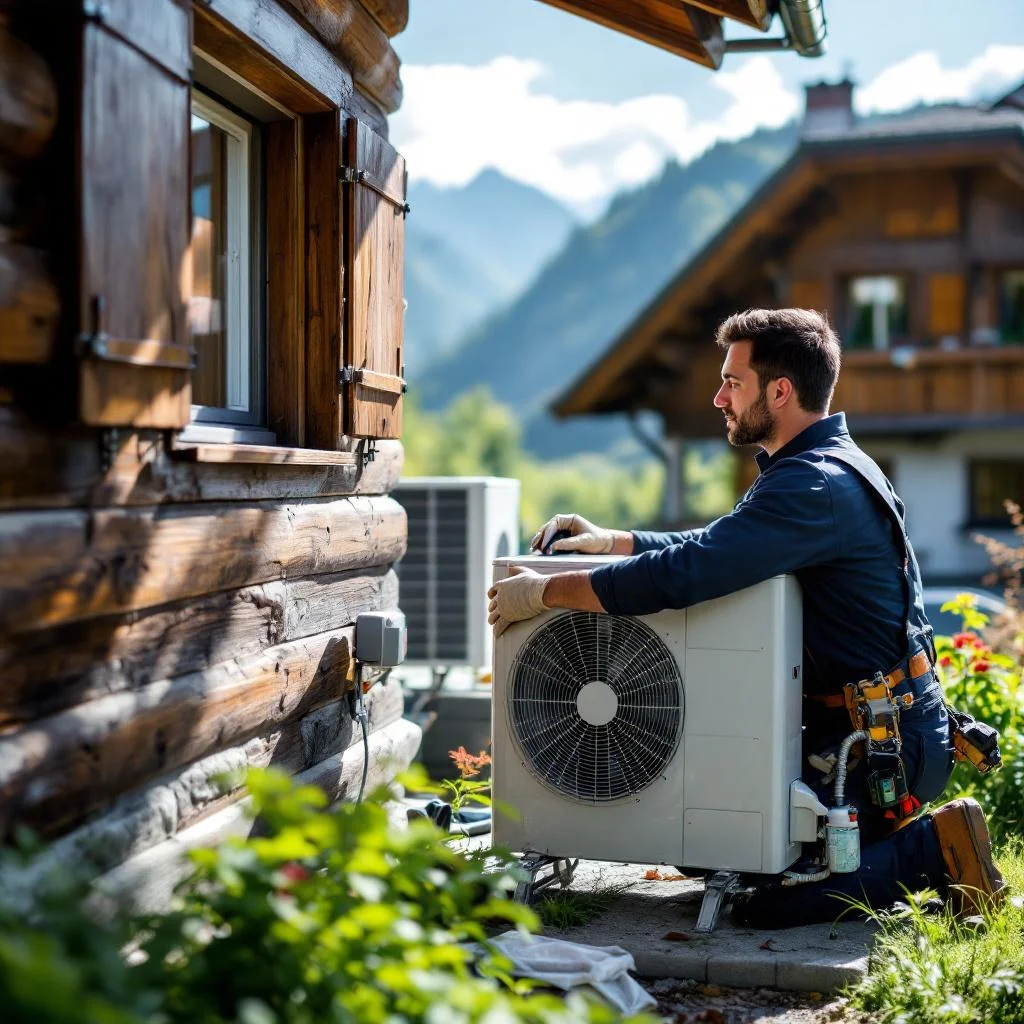
Looking for a heating engineer in Lausanne usually means facing an ageing boiler, radiators that heat poorly or a wish to move away from oil. In a city stepped between the lake and the heights, the same heating project does not look the same from one district to the next. This page describes what the trade involves in Lausanne, what to check before starting and how to prepare your quote request.
The most common heating work in Lausanne
A heating engineer installs, maintains and replaces heating systems: oil, gas, wood, heat pumps, connection to district heating. They also work on radiators, underfloor heating and controls, that is, everything that regulates the temperature room by room and by time of day.
In Lausanne, several situations come up often:
- Replacing an old boiler in a rented block or a co-ownership building, with the question of which fuel to choose next.
- Switching to a heat pump in a house in the upper part of the city or in a small apartment building. The subject has its own page: heat pump in Lausanne.
- Replacing radiators or adding underfloor heating during a full renovation, for example when a kitchen or bathroom is redone and the floors are opened up.
- Controls: sensors, thermostatic valves, programming. In a building where some flats are overheated and others cold, a well-done adjustment often changes more than a new boiler.
- Maintenance and inspection of existing installations, whose rules are set by the canton.
A city on a slope, from the lake to the heights of Lausanne
Lausanne was built on a hillside, between Lake Geneva at Ouchy and the upper districts. The very steep m2 metro gives a good picture of it. This topography has a very concrete effect on heating works.
By the lake, the climate is that of the Lake Geneva basin, rather mild. In the higher districts, winters are felt more and the bise (the cold north wind) can chill exposed façades. A well-placed south-facing building and another at the top of a slope on the north side do not have the same heating needs: sizing an installation must take into account the building’s real exposure, not just its floor area.
The slope also affects access. Delivering a boiler, a heat pump or a hot-water tank in a narrow or steep street, carrying equipment up in a building without a lift or down into a cellar with narrow access, all of this takes time and has a cost. Mention these constraints from the start: a heating engineer who has not seen the access cannot price the handling properly.
The Cité, old buildings and sensitive properties
Around the cathedral, the old town of the Cité has historic buildings, often protected or located in a sensitive area. For a heating engineer, this changes several things:
- drilling through a wall for a flue outlet or an air intake is not trivial on an old façade;
- an outdoor heat pump unit is visible, and its location may raise questions in a historic setting;
- thick walls and original floors complicate the routing of new pipes, particularly for underfloor heating;
- the noise of equipment matters more in narrow lanes, where neighbours are close.
Before choosing a solution, ask the municipality what is permitted for your address. If your building is old, insulation also determines the useful output: see the page on thermal insulation in Lausanne to understand how the two subjects relate.
District heating, oil, gas or heat pump
In town, the question of district heating arises: can a building be connected to a heat network, and under what conditions? It is not possible to answer without knowing the address. Ask your property manager, the municipality or the energy supplier whether your street is served, or whether a connection is planned.
For a building that cannot be connected, the choice is between keeping a fossil-fuel boiler, where the law allows it, and a renewable system such as a heat pump or wood. Replacing a fossil-fuel heating system is governed by the Vaud energy law, which may require or restrict it. So do not assume you can put back an identical oil boiler: check with the cantonal energy directorate.
Procedures in Lausanne: permit, energy, landlord
The building permit is issued by the municipality of the commune. When cantonal services must give an opinion, the file goes through the cantonal authorisations centre (CAMAC). Not all heating work requires a permit, but some, such as an outdoor unit, a new technical room or work in a protected setting, may do so. The commune of Lausanne is the point of contact to find out.
On the energy side, the cantonal energy directorate applies the Vaud energy law and manages the cantonal subsidy programme. Its conditions depend on the type of installation and may change: find out before ordering, because support generally has to be requested before work begins.
That leaves the question of who decides:
- House owner: you decide, within the rules above.
- Co-ownership: shared heating is a matter for the meeting of co-owners. A comparative quote makes the discussion easier.
- Tenant: the installation belongs to the landlord. You can report a problem and ask for work to be done, but you cannot replace the heating on your own initiative.
Preparing your request and comparing quotes
The more precise your description, the more comparable the quotes. Indicate:
- the type of building (house, rented block, co-owned flat) and its approximate age;
- the current system (fuel, type of distribution, presence of a hot-water tank);
- what is wrong: breakdowns, consumption, noise, cold rooms;
- your district and the access to the technical room or cellar;
- whether you are also considering insulation or renovation work, which affects the output required.
A serious quote itemises its lines. Look for the removal and disposal of the old installation, supply of the new equipment, hydraulic and electrical connections, controls, commissioning and any administrative procedures that are handled for you. If the chimney, the room or the tank must be dealt with, that should also appear.
What makes the cost vary: the type of system, the size of the building, the condition of the existing pipework, the difficulty of access, the need to adapt the radiators, the time on site and the related procedures. That is why no amount can be stated without a visit: only the quote gives a reliable figure for your home. If you are ready, you can request a quote by describing your situation; your request is passed to tradespeople in the area, who will contact you for a free, no-obligation quote.
Also remember to compare the terms: planned duration, what remains at your expense, maintenance after commissioning.
Useful pages around Lausanne
- The trade in general: heating engineer
- The city: work in Lausanne
- The canton: canton of Vaud
- In the same commune: heat pump in Lausanne, thermal insulation in Lausanne and kitchen renovation in Lausanne
Updated 29 October 2026