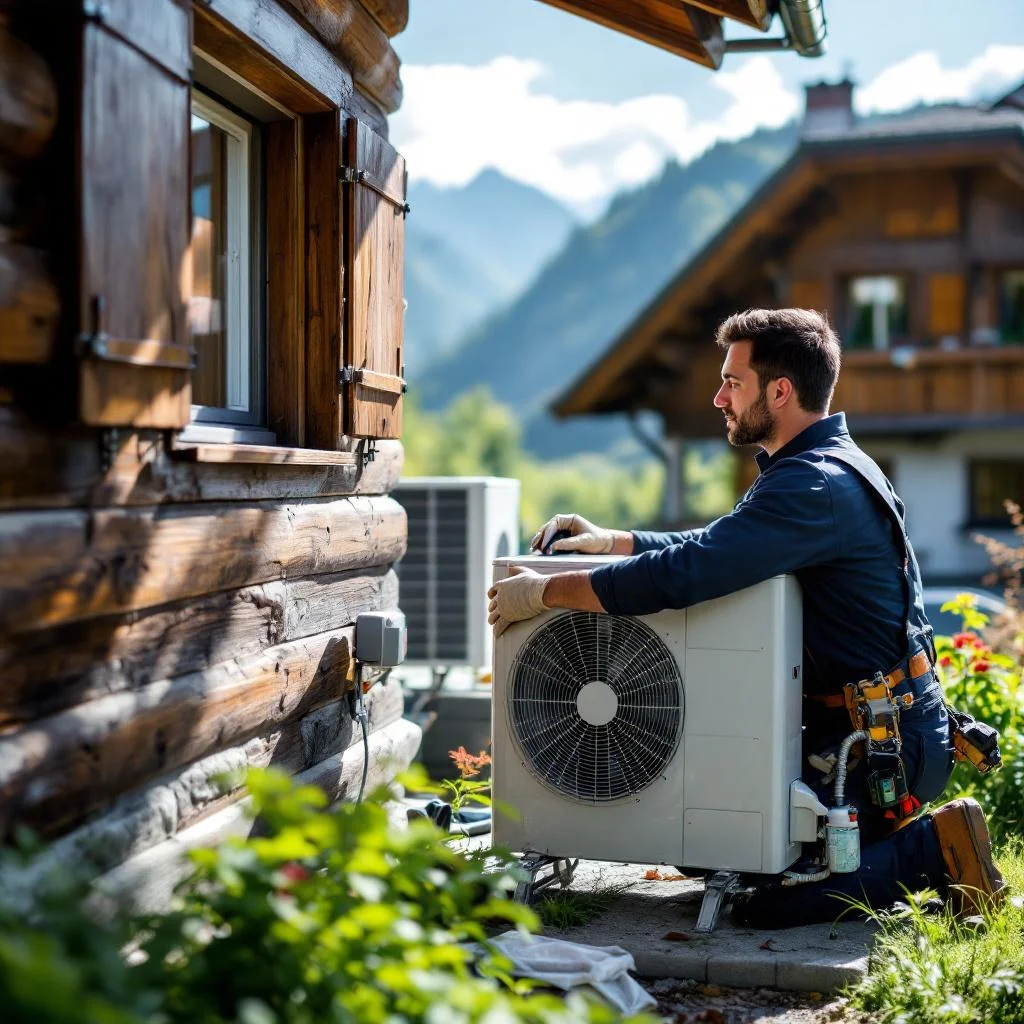
Are you looking for a heating engineer in Vernier to replace a boiler, install a heat pump or rework radiators? Between the village, Aïre, Châtelaine and Le Lignon, the municipality brings together very different situations: houses, small apartment buildings, large estates run by property managers (régies), and premises close to the industrial zones. The right person to contact is not the same from one neighbourhood to the next, and this page helps you place your case before you ask for quotes.
What heating work comes up in Vernier village and Aïre?
In Vernier village and around Aïre, there are more detached houses and small apartment buildings. Requests often come down to the same question: what to do with an old oil or gas boiler nearing the end of its life? A heating engineer can maintain the existing system, replace it with one of the same type where the law allows, or propose a heat pump, a wood boiler or another system.
Other common jobs are more modest but useful:
- replacing radiators or thermostatic valves;
- reworking a circuit that heats poorly or makes noise;
- installing or adjusting controls, so that the temperature follows the hours you are at home;
- creating or restoring underfloor heating as part of a wider renovation;
- regular servicing of the burner and boiler.
In a house, the owner often decides alone. The work can therefore be planned outside the winter months, when being without heating during the job is less of a problem.
Heating in Le Lignon and Châtelaine: shared buildings and property managers
Le Lignon is known for its very long block of flats. At that scale, heating is generally a collective matter: a central installation for a building or a whole complex, maintained by or on behalf of the owner and their property manager. In Geneva, many rental buildings are run by régies, and it is with them that work on a boiler room, a riser or a building’s controls is decided.
In practice, depending on your status:
- Tenant: you do not order the replacement of a boiler. You report faults, lack of heat or unusual noises to the régie in writing, with the date and the room concerned. For work limited to your own flat (radiator, valve), ask for the landlord’s consent before any quote.
- Owner of a flat in co-ownership: the shared heating is a matter for the owners’ meeting and the co-ownership rules. Quotes for the boiler room are prepared with the administrator, not on your own.
- Property manager or building owner: a heating engineer can assess the condition of the heat production, pumps and distribution before proposing maintenance or replacement.
In Châtelaine, the built environment mixes rental buildings and businesses; the logic remains the same: identify who decides, then gather the useful information before asking for a quote.
Lakeside plain and mild winters: what this changes for a heating system
Geneva is a very urban canton, on the lake, with mild winters on the plain and hot summers in town. That does not remove the need for heating, but it shifts the questions. Peak demand is less pronounced than in the mountains, so sizing matters: an oversized installation switches on and off constantly, wears out its equipment faster and heats poorly. Ask your heating engineer how they estimated the output required, and on what basis.
Hot summers in town also raise a question to consider early on: some heat pumps can run in cooling mode, depending on the model and the installation. This is a point to discuss with the professional, without treating it as an automatic promise.
Vernier is close to the industrial zones and the airport. For a heating engineer, this mainly shows in site access and in the type of building: commercial premises, small offices and workshops whose heating needs differ from those of a home. Say so in your request if your property is not a standard dwelling.
District heating, heat pump or boiler: what to compare in Vernier
In town, district heating is an option worth examining: it replaces the building’s boiler with a connection to a network. Not every area is served, and we have no reliable data on what exists at any given spot in the municipality. Ask your régie, your administrator or the relevant services whether a connection is possible for your address.
For a house or small building off the network, the comparison is often between a heat pump, a wood boiler and a fossil-fuel installation, where this is still permitted. If you want to look into this further, the page on heat pump in Vernier covers that option. And if the question first comes from heat loss, thermal insulation in Vernier is the right starting point: a better-insulated building needs a more modest installation.
Steps for heating work in Vernier: cantonal law, OCEN and landlord’s consent
Replacing a fossil-fuel heating system is governed by the cantonal energy law (LEn), which may require or restrict it. In Geneva, the reference authority for energy is the Cantonal Energy Office (OCEN), which also handles the Buildings Programme subsidies. Before ordering anything, ask it what applies to your building: the heating engineer can advise you, but checking with the cantonal service remains your responsibility.
Depending on the scale of the work, a building permit may be needed. It is issued by the canton, through the building permits office. An outdoor installation, a change of fuel or work on a building in a protected area deserve a prior check: ask the municipality or the relevant cantonal service whether your project is affected.
Chimney sweeping and boiler inspections are regulated by the canton. To find out how often and on what terms, ask the relevant cantonal service rather than relying on a general rule.
Finally, regarding consent:
- tenant: written consent from the landlord or the régie before any work in the flat;
- co-ownership: decision of the owners’ meeting for the common parts;
- subsidy: do not order before checking whether the application must come before the work.
Preparing your heating engineer quote request in Vernier
A useful quote starts with a precise request. Gather the following before contacting anyone:
- the type of property (house, flat, building) and the Vernier neighbourhood;
- the current system: fuel, approximate age, make if you know it, a photo of the rating plate;
- the problem or goal: breakdown, noise, replacement, change of energy source, savings;
- the heat distribution: radiators, underfloor heating, or both;
- access constraints: cellar, plant room, lift, possible position of an outdoor unit;
- your status: owner, tenant, co-owner, with the consent already obtained or not.
To compare, ask for several written quotes on the same basis. Each quote should state the equipment planned, the removal and disposal of the old installation, the hydraulic and electrical connections, the controls, commissioning, any masonry or paintwork repairs and the exclusions. The cost varies with the system chosen, the output, the condition of the existing distribution, the difficulty of access and the scale of the related work. That is why a price given without a visit is worth little.
To get started, you can request a quote describing your situation: the request is passed on to tradespeople and firms in the region, who will contact you to prepare a free, no-obligation quote.
Further information for Vernier
- The trade page: heating engineer
- The municipality as a whole: works in Vernier
- The cantonal framework: canton of Geneva
- Other work in Vernier: heat pump in Vernier, kitchen renovation in Vernier, thermal insulation in Vernier
Updated 29 October 2026