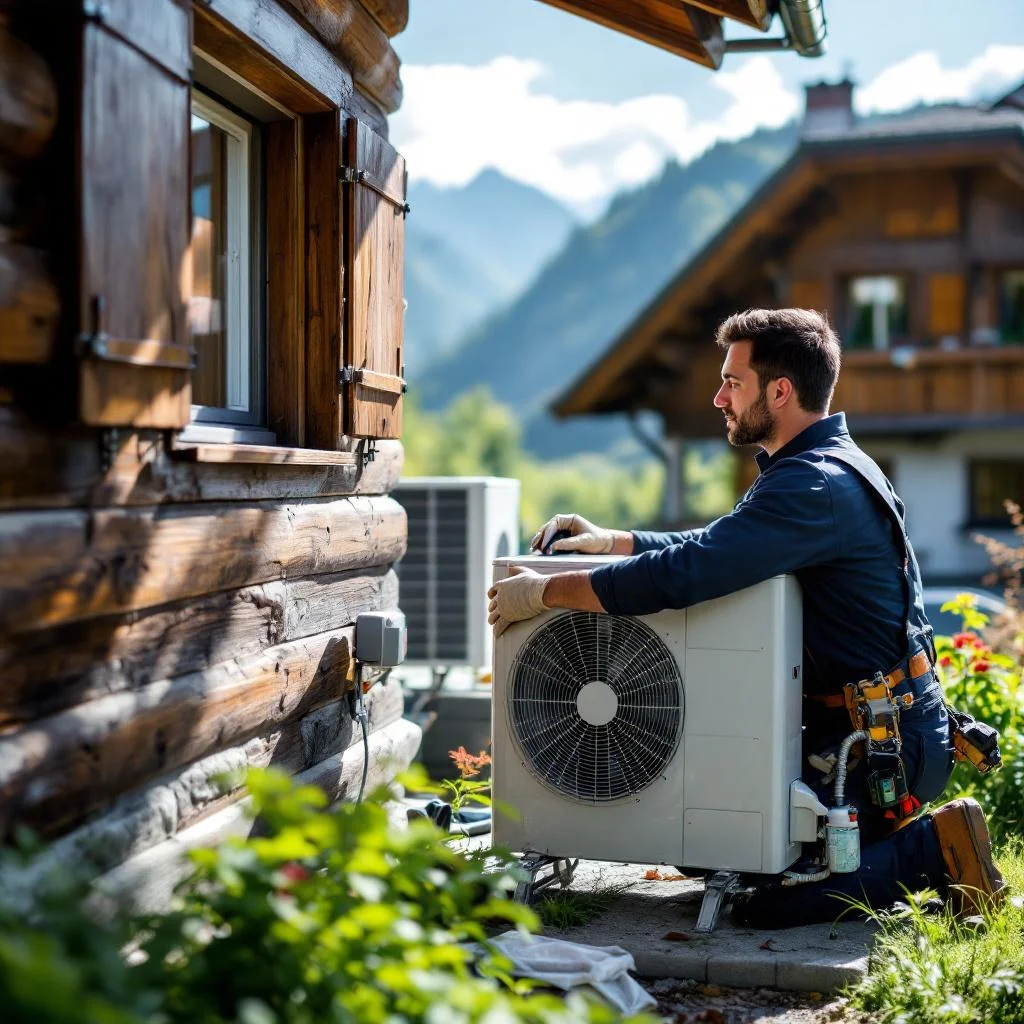
You are looking for a heat pump in Vernier, either to replace an old boiler or to equip a building. This commune on the right bank of the Rhône, north-west of Geneva, combines very different neighbourhoods: a thermodynamic heating system is not installed in the same way in a house in Aïre and in a large housing complex. This page describes what this context changes, before you request quotes.
Vernier-village, Aïre: villas and small houses
In more residential areas such as Vernier-village or Aïre, you find detached houses and small apartment buildings. The question often arises as follows: replacing an oil or gas boiler with a heat pump, without reworking the whole house.
Three families of pump are possible:
- air-water: the outdoor unit draws heat from the air; it is the simplest to install on a limited plot;
- ground-water: one or more geothermal probes capture heat from the subsoil;
- water-water: it uses groundwater, with even stricter requirements.
Around a villa, the space available guides the choice. An open garden leaves room for an outdoor unit or for a drilling; a plot squeezed between two neighbours limits the options. Also note where the pipes run and where the current boiler room is: the connection to the heating circuit and the capacity of the radiators or underfloor heating affect the result.
Le Lignon and apartment buildings: a different scale
Le Lignon is known for its very long block of apartment buildings. Complexes of this kind are not treated like a villa: heating is most often shared, the decision lies with the co-ownership or the owner, and management frequently goes through a property manager. In Geneva, many rental buildings are run by property managers, which means that the starting point of a project is an approach to them, not to each occupant.
For a shared building, a heat pump project calls for a more thorough study: power required, space in the boiler room or on the roof, domestic hot water production, and phasing of the work so that homes are not left without heating. If you represent a co-ownership, ask for quotes that describe these points separately rather than a single global price that is hard to read.
Châtelaine, industrial zones, airport: the question of noise
Vernier combines dense housing, economic activity and proximity to the airport. This does not prevent you from installing a heat pump, but it makes the question of neighbours more concrete. An outdoor air-water pump must comply with the noise limits of the Noise Abatement Ordinance (OPB), and may require a building permit depending on the commune.
A few practical pointers:
- keep the outdoor unit away from bedroom windows, yours as well as your neighbours’;
- avoid a closed courtyard corner where noise echoes;
- ask the installer for the sound level of the appliance and how they check compliance with the OPB at the planned position;
- in a tight area such as Châtelaine, consider an indoor unit or a monobloc heat pump placed in a technical room, if the building allows it.
Ambient noise from an industrial zone or a flight path does not cancel these requirements: a nearby neighbour is still affected by what your appliance produces.
Geneva climate and sizing
The canton is very urban, beside the lake, with rather mild winters on the plain and hot summers in town. This climate suits an air-water heat pump, as it works with outdoor temperatures that generally remain moderate. Sizing depends mainly on the building: insulation of the envelope, type of heat emitters, flow temperature of the circuit.
In a poorly insulated house with small high-temperature radiators, a badly sized pump will consume a lot. In that case, the installer may first recommend work on the envelope or the replacement of some radiators. A sound quote justifies the choice of power instead of presenting it as self-evident. Some heating engineers also offer a reversible model: an air-water pump can sometimes cool in summer, which is of interest for very exposed homes. If this matters to you, mention it from the start of your request; you can also consult the air conditioning in Vernier page.
Permits and cantonal rules to check
The rules depend on the type of pump and on the plot. What to remember:
- geothermal probe: cantonal authorisation linked to groundwater protection; it is not permitted everywhere;
- outdoor air-water pump: compliance with the OPB, and a building permit may be needed depending on the commune;
- building permits: issued by the canton, through the Office for Building Permits;
- energy: the cantonal energy law (LEn) and the cantonal energy office (OCEN) govern heating projects;
- protected buildings: Geneva has protected neighbourhoods and buildings; if yours is one of them, additional constraints may apply to the outdoor unit.
Do not assume anything: check with the commune of Vernier and the competent cantonal service before ordering. A good installer can tell you which procedures are required and which they take on.
Landlord’s or co-ownership’s agreement
If you are a tenant, the heating system belongs to the landlord: no replacement without them. If you are in a co-ownership, the decision goes through the owners’ meeting, with its majority rules. Allow time to gather these agreements, and do not sign a quote before they are obtained.
Subsidies
Subsidies may be available through cantonal programmes (Buildings Programme), and in Geneva the OCEN is the contact. Conditions and amounts change: consult the cantonal service before signing, as a grant requested after work has started may be refused. Ask the installer whether they prepare the application or whether it is left to you.
Preparing your request and comparing quotes in Vernier
To obtain comparable quotes, describe:
- the type of home (villa, flat, building) and its neighbourhood;
- the current heating (oil, gas, electric, other) and its approximate age;
- the type of emitters: radiators, underfloor heating;
- the space available outside and in the technical room;
- your constraints: close neighbours, protected building, co-ownership;
- hot water production, if it is to be covered by the same installation.
A useful quote details the type of pump and its position, the hydraulic and electrical connection, the removal of the old installation, the procedures included and those that remain at your expense, as well as ancillary work (drilling for a probe, base, room). The cost varies with the type of pump, the power, the difficulty of access, the need for drilling, the state of the heating network and the restoration work. Compare quotes item by item rather than on a total.
You can request a quote by describing your project: your request is passed on to craftspeople and companies in the region, who will get back to you to prepare a free, no-obligation quote.
Further reading: useful pages around Vernier
- heat pump: the trade in general;
- work in Vernier: the commune page;
- canton of Geneva: the cantonal framework;
- roofing in Vernier, useful if a unit or panels must go on the roof;
- bathroom renovation in Vernier;
- air conditioning in Vernier.
Updated 29 October 2026