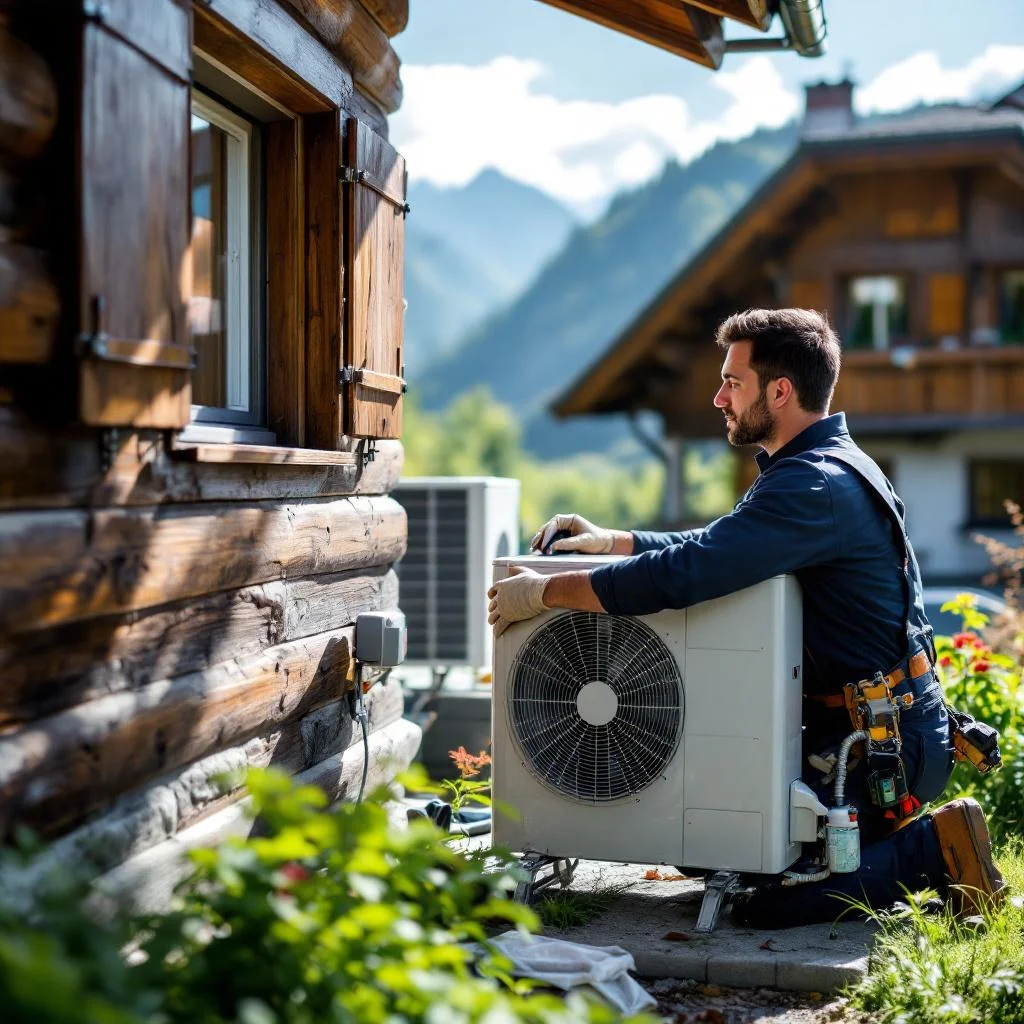
Are you looking for air conditioning in Vernier for a flat, a house or business premises? This page explains what installing a cooling system involves in this Geneva commune on the right bank of the Rhône, and how to prepare a quote request. Your request is passed on to craftspeople and companies in the region, who contact you to prepare a free, no-obligation quote.
The most common air conditioning work in Vernier
The canton of Geneva is highly urban, with hot summers in the city. Vernier reflects this well: dense neighbourhoods, apartment blocks, industrial zones and a calmer area of detached houses. Requests generally fall into a few main types of work.
- The fixed split air conditioner: an indoor wall unit connected to an outdoor unit. This is the most common solution for one or two rooms, for example a south-facing living room or a bedroom under the eaves.
- The multisplit system: a single outdoor unit supplies several indoor units. It suits a house or a large flat, but the routes for the refrigerant lines must be planned.
- The reversible heat pump: it heats in winter and cools in summer. It makes most sense when the heating needs replacing, which brings it close to the work of a heating engineer in Vernier.
- Cooling business premises: offices, workshops or shops, with constraints specific to their use and operation.
Air conditioning in Vernier by neighbourhood
The same unit raises different issues in Vernier-village, Aïre, Châtelaine or Le Lignon.
Le Lignon and its large buildings. The very long residential block of Le Lignon brings many homes together in a single building. Nothing is decided alone here: the appearance of façades and balconies is up to the co-ownership or the landlord, and several outdoor units fitted without coordination would change the look of the building. A flat on a high floor, exposed to the afternoon sun, can quickly overheat in summer. If several neighbours are considering the same step, discussing a shared solution with the property manager is more realistic than a one-off installation.
Vernier-village. The houses and small apartment buildings in this area more often allow the outdoor unit to be placed on the ground or against a garden wall. What remains is to check the distance to property boundaries and neighbouring windows, which affects compliance with the noise limits.
Aïre and Châtelaine. These neighbourhoods mix housing and business activity. For business premises or a home near a workshop, the question is not only how to cool: you also need to know where the hot air will be discharged and how the unit will be maintained.
Industrial zones and proximity to the airport. They bring together commercial buildings whose cooling needs differ from residential ones: larger volumes, daytime use. This proximity may also change how noise is perceived around a home, but it never removes the need to meet the OPB limits for the outdoor unit.
Heat, the Rhône and alternatives to air conditioning
Winters are mild on the plain and summers are hot in town. In a dense neighbourhood like Vernier, built-up surfaces and concrete stay warm after sunset, which makes some nights uncomfortable on the upper floors or under the roof.
Before installing a unit, it is worth looking at whether the problem can be reduced at source. External sun protection (blinds, shutters, brise-soleil) stops the heat before it passes through the glass, whereas an interior blind lets it in already. Well-managed night ventilation and well-oriented glazing complete the picture. In many cases, these measures reduce the power you need, or even avoid air conditioning altogether. A serious installer can tell you this during the visit rather than selling you a unit on principle.
If you already have a well-exposed roof, the question may also overlap with solar panels in Vernier: the electricity used by an air conditioner is precisely needed during the sunniest hours. This is a point to raise with professionals, without treating it as a promise of savings.
Permits and consents needed for air conditioning in Vernier
Three levels should be looked at, in this order.
1. The cantonal framework. In Switzerland, installing air conditioning can require a permit or a justification depending on the canton, under the cantonal energy law. In Geneva, building permits are issued by the canton (Office des autorisations de construire), and energy falls under the cantonal energy law (LEn) and the Office cantonal de l’énergie (OCEN). Depending on the nature of the project, a reversible heat pump or a cooling system may be treated differently from a small split unit. You should therefore check with the commune of Vernier or the competent cantonal service before signing, not after installation.
2. Noise. The outdoor unit must comply with the noise limits of the Noise Abatement Ordinance (OPB). The choice of model and above all of location (away from a bedroom window, facing an open space) are decisive. A good quote states where the unit will be placed and why.
3. The owner’s consent. In Geneva, a large part of the housing stock consists of rental buildings run by property managers (régies). If you are a tenant, the landlord’s consent is needed before any installation, even for a small split unit on a balcony. In co-ownership, the co-owners’ consent is required as soon as the façade, a common area or the balcony is involved. Ask for it in writing, with a location plan and the unit’s data sheet.
If your project includes a heat pump, subsidies may exist under the Programme Bâtiments, on which the Office cantonal de l’énergie depends. Their conditions change: check directly before ordering, because a subsidy applied for after the work may be refused.
Preparing your request and comparing quotes
The more precise the request, the more comparable the quotes. Here is what it is useful to describe.
- the type of home (flat, house, business premises), the floor and the orientation of the rooms to be cooled;
- your status: owner, co-owner or tenant, and whether the consent of the property manager or co-ownership has already been requested;
- the rooms concerned and their use: living room, bedrooms, office;
- the planned location for the outdoor unit (balcony, façade, garden, roof);
- your current heating installation, if you are considering a reversible heat pump;
- your constraints: noise, façade appearance, access for the lines and condensate drainage.
A serious quote details the unit or units (make, type, number of indoor units), installation, the electrical connection, the routing of the lines, condensate drainage, commissioning and what is planned for maintenance. It also states who handles the permit applications, if they are needed.
The cost depends mainly on the number of rooms to be treated, the type of system, the length and difficulty of the routes, the accessibility of the façade or roof, and the electrical work required. A tall building or a hard-to-reach façade requires more resources than a single-storey house. Rather than comparing totals, compare what each quote includes.
Once your description is ready, you can request a quote: it is free and without obligation.
Useful pages for your project in Vernier
- the trade page: air conditioning;
- the commune page: works in Vernier;
- the canton: canton of Geneva;
- in Vernier: heating engineer in Vernier, solar panels in Vernier and tiling in Vernier.
Updated 29 October 2026