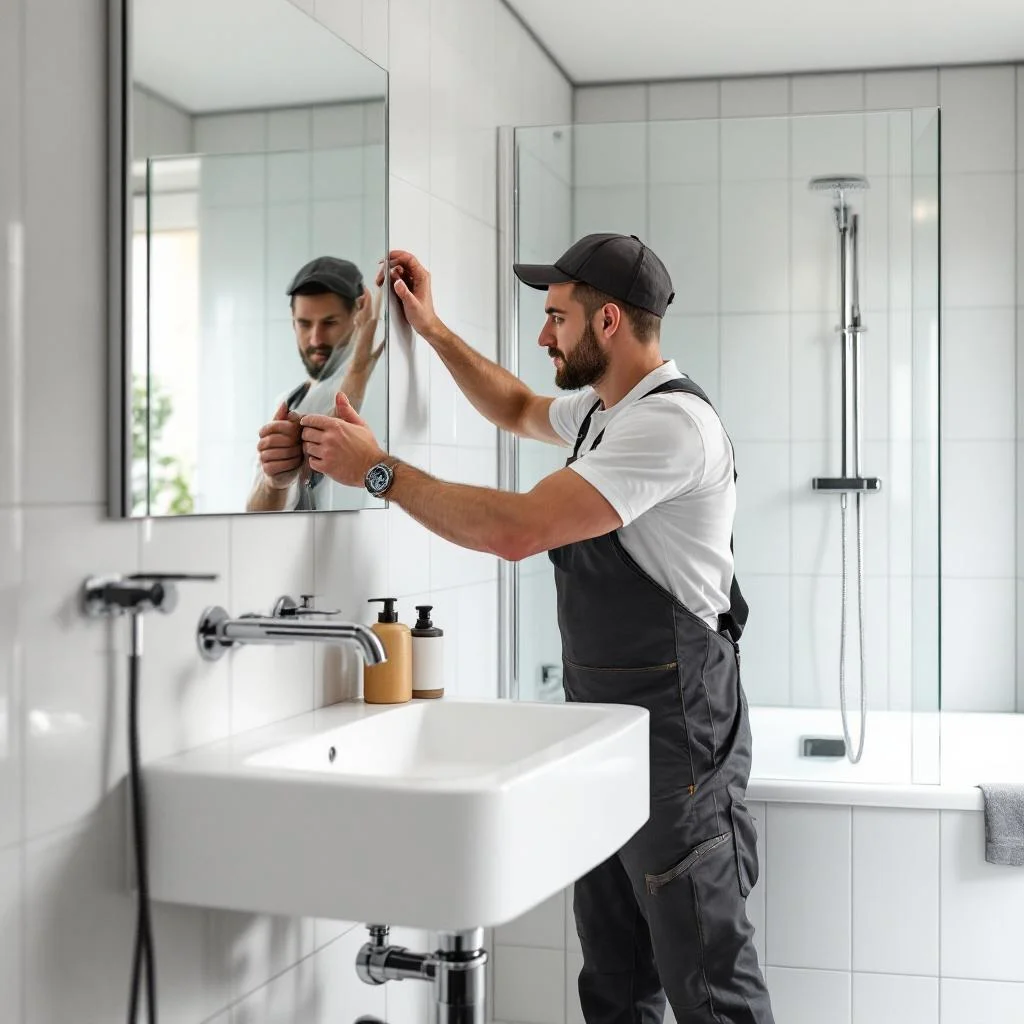
Looking for a plumber in Lausanne means first dealing with a city built on a slope, between the lakeside at Ouchy and the upper parts of town. A dripping tap, a blocked drainage stack or a bathroom to redo are not handled the same way depending on the age of the building and its position on that slope. This page helps you define your request, then compare the quotes that companies in the area send you.
What a plumber does in Lausanne, from the lake to the upper town
The most common jobs involve hot and cold water, drainage and sanitary fittings. In a cantonal capital with very varied housing, you will find the full range of the trade:
- Finding and repairing leaks: a faulty joint, a worn flexible hose, a concealed pipe that seeps. The difficulty often lies in locating the source, because water sometimes appears far from where it starts.
- Replacing old pipes: galvanised steel in many older buildings, and lead in very old ones. Rusty-coloured water or a flow that weakens over the years are common signs.
- Sanitary fittings: replacing a basin, bath, shower or WC, often as part of a wider renovation.
- Drainage: unblocking, replacing traps, repairing damaged sections.
- Hot water: replacing or servicing a water heater, adjusting the distribution.
In Switzerland, the reference qualification for a sanitary installer is the CFC (Federal Certificate of Proficiency). You can ask the company answering your request which qualifications its staff hold, rather than assuming.
What the slope and the age of the building change for plumbing in Lausanne
The terrain is the most visible feature of the city: the m2 metro line is itself very steep, which gives an idea of the difference in height between Ouchy and the upper districts. For a water installation, this raises a practical question. A building near the lake and one perched on the heights do not sit at the same level relative to the network, and pressure and flow may behave differently from one spot to another. If you notice pressure that is too low or too high, give the tradesperson the exact address and, if needed, ask the municipal water supplier about the network in your area.
The slope also affects drainage and cellars. In a building set against the hillside, buried or semi-buried rooms need particular attention: a floor drain, a drainage stack running down to the basement or a low point in the network are worth examining during a diagnosis.
The Cité old town and older buildings
Around the cathedral, the Cité is the historic heart of Lausanne. In a building of this kind, the risers are often concealed, the ducts narrow and the walls thick. Replacing a pipe may mean opening up walls, taking roundabout routes or working within conservation constraints. The diagnosis therefore takes longer than in a recent building, and a serious quote reflects this by explaining the intended method rather than giving a simple total.
In later buildings, notably post-war ones, the installations are often several decades old: galvanised steel is frequently found, which scales up and corrodes from the inside. Replacement is best prepared together with all the co-owners or with the property manager, because it affects risers that serve several homes.
Hard water and frost: what to check
Water hardness depends on the region and the network. It is not the same everywhere, and the municipal water supplier can tell you about your address. Marked limescale clogs water heaters, mixer taps and shower heads; it therefore weighs on the choice of equipment and on whether a water softener or another treatment is needed.
On the shores of Lake Geneva, the climate is mild and frost is less of a concern than in the mountains. It does not disappear, though: a pipe on a facade, an outdoor tap, an attic or an unheated cellar can freeze during a cold spell. If your home is in the upper town, mention it to the tradesperson during the visit so that exposed sections can be protected or insulated.
A university city, rented buildings: who decides on the work?
Lausanne is a university city, with UNIL and EPFL nearby, and is home to the headquarters of the International Olympic Committee. In housing terms, this translates into a large share of rented homes and shared flats. For tenants, one simple rule applies: in a rented building, the work generally goes through the property manager or the landlord. A tenant does not have a pipe or fitting replaced on their own initiative; they report the problem, and it is the landlord who decides or gives written approval.
In co-ownership, you need to distinguish what belongs to your unit (the fittings in a flat) from what is shared (risers, main drains, central hot water production). Work on shared parts goes through the building’s management and, depending on the case, a vote of the co-owners. The owner of a house decides alone, but remains bound by building rules if the work changes the building envelope or its use.
Permits and rules in the canton of Vaud
Many plumbing jobs require no specific permit: replacing a tap, a trap or a flexible hose counts as maintenance. As soon as the work changes the layout, affects the facade or forms part of a wider conversion project, the question arises.
- The building permit is issued by the municipality. When cantonal departments need to give an opinion, the file goes through the cantonal permit office, the CAMAC.
- If your work is linked to energy, for example hot water production tied to a change of heating, the Vaud energy law and the cantonal energy directorate are the references, and a cantonal subsidy programme exists. Conditions change: find out before you sign, because aid applied for after the fact can be refused.
- For an old building or one located in a sensitive area, find out about any protections.
In every case, confirm with the City of Lausanne or the competent cantonal department what applies to your building. This text gives a general framework, not a legal answer for your address.
Preparing your plumber quote request in Lausanne
The more precise the description, the more comparable the quotes. Before contacting anyone, gather:
- the address, the type of building (rented block, co-ownership, house) and its approximate era;
- the floor, whether there is a lift and the access for materials;
- the nature of the problem: leak, smell, noise in the pipes, rusty water, uneven pressure, fitting to replace;
- photos of the fittings, the cellar and the places where you see signs of damp;
- your status (owner, co-owner, tenant) and, if you rent, the approval or instructions of the property manager.
A good quote details the materials, labour, travel, opening up and making good the walls, removal of the old fittings and what is excluded. The cost depends mainly on how accessible the pipes are, the material chosen, the number of water points affected, the extent of the making good and the urgency. No serious figure can be given without seeing the premises: that is the role of the quote, which is free and without obligation.
You can request a quote by describing your situation; your request is passed on to tradespeople and companies in the area, who will get back to you. Compare the proposals on the same scope, ask questions about anything unclear, and do not hesitate to ask for an on-site visit for work in an old building.
Useful pages around plumbers in Lausanne
- The trade in general: plumber
- The city: works in Lausanne
- The canton: canton of Vaud
- Other work in Lausanne: electrician in Lausanne, interior painting in Lausanne, carpenter in Lausanne
Updated 29 October 2026