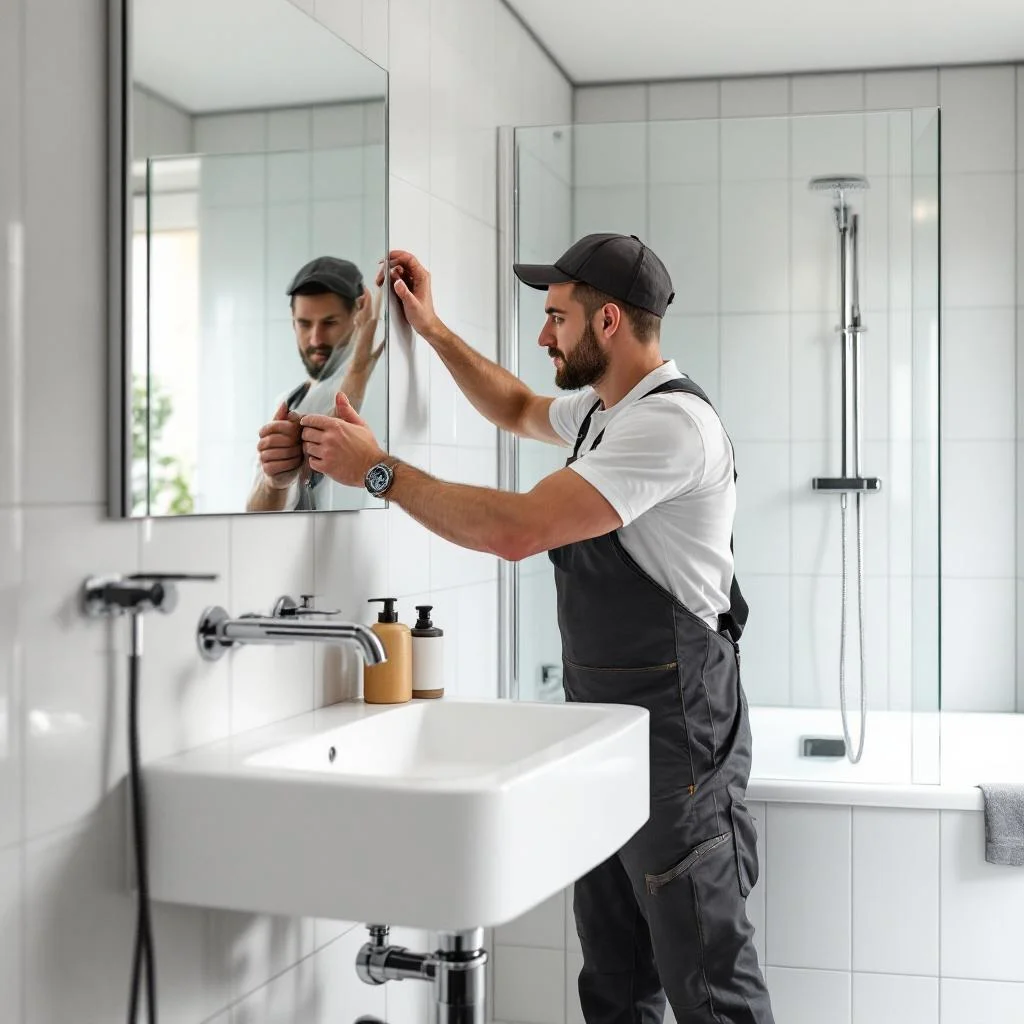
A leak under a sink, a tiring water heater, a bathroom to redo or an ageing water riser: plumbing touches the most everyday part of a home. On this page you will find what the plumber’s trade covers, what varies from one French-speaking canton to another and how to prepare a useful request. SOS Travaux passes your request on to tradespeople and companies in the region, who get back to you to prepare a free, no-obligation quote.
What a plumber does: water, drainage and sanitary fixtures
The plumber, known in Switzerland as a sanitary installer, deals with everything that brings water into a building and carries it out again. The most frequent jobs fall into a few families:
- cold and hot water installations: fitting new pipes, connecting kitchens and bathrooms, adapting the system after a renovation;
- drainage: traps, downpipes, connections to soil stacks, replacing cracked or blocked pipes;
- sanitary fixtures: washbasins, toilets, showers, bathtubs, taps, and washing machines and dishwashers to be connected;
- finding and repairing leaks, whether visible or hidden in a slab, a partition or a ceiling;
- replacing old pipes, notably galvanised steel, and lead in very old buildings.
These categories often combine. A complete bathroom involves stripping out, adapting the network, fitting the fixtures and recommissioning; a kitchen renovation project also involves supply and drainage.
When to call a sanitary installer
Some situations cannot be solved with a seal or a shop-bought product. It is best to consult a professional in the following cases:
- a damp patch spreading across a wall or ceiling, with no visible cause;
- water pressure that drops, or water that comes out discoloured;
- leaks that return after a first repair;
- a very old original installation that you want to modernise before a renovation;
- a plan to move fixtures, add a new shower or a new kitchen.
In the event of a major flow of water, first shut off the main water supply if you know where it is, then contact the property manager, the landlord or a tradesperson. A hidden leak can damage a building for a long time before it is spotted, which is why it is best not to wait.
CFC training and sanitary expertise in Switzerland
Switzerland trains its sanitary installers through apprenticeship, which leads to the CFC for sanitary installers. This qualification attests to a foundation of knowledge in networks, materials, plan reading and fitting rules. It says nothing, however, about the availability or price of a given company: it is the quote that allows you to compare.
For a somewhat complex project, do not hesitate to ask the tradesperson how they intend to proceed, which materials they plan to use and whether they subcontract certain parts, for example the masonry or the tiling around a shower.
Building age, hard water and frost: what changes from one home to another
Three factors come up in almost every plumbing project in French-speaking Switzerland.
The age of the building. In an old town or an older building, the networks have often been extended in successive layers. You sometimes find galvanised steel there, and in very old buildings, lead. A post-war building does not have the same layouts or materials as a recent one, which guides the diagnosis and the replacement method.
Water and limescale. Water hardness depends on the region. Where it is harder, scaling wears out taps, water heaters and shower heads faster. To find out the situation where you live, ask your municipality’s water supplier: it is the one that provides reliable information.
Frost. At altitude, notably in chalets and mountain second homes, exposed pipes or a house left unheated can freeze. A burst pipe is often discovered at the thaw. A plumber can advise on protecting pipes, draining the installation before an absence and routing networks in exposed areas.
Cantonal rules: permits, energy and heritage
Replacing a fixture or repairing a leak does not generally require any particular formalities. Heavier projects, however, may do so, and the rules differ from one canton to another. Here are the useful benchmarks, to be confirmed systematically with the municipality or the relevant cantonal department.
- Geneva: building permits are issued by the canton, by the Office des autorisations de construire. On energy, the cantonal energy law (LEn) and the cantonal energy office (OCEN) govern, among other things, the subsidies of the Buildings Programme. Many rented buildings are managed by property managers, and the old town as well as certain neighbourhoods are protected.
- Vaud: the building permit is issued by the municipality, with the file going through the cantonal permits centre (CAMAC) when cantonal departments must give an opinion. Energy falls under the Vaud energy law and the cantonal energy directorate, with a cantonal subsidy programme. The old towns and the Lavaux vineyards, a World Heritage site, call for particular attention.
- Valais: the building permit is issued by the municipality within the building zone, and by a cantonal commission outside it. The cantonal energy and hydropower service manages the subsidy programme. Chalets and second homes fall, in the municipalities concerned, under the federal law on second homes.
- Fribourg: permit applications go through the cantonal FRIAC platform, with the permit issued by the prefecture or the municipality depending on the type of work. The cantonal energy service manages a subsidy programme. The canton is bilingual and has protected old towns.
- Neuchâtel: applications go through the cantonal SATAC desk, with the decision taken by the municipality. The cantonal energy and environment service manages a subsidy programme. The watchmaking heritage of La Chaux-de-Fonds and Le Locle is listed by UNESCO.
- Jura: the permit is issued by the municipality or the canton depending on the size of the project. The cantonal energy section manages a subsidy programme. Delémont, Porrentruy and Saint-Ursanne have old towns.
- Bern (Biel/Bienne): the permit is issued by the municipality or the prefecture depending on the project. The cantonal office for the environment and energy manages the subsidy programme. Biel/Bienne is officially bilingual, French and German.
If your plumbing project accompanies a change of heat source, for example a water heater linked to a new installation, find out about cantonal subsidies before signing: they often depend on conditions that must be met before work begins. For details by canton, see the pages for the canton of Geneva, the canton of Vaud or the canton that concerns you.
Preparing your plumber request: the information that matters
A tradesperson prices better what they understand well. Before filling in the form, gather a few items:
- the type of property (house, flat, business premises) and its approximate age;
- the nature of the problem or project: leak, fixture replacement, complete bathroom, pipes to renew;
- the precise location in the property and the floor;
- clear photos of the current installation, and of the leak if it is visible;
- your status: owner, co-owner or tenant. In the latter case, the landlord’s or property manager’s agreement is required;
- the timing you would like for the work and your access constraints.
In a co-ownership, work on a shared riser is generally decided with the administrator or the assembly. Tell the tradesperson: it changes the contact person and the schedule.
What a reliable plumbing quote should detail
A good quote can be read without guesswork. It specifies the scope of work, the materials and fixtures planned with their references, the labour time, any travel, the removal of old elements and what is excluded, such as masonry, tiling or painting after opening a partition. It also states the payment terms and the validity of the offer.
Several factors make the cost vary, and no amount can be given without a visit:
- the accessibility of the pipes, exposed or embedded in masonry;
- the type and quality of the taps and fixtures chosen;
- the condition of the existing network and the need to replace it partly or entirely;
- the floor, access to the site and whether or not there is a lift;
- related masonry, tiling or heating work;
- the need for an intervention outside normal hours.
Compare several quotes on the same basis: if the descriptions differ, the totals cannot be compared.
Legal warranties on a plumbing job
The Code of Obligations governs defects in work. For work on immovable property, the warranty is 5 years under art. 371 CO; for movable work, it is 2 years. A sanitary installation fixed to the building falls in principle under the first case. If the contract refers to the SIA 118 standard, it also applies. Inspect the work on handover, report defects in writing and keep the quote, invoice and correspondence.
Request a plumber quote
Describe your project in a few lines, add photos if you have any, and state your municipality: the form to request a quote is free and without obligation. Your request is passed on to tradespeople and companies in the region, who get back to you for the next steps.
Plumber near you: pages by city
Find local benchmarks in the pages for your city:
- Geneva and surroundings: plumber in Geneva, plumber in Carouge, plumber in Lancy, plumber in Vernier
- Vaud: plumber in Lausanne, plumber in Nyon, plumber in Vevey, plumber in Montreux, plumber in Yverdon-les-Bains, plumber in Morges
- Valais: plumber in Sion, plumber in Martigny, plumber in Monthey, plumber in Sierre
- Fribourg: plumber in Fribourg, plumber in Bulle
- Neuchâtel, Jura and Biel/Bienne: plumber in Neuchâtel, plumber in La Chaux-de-Fonds, plumber in Delémont, plumber in Biel/Bienne
Updated 29 October 2026