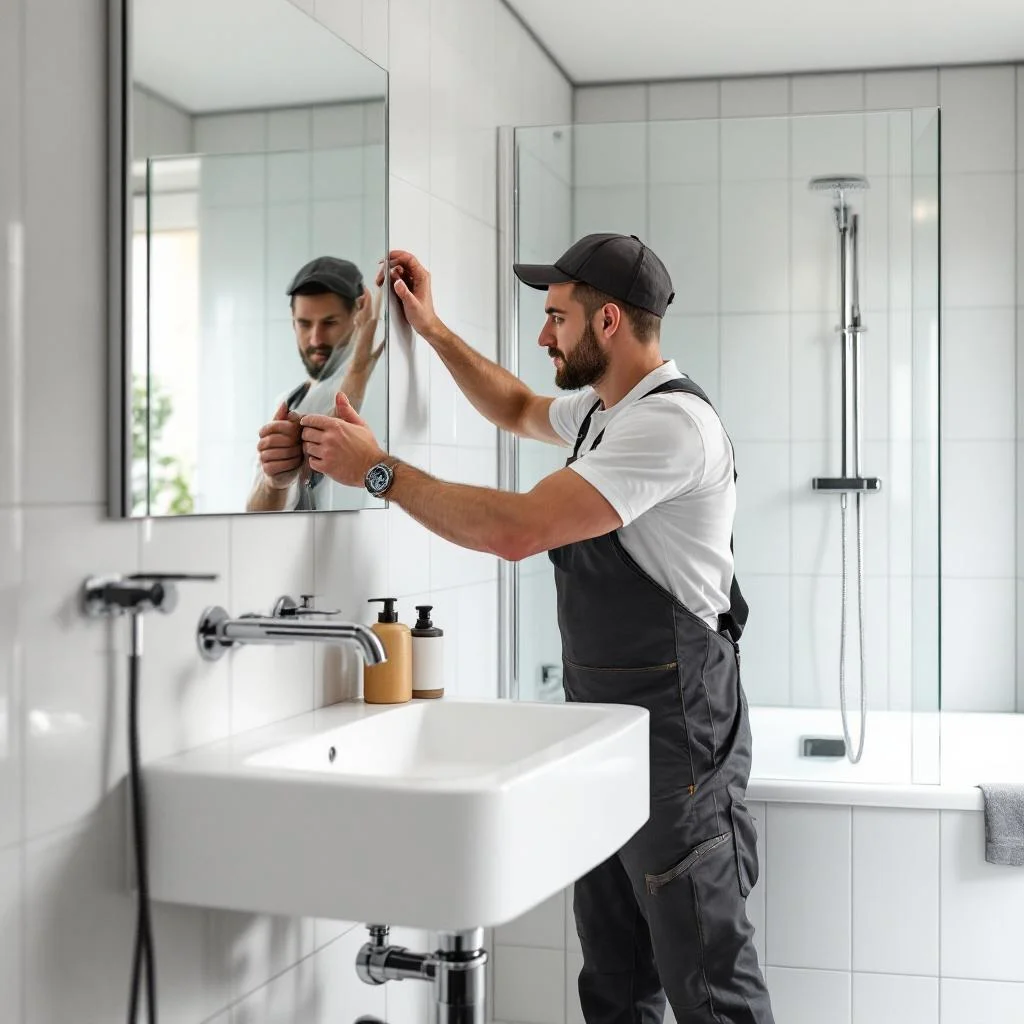
Looking for a plumber in Yverdon-les-Bains? The second-largest town in the canton of Vaud, at the end of Lake Neuchâtel, has a very varied building stock: an old town around the castle, rented apartment blocks, villas, and buildings linked to the thermal centre and the engineering university (HEIG-VD). Each of these types of building raises its own questions about pipework, drainage and sanitary fittings. On SOS Travaux, you describe your project online; your request is passed on to tradespeople and firms in the region, who contact you to prepare a free, no-obligation quote.
The most common plumbing jobs in Yverdon-les-Bains
A sanitary installer works on cold and hot water, on drainage and on fittings: washbasins, showers, baths, WCs, sinks, water heaters. In Yverdon-les-Bains, requests are spread roughly according to the type of building.
- Leak detection and repair: a stain on the neighbour’s ceiling, a meter that turns with no consumption, persistent damp at the foot of a wall.
- Replacement of old pipes: in pre-war buildings, galvanised steel is still found; in very old buildings, lead pipes may even remain. Replacing them is something to examine with a professional.
- Bathroom or kitchen renovation: removal of old fittings, new supply and drainage, installation of taps and shower.
- Descaling and replacement of water heaters: a frequent job where the water leaves deposits.
- Emergency drain clearing: traps, stacks, slow drainage.
Old town, castle and apartment blocks: how the building affects the plumbing
The old town of Yverdon-les-Bains and the streets near the castle include old buildings. In this type of construction, rising mains and drains often pass through thick walls or floors whose structure is not always easy to open up. A plumber familiar with this kind of building will start by tracing the route of the pipes before proposing any work, so as to avoid drilling at random.
Post-war apartment blocks, for their part, frequently still have their original pipes, sometimes in galvanised steel. After several decades, internal corrosion restricts the passage of water: pressure drops at the tap, discoloured water on first draw, small leaks at joints. Replacement in stages, floor by floor or stack by stack, is an option the tradesperson can assess according to the actual condition of the installation.
In villas in residential neighbourhoods, the issues are different: water heaters, the domestic hot water network, bathrooms added over the years as the house was extended, outdoor watering. The work is often easier to access than in an old block, but the connection between the old and new installations deserves to be described precisely when the quote is prepared.
Water, limescale and frost: local constraints
Yverdon-les-Bains lies on the plain, on the shore of Lake Neuchâtel. Frost damage to pipes, a major concern in the higher parts of the canton, is therefore less of a worry than in the mountains; it remains relevant for outdoor pipes, garages, unheated cellars and garden sheds. If you have an outside tap or a pipe in an unheated room, mention it in your request: a plumber can advise on frost protection or insulation.
Limescale is the other recurring topic. Water hardness depends on the network and the region; it speeds up scaling of water heater elements, aerators, shower heads and washing machines. To find out the situation in your neighbourhood, contact the commune’s water supplier. This information then helps in choosing an appliance and, where relevant, in discussing water treatment with the tradesperson.
Finally, the presence of the thermal centre is a reminder that water is part of the town’s identity; this does not change the basic rule, however: your domestic installation depends on the commune’s distribution network, not on the thermal waters.
Permits, managing agents and co-ownership for your plumbing work
Many routine plumbing jobs (replacing a tap, a trap or a like-for-like water heater) do not require any particular procedure. As soon as the project affects the structure, the building envelope or its use, the question of a permit arises.
In the canton of Vaud, the building permit is issued by the municipality of the commune; the file goes through the cantonal permit centre (CAMAC) when cantonal departments must give their opinion. For plumbing work, the first step is to ask the building department of Yverdon-les-Bains whether your project requires a permit. This check is all the more useful if the building is in the old town or enjoys protected status.
If your project includes an energy-related installation (hot water production with a heat pump, for example), the Vaud energy law and the cantonal energy directorate are the reference authorities, and a cantonal subsidy programme exists. Check with the relevant cantonal department what applies to your case before signing a quote.
As for internal agreements:
- Tenant: obtain the consent of the landlord or managing agent before any work that alters the apartment. For a leak, it is generally the managing agent who instructs or approves the work.
- Apartment owner in a co-ownership: shared pipes (rising mains, main drains) belong to the community; only the private installations belong to you. Consult the co-ownership regulations and, if necessary, the administrator.
- Villa owner: you decide, but a connection to the public network or to the drainage pipes remains subject to communal rules.
Preparing your request and comparing plumbing quotes
The more precise your description, the more comparable the quotes will be. Remember to state:
- the type of building (old town, rented block, villa) and its approximate age;
- the floor, the access (narrow staircase, courtyard, lift) and whether the water can be shut off;
- the problem observed: leak, noise in the pipes, drop in pressure, cloudy water;
- the type of pipes, if you know it (copper, steel, plastic);
- your photos of the installation and the fittings concerned;
- your status: owner, tenant, co-owner, and the landlord’s consent if necessary.
A good quote clearly states what is included: removal of old equipment, supply of pipes and fittings, labour, disposal of waste, making good the walls or tiles opened up to reach the pipes. If making good is not listed, ask who is responsible for it, as it sometimes involves another trade.
The cost varies according to how accessible the pipes are, the extent of the replacement, the quality of the fittings chosen, the need to open up walls or floors, and the possible presence of old materials to be dealt with. This is why a figure given without a visit is rarely reliable; the quote, for its part, lets you compare proposals built on the same scope. Swiss sanitary installers are trained through a CFC (federal certificate of proficiency): you can ask the firm to specify the qualifications of the team who will work at your home.
Ready to move forward? You can request a quote by describing your situation; it is free and without obligation.
Going further in Yverdon-les-Bains
To broaden your project or place it in context:
- the trade page: plumber;
- the town page: works in Yverdon-les-Bains;
- the canton page: canton of Vaud;
- other work in the same commune: electrician in Yverdon-les-Bains, interior painting in Yverdon-les-Bains, carpenter in Yverdon-les-Bains.
Updated 29 October 2026