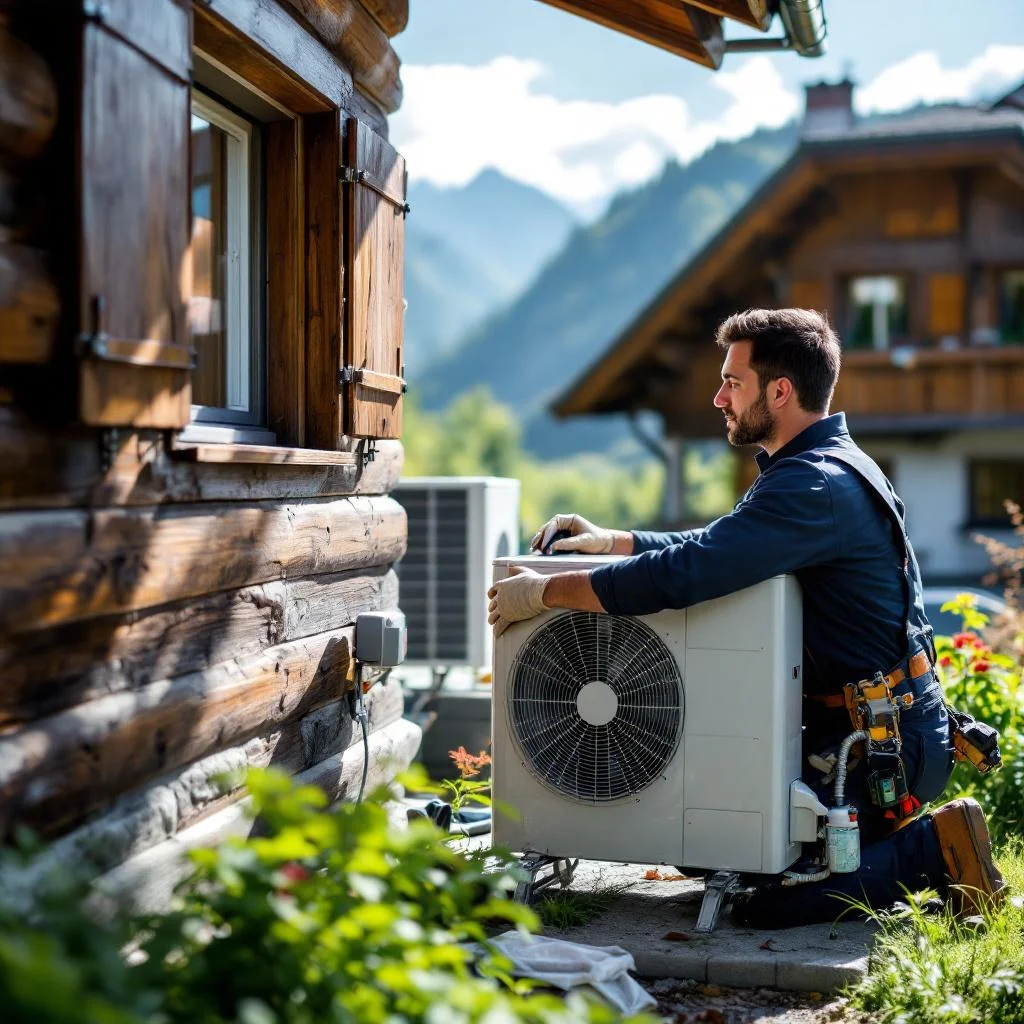
Are you looking for air conditioning in Fribourg? Whether it is a split unit for a bedroom under the eaves, cooling for an office or a reversible heat pump, the city has its particularities: a protected old town, a pronounced relief above the Sarine and many buildings where a third party’s approval is needed.
This page helps you frame your project, identify the likely procedures and compare the quotes that local tradespeople will send you after your request.
What air conditioning work in Fribourg?
The most common installations are fixed split air conditioners: an indoor unit mounted on the wall or ceiling, and an outdoor unit linked by pipework. They are fitted for a single room, or for several rooms with one outdoor unit. Reversible heat pumps do the same cooling job in summer and heat in winter.
In Fribourg, the building stock offers a variety of situations:
- flats in older buildings, sometimes under the roof, where heat builds up in summer;
- detached houses and villas outside the centre, where the outdoor unit finds a place more easily;
- business premises, practices or offices, notably around the university;
- co-owned homes where the facade and shared areas do not belong to you.
Old town, Bourg, Auge and Neuveville: Fribourg’s constraints
Fribourg’s medieval old town is very extensive. It includes the Bourg district, the Auge and the Neuveville, set in the loop of the Sarine. The canton has protected old towns, and an installation that changes the appearance of a facade, a roof or a courtyard is examined closely there.
In practice, an outdoor unit fixed to a wall facing the street or placed on a visible balcony is not trivial in these districts. Depending on the building, pipe runs can also be complicated: thick walls, old facades, narrow courtyards. Before asking for prices, it is worth finding out whether your building is covered by a protection and whom to ask: the commune of Fribourg is the right first contact.
In these tight lanes, noise counts more than elsewhere. An outdoor unit placed in an inner courtyard or near a neighbour’s window is quickly noticed. The OPB noise limits apply, and the chosen position weighs as much as the machine itself.
A spur above the Sarine: access and installation
The city is built on a spur overlooking the Sarine, with a relief that is partly crossed by the funicular. For a worksite, this means access that is sometimes narrow, sloping streets and equipment deliveries to organise. Tell the installer from the outset how the building is accessed: stairs, floor, no lift, a courtyard or facade that is hard to reach, whether a vehicle can park nearby.
These details affect how long the job takes and therefore the price. They cannot be guessed from a distance, and a serious tradesperson will note them during a visit.
Summer heat: air-condition or shade from the sun?
The canton of Fribourg stretches from the plateau to the Prealps and the Gruyère, with snowy winters and lakeside areas. The city of Fribourg itself is a dense urban setting in places, where walls and roofs can give back heat. Before choosing a machine, it is reasonable to consider the alternative: external solar shading (blinds, shutters, slats), night-time ventilation, or cooling only the bedroom or office concerned.
These solutions do not always replace air conditioning, but they sometimes reduce the power needed. A good tradesperson will tell you honestly whether your room mainly needs shade or an appliance. Ask them to price both options if you are unsure.
Procedures for air conditioning in Fribourg
Several points need checking before you sign:
- Permit or justification. The installation may require a permit or a justification under the cantonal energy law. The cantonal energy office is the contact for the energy aspect.
- Building permit. If an application is required, it is submitted through the cantonal FRIAC platform. The permit is issued by the prefecture or by the commune, depending on the type of work. Ask the commune whether your project falls under it.
- Noise. The outdoor unit must comply with the OPB limits. Its position must therefore be thought through with the installer.
- Co-owners’ or landlord’s approval. In a building, the outdoor unit is often fixed to the facade or placed on a shared area: the approval of the co-owners or the landlord is required. If you rent, ask for it in writing.
- Subsidies. The canton has an energy subsidy programme. Ask the cantonal energy office whether a reversible heat pump or other equipment may qualify, before ordering.
These rules change and depend on each case: confirm them with the commune or the competent cantonal office rather than relying on a general rule.
Preparing your request and comparing quotes
The more precise your description, the more comparable the quotes will be. Please state:
- the type of home (flat, villa, business premises), the floor and the district;
- the rooms to be cooled and their use (bedroom, living room, office);
- the planned position of the outdoor unit and whether there is a courtyard, a balcony or a street-facing facade;
- your status: owner, tenant, co-owner, and how far the necessary approvals have progressed;
- whether you would like a reversible heat pump rather than a simple split unit;
- access constraints: stairs, no lift, sloping street.
A useful quote details supply and installation, the electrical connection, the pipe runs, the drainage of condensation water, commissioning, and the procedures that remain your responsibility or the installer’s. It also states the make and model, and what is planned for the noise of the outdoor unit.
The cost varies with the number of rooms, the type of appliance, how difficult the pipe runs are, access to the site, the position of the outdoor unit, any electrical work and the administrative procedures. That is why a visit on site matters more than an estimate given remotely. Compare at least two or three offers on the same basis.
To get started, you can request a quote: your request is passed on to tradespeople and companies in the region, who will contact you to prepare a free, no-obligation quote.
Useful pages around Fribourg
- The trade page: air conditioning
- The city page: works in Fribourg
- The canton page: canton of Fribourg
- Other work in Fribourg: solar panels in Fribourg, heating engineer in Fribourg, tiling in Fribourg
Updated 29 October 2026