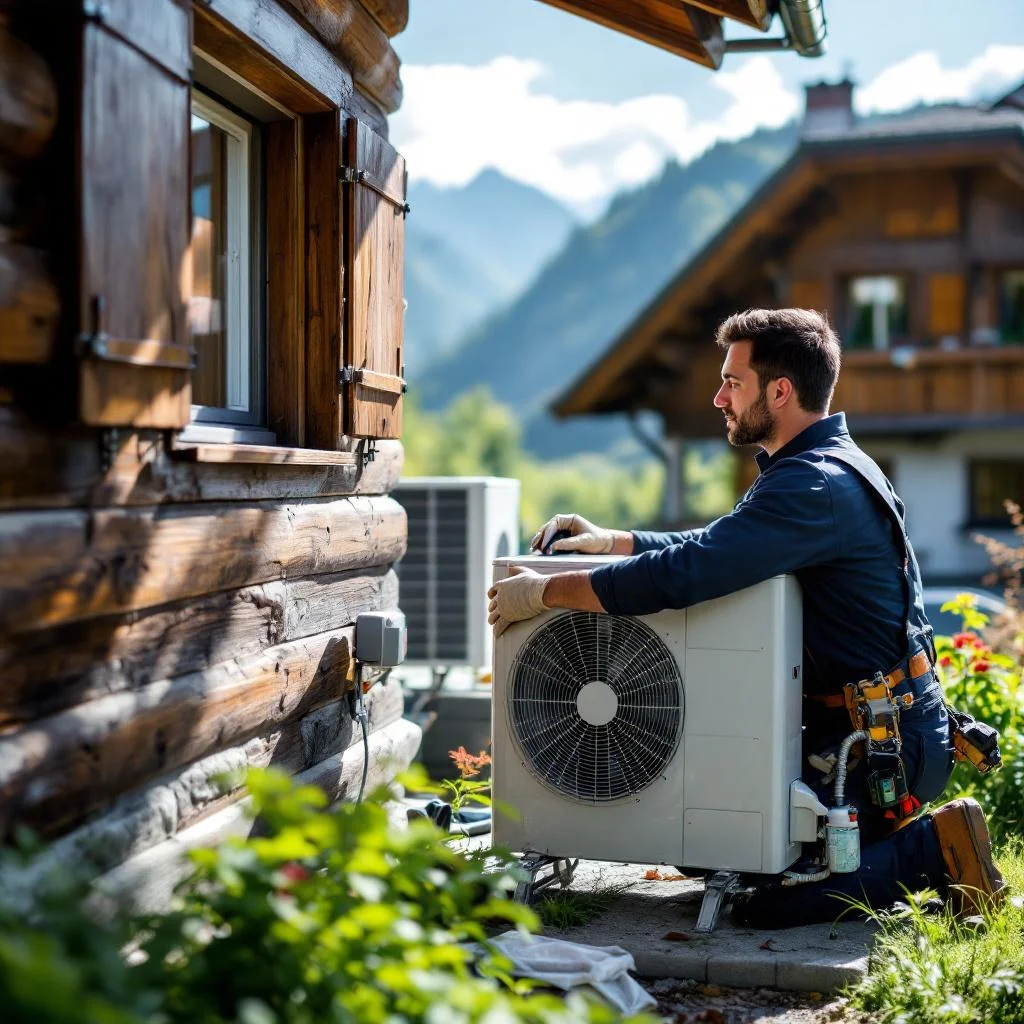
Are you looking for a heating engineer in Fribourg to replace a boiler, install a heat pump or restore a radiator network? The city has a very varied building stock: a spur overlooking the Sarine, an extensive medieval old town, and newer districts further from the centre. A Fribourg heating installer therefore never meets the same job twice.
On SOS Travaux, you describe your project online; the request is passed to craftspeople and companies in the region, who get back to you to prepare a free, no-obligation quote.
The most common heating work in Fribourg
The heating engineer’s trade covers the installation, maintenance and replacement of heating systems: oil, gas, wood, heat pump, connection to district heating, as well as radiators, underfloor heating and controls. In Fribourg, several situations come up regularly.
- Replacing an old boiler in a house or building whose fossil-fuel system is reaching the end of its life.
- Switching to a heat pump, which requires looking at the building as a whole (see also heat pump in Fribourg).
- Upgrading the controls: sensors, thermostatic valves and programming, to avoid heating unoccupied rooms.
- Maintenance and inspection of an existing installation, with rules set by the canton.
- Replacing radiators or creating an underfloor heating circuit during a renovation.
Heating in the old town, the Bourg, the Auge or the Neuveville
Fribourg’s old town is very extensive and is laid out within the loop of the Sarine: the Bourg district at the top, then the Auge and the Neuveville by the river. These districts share old buildings, often tightly packed, with narrow stairwells, vaulted or shallow cellars and thick walls. For a heating engineer, this raises very practical questions.
Where can pipes run without damaging original features? How do you bring a boiler, a hot-water tank or a fuel tank into a basement reached by a steep staircase or a low door? Where can a technical room go when the building was never designed for one? These points are checked on site and often weigh more in the quote than the appliance itself.
In a protected old-town area, outward appearance also matters. An outdoor heat pump unit, a ventilation outlet or a modified chimney can raise objections that would not arise in a newer district. The canton of Fribourg has protected old towns: it is wise to ask the municipality before choosing a system, not afterwards.
A spur, the Sarine and the funicular: what the terrain changes for the work
Fribourg is built on a spur above the Sarine, and the drop between the upper town and the riverbank is an everyday reality, as the funicular reminds you. For a heating job, this terrain has two practical effects.
The first is access. Delivering and lifting heavy equipment (boiler, tank, heat pump unit) along a steep or narrow lane takes preparation: space for the lorry, possibly a crane or hoist, and a route inside the building. Mention it in your request: it avoids unpleasant surprises when the work is priced.
The second is exposure. A building on the edge of the spur, a building at the bottom of the river loop and a villa on the plateau do not behave the same way thermally, nor offer the same installation options. The canton has winters when the plateau, the Pre-Alps and the Gruyère are under snow; the system must be sized for the coldest period, not the average. It is the heating engineer’s job to calculate this from your building, not yours to pick an output from a catalogue.
Rental buildings, co-ownerships, villas: who decides?
Fribourg is a university city, with many rented homes and small apartment buildings. The heating is then, in most cases, shared equipment or belongs to the building’s owner.
- Tenant: you cannot change the system yourself. You can report a fault to the landlord or the managing agent, and any modification requires their agreement.
- Co-ownership (PPE): replacing a shared boiler is generally a matter for the owners’ meeting. Comparable offers are needed in order to decide.
- House owner: you decide, but you remain subject to cantonal energy rules and, depending on the work, to a building permit.
If your building is in an area where district heating is offered, ask the municipality or the local supplier: availability depends on the address and cannot be assumed.
Permits and cantonal rules for heating in Fribourg
Replacing a fossil-fuel heating system is governed by the cantonal energy law. Depending on the canton, it may require or restrict certain solutions. For the canton of Fribourg, the point of entry is the cantonal energy office: it will tell you what applies to your building and your project. Do not wait until the quote is signed to contact it.
For permits, building permit applications are submitted through the cantonal FRIAC platform. The permit is then issued by the prefecture or by the municipality, depending on the type of work. Not every heating replacement necessarily requires an application, but some projects (a new outdoor installation, a visible change to the façade, work on a protected building) may require one. The safest course is to ask the municipality of Fribourg, with a simple description of the project.
The canton also runs an energy-related subsidy programme. Conditions, deadlines and amounts depend on the cantonal office; some grants require an application before work begins. Keep the quote to hand, but do not order anything before you have checked.
Chimney sweeping and boiler inspection are regulated by the canton. A heating engineer can advise you on routine maintenance of your installation, but the rules to follow are those of the canton of Fribourg.
Preparing your request and comparing quotes
A good request saves everyone time. Before requesting a quote, gather the following:
- the type of building (house, rental building, PPE) and its district in Fribourg;
- the current system: oil, gas, wood, heat pump or district heating, and its approximate age;
- how heat is distributed: radiators, underfloor heating, or both;
- the location of the boiler room, the access (stairs, lane, floor) and the space available;
- your wishes: keep the same type of energy, switch to another, add controls;
- your status: owner, co-owner or tenant with the landlord’s agreement.
To compare offers, check that they describe the same thing. A serious quote generally details:
- the supply of the appliances, with make and model;
- removal of the old system and disposal (tank, boiler);
- pipes, fittings, valves and controls;
- any ancillary work (electrics, chimney, masonry);
- commissioning and what is included afterwards;
- what is not included, notably the paperwork and subsidy applications.
The cost varies with the chosen system, the size and condition of the building, the difficulty of access, the extent of the removal work, the adaptations to the distribution network and any constraints linked to a protected building. No reliable figure can be given without a visit: only the quote gives a price for your case.
Heating work combines well with other projects. If the building envelope is poor, thermal insulation in Fribourg can change the output required; during a kitchen renovation in Fribourg, it is the right moment to move a radiator or a water supply.
Going further in Fribourg
- The trade in general: heating engineer
- The municipality: work in Fribourg
- The canton: canton of Fribourg
- In the same municipality: heat pump in Fribourg, kitchen renovation in Fribourg, thermal insulation in Fribourg
Updated 29 October 2026