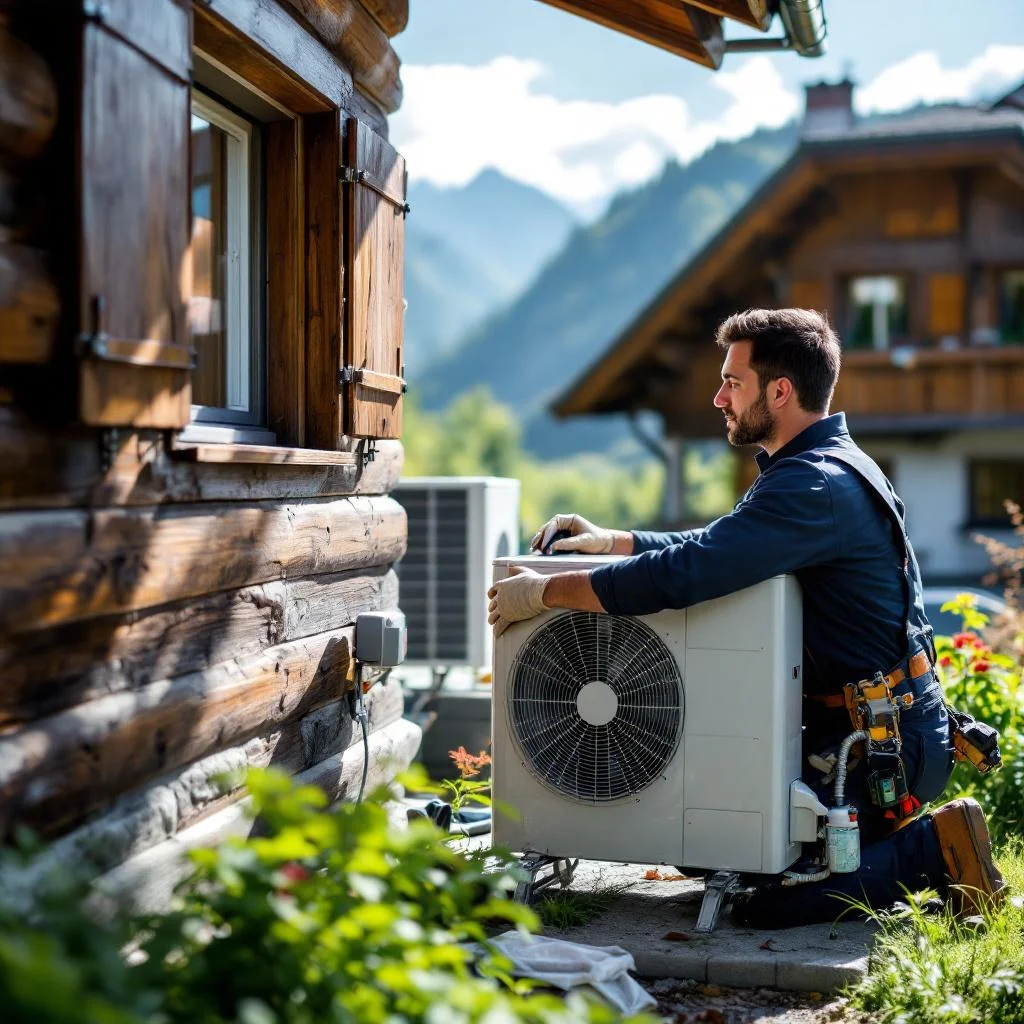
Looking for a heat pump in Fribourg quickly brings you up against a practical reality: the city sits on a spur above the Sarine, with a very extensive medieval old town, and few buildings resemble each other. A heat pump heating installation in Fribourg is therefore not approached as it would be in a recent housing estate: space, neighbours and the protection of the building weigh as much as the technology.
This page explains what the location changes for this type of project, which procedures to check and how to prepare your request before receiving quotes.
Air-water, ground-source or water-water: what the Fribourg site allows
There are three families of heat pumps, and each meets Fribourg’s layout in a different way.
- The air-water pump draws heat from the outside air. It needs a unit outside the building, sometimes with a part inside. It is often the simplest solution to fit in, but the unit makes noise and is visible.
- The ground-source pump uses a geothermal probe drilled into the ground. It requires a cantonal permit under groundwater protection and is not allowed everywhere.
- The water-water pump draws on a water table or a watercourse. It also falls under the rules on water, and its use remains rarer.
On land that slopes down towards the Sarine, the question of groundwater is not theoretical: the cantonal department will say whether a probe is feasible at the exact address, and under what conditions. Do not rely on what a neighbour has done: two nearby plots can receive different answers.
The Bourg, the Auge and the Neuveville: heating an old building
The Bourg, the Auge and the Neuveville sit within the loop of the river. These old-town districts combine narrow houses, terraced buildings and buildings that may be protected. For a heat pump, this raises several practical questions:
- Where should the outdoor unit go? An inner courtyard, a roof or a façade visible from the street are not treated the same way. In a protected urban fabric, the outward appearance is often the first thing examined.
- Where should the pipes run? In an old building with thick walls, piercing a façade or crossing a floor calls for care.
- What can be done without a probe? In a cramped courtyard, drilling is not straightforward. Air-water, with a discreet unit, is often the option studied first, though this is not a rule.
- Is the building ready? An older, poorly insulated building with radiators designed for very hot water does not respond like a recent construction. The professional will look at the heat distribution before proposing a machine.
In these districts, dialogue with the municipality and with the department responsible for protected buildings should start early, even before ordering.
Villas, apartment blocks and dense neighbourhoods: location comes first
Outside the old town, Fribourg has villas with some land and rental or co-owned apartment blocks. The situations differ.
A villa generally offers more freedom: the air-water unit can be placed further from windows, and more open land sometimes allows a probe to be considered. But the slope, access for a drilling rig and the distance to the property boundary must be checked on site.
An apartment block raises other issues: plant room, routing of risers, sharing of costs between occupants, and above all a collective decision if the building is co-owned. The noise of an outdoor unit is measured at the nearest neighbour’s window, not the owner’s.
Dense neighbourhoods concern the whole city: the OPB sets noise limits that the installation must meet. A machine placed too close to a neighbour’s bedroom, or in a corner that reflects sound, can become a source of dispute. Ask the installer to tell you where they plan to put the unit and why that spot.
The canton’s climate and sizing
The canton of Fribourg covers the plateau, the snowy Prealps and the Gruyère in winter, as well as the lake shores. In Fribourg itself, cold winters are a factor to take into account: a heat pump must be sized for the periods when heat is most needed, not for a mild day. A serious quote starts from the building’s real needs, not from a standard model.
The city’s changes in elevation, the exposure of a façade and the condition of the building envelope also influence this need. Hence the value of a site visit rather than a remote estimate.
Permits and procedures in Fribourg
A few pointers, to be confirmed with the municipality and the competent cantonal department:
- Geothermal probe: cantonal permit under groundwater protection; it is not granted everywhere.
- Outdoor air-water pump: compliance with the OPB noise limits, and a possible building permit depending on the municipality.
- Building permit: applications are submitted through the cantonal FRIAC platform; the permit is issued by the prefecture or by the municipality depending on the type of works.
- Energy and subsidies: the cantonal energy department and the cantonal subsidy programme (Buildings Programme) are the contacts. Check the conditions before signing an order.
- Protected building: if your building is in a protected area, the municipality will tell you which bodies to consult.
The canton is bilingual: depending on your contact, exchanges and forms may be in French or German.
Tenant, landlord and co-ownership
A tenant does not decide on the heating system. If you would like to open the discussion, speak to the property manager or the landlord. In a co-owned building, a collective heat pump or a unit placed on a common area goes through the co-owners’ association. A quote request can be made with the owner’s agreement, but the works only make sense once the decision has been taken.
Preparing your request and comparing quotes in Fribourg
The more precise your description, the more comparable the quotes will be. Gather:
- the type of building (villa, apartment block, old-town house), its approximate year of construction and its state of insulation;
- the current heating system (oil, gas, electric, other) and the location of the boiler;
- the space available outside (courtyard, garden, roof) and the distance to neighbouring windows;
- any heritage protection;
- access for a delivery, or even for drilling;
- whether you are an owner, tenant or co-owner.
A useful quote details:
- the type of pump and its output, with the reason for the choice;
- the planned location of the outdoor unit, or of the drilling;
- ancillary work: removal of the old installation, hydraulic and electrical connections, any replacement of heat emitters;
- what is included for the procedures (permit application, subsidy application) and what remains your responsibility;
- commissioning and maintenance.
The cost varies with the type of pump (a probe involves drilling, hence more work), the size of the building, the condition of the heat distribution, site access and the procedures required. Compare quotes covering the same scope, otherwise the price difference means nothing. To get started, you can request a quote by describing your project: your request is passed on to craftspeople and companies in the region, who will contact you with a free, no-obligation quote.
Useful pages around Fribourg
- The trade: heat pump
- The city: works in Fribourg
- The canton: canton of Fribourg
- In the same municipality: roofing in Fribourg, bathroom renovation in Fribourg, air conditioning in Fribourg
Updated 29 October 2026