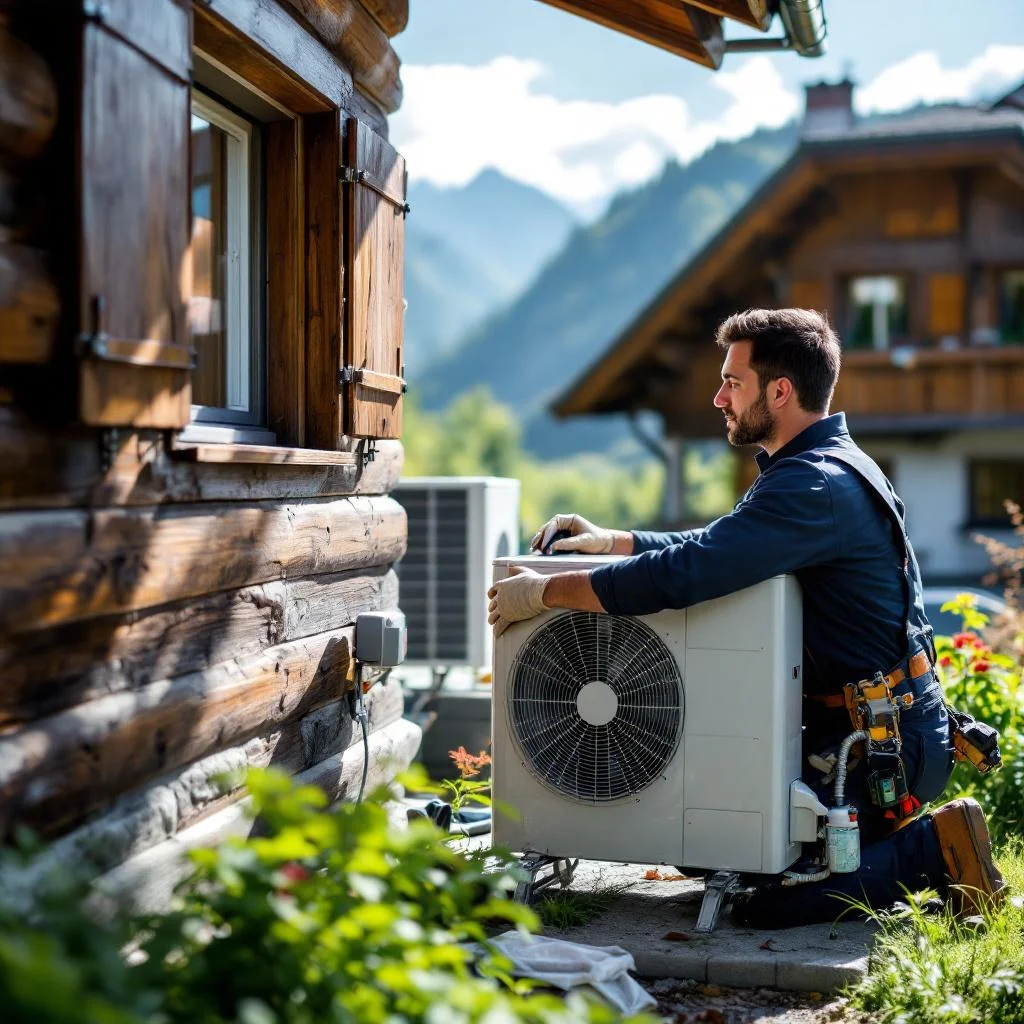
Are you looking for a heat pump in Geneva, for a house, a rental building or a co-owned property? The project depends a great deal on the plot, the neighbourhood and the type of pump chosen. This page covers the points specific to the city, to help you prepare your quote request.
Which type of heat pump for a Geneva building?
Three families exist: the air-to-water heat pump, the ground-source heat pump with geothermal probes, and the water-to-water heat pump. In Geneva, the choice depends less on the principle than on what the site allows.
Geneva is a very urban city-canton. Plots are often small, buildings stand close together, and the space around a building limits the options. The air-to-water heat pump is the simplest to consider when a probe is ruled out: it mainly needs a location for the outdoor unit, or an indoor unit with air intakes. The ground-source heat pump with probes requires land and a permit. The water-to-water heat pump depends on access to groundwater or surface water, which is checked with the cantonal department.
Dense buildings in Les Pâquis, Les Eaux-Vives and Plainpalais
In the districts of Les Pâquis, Les Eaux-Vives, Plainpalais and La Jonction, most buildings are rental blocks sharing party walls, often run by managing agents. Replacing a boiler with a heat pump there is a collective project: it affects the heat supply of the whole building, the distribution to the flats and sometimes the cellar or courtyard.
The practical questions are familiar:
- where to place the outdoor unit without disturbing neighbours, the passageway or the windows of neighbouring homes;
- how to bring the equipment into a narrow courtyard or a basement with limited access;
- whether the existing radiators suit the flow temperature of a heat pump, or need adapting;
- how to organise the works without leaving residents without heating for too long.
An installer needs to see the site: a quote prepared remotely cannot settle these points.
Houses and residential areas of Champel
In Champel, as in other areas of houses or small buildings with gardens, there is generally more room than in the centre. The outdoor unit of an air-to-water heat pump can often be placed away from the property boundaries, which helps meet the noise limits. A geothermal probe also becomes more conceivable when the land is open, subject to the cantonal permit and groundwater protection.
Even then, Geneva’s density is still present: a neighbour may be only a few metres away. Position the unit thinking of your neighbour’s bedroom as much as your own.
The old town and protected areas
Around Saint-Pierre Cathedral, the old town is built on a hill and is part of the protected areas. In these buildings and in the city’s other protected districts, an outdoor unit visible from the street, a ventilation grille or work on a façade is not to be decided lightly. The project may be subject to special conditions, to be checked with the cantonal departments before any order.
In such cases, the cellar or an indoor technical room is often the only option. You then need to check access, ceiling height and the routing of the pipes. State in your quote request that the building is in the old town or protected.
Geneva’s climate and sizing
Winters are mild on the plain and summers hot in the city, lakeside included. For a heat pump, this does not remove the need for calculation: it is the building that sets the required output, with its insulation, windows, distribution system and number of occupants. An old, poorly insulated building and a renovated one do not have the same needs, even when they face each other in the same street.
Some heat pumps can also cool. If hot city summers are a problem for you, ask the installer what the proposed equipment can do, and compare with air conditioning in Geneva.
Procedures: noise, permits and subsidies
Building permits are issued by the canton, through the Office des autorisations de construire. Here are the points to check before signing:
- Geothermal probe: it requires a cantonal permit linked to groundwater protection and is not permitted everywhere. Order nothing before you have the answer.
- Outdoor air-to-water heat pump: it must comply with the noise limits of the Noise Abatement Ordinance (OPB) and may require a building permit. Ask the canton or the commune whether an application is needed in your case.
- Energy: the cantonal energy law (LEn) and the Office cantonal de l’énergie (OCEN) govern heat production. The Buildings Programme subsidies in Geneva depend on the OCEN.
- Owner, managing agent or co-ownership: a tenant does not decide alone. In a building run by a managing agent, the request goes through them; in co-ownership, it goes through the co-owners’ association.
For subsidies, submit the application before work starts, unless the office states otherwise: check the up-to-date conditions with it.
Preparing your request and comparing quotes
To make offers comparable, describe your situation precisely:
- type of building (house, rental building, co-ownership), approximate year of construction, state of the insulation;
- current heating system and its age, type of distribution (radiators, underfloor heating);
- available space: garden, courtyard, cellar, technical room, access for equipment;
- nearby neighbours, and any heritage protection;
- your preference for a probe, if the land allows it.
A good quote details the type of pump and its output, supply and installation, hydraulic and electrical connection, removal of the old installation, drilling or earthworks if any, commissioning, and which procedures are included or not. Also check who submits the permit and subsidy applications.
The cost varies with the technology chosen, the output, the condition of the existing installation, site access, ancillary work on the heating system and the permits required. Compare offers covering the same scope, not just the totals.
Once your description is ready, you can request a quote: your request is passed to tradespeople and companies in the area, who will contact you for a free, no-obligation quote.
Useful pages for your project in Geneva
- The trade in general: heat pump
- The city: building work in Geneva
- The canton: canton of Geneva
- In the same commune: roofing in Geneva, bathroom renovation in Geneva, air conditioning in Geneva
Updated 29 October 2026